Get Full Government Meeting Transcripts, Videos, & Alerts Forever!
Get email alerts on the Land Use Golf Club Expansion topic
No spam. Unsubscribe anytime.
Rockbridge supervisors approve special exception for Lexington Golf & Country Club expansion with conditions
Summary
On June 9, 2025, the Rockbridge County Board of Supervisors voted 4–1 to grant a special-exception permit allowing expansion and new recreational facilities at the Lexington Golf & Country Club, imposing conditions on hours, lighting, noise mitigation and water testing after resident concerns about noise and groundwater.
LEXINGTON, Va. — The Rockbridge County Board of Supervisors on Monday approved a special-exception permit for LGCC W&L Joint Venture LLC to expand the Lexington Golf & Country Club in a residential R‑1 district, adopting a set of conditions intended to limit noise, lighting and water impacts on nearby homes. The board’s motion passed by a 4–1 vote; Supervisor Day voted no.
The vote follows months of review by the planning commission and a public hearing in late May. The application, for work shown on schematic plans prepared by Perkins and Orson (dated 03/24/2025, rev. 04/30/2025), would add courts, an outdoor pool and a playground, and reserves space for an events pavilion. The board adopted the commission’s recommended conditions with several staff- and board-requested edits.
Supervisors and nearby residents focused discussion on three clusters of concern: water and groundwater, noise and amplified sound, and lighting. County planning staff and the applicant agreed to a monitoring and mitigation package the board required before and after construction.
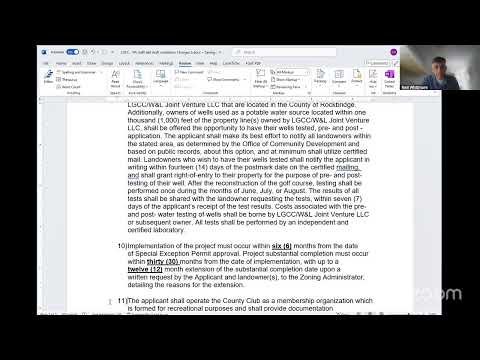
Under the conditions the board adopted, the county will require pre‑construction and follow‑up water testing. The written conditions require an initial, full battery of tests before any glyphosate or other herbicide application and post‑application testing specifically for glyphosate within three to seven days after each glyphosate application. A fuller set of tests — including PFAS (EPA method 1633), glyphosate (EPA method 547) and specified heavy metals (cadmium, chromium, lead, mercury) plus nitrate/nitrite — must be taken prior to construction and at least once annually during June, July or August for five years after course reconstruction. The applicant must make test results publicly available within seven days of receipt; tests are to be performed by an independent, certified laboratory and the applicant will cover testing costs.
The board also adopted an offer to property owners: owners of potable wells within 1,000 feet of the club property will be offered pre‑ and post‑construction well testing; owners who request testing must give the applicant written notice within 14 days of the certified‑mail postmark, and provide a right of entry for testing. The conditions state the applicant will use county records and certified mailing as the primary notification method.
On noise and hours, supervisors limited routine daily uses. Hours of operation for the pickleball/tennis courts, outdoor swimming pool and playground were set at 8 a.m. to 9 p.m. The board required that any amplified music played outdoors end by 9 p.m.; the board also required that scheduled outdoor events conclude no later than 10 p.m. (indoor events were not subject to the outdoor‑amplified‑music restriction). The board directed that lights associated with the pool, courts and playground be extinguished no later than 30 minutes after closing.
Lighting standards were left tied to the county Land Development Regulations (sections 13‑0‑3.03, 13‑0‑3.04 and 13‑0‑3.05). The board added that any site lighting plan shall be submitted to and approved by the zoning administrator and that the administrator may require additional measures as appropriate; supervisors discussed but did not require a single certification standard, instead directing staff and the applicant to aim for fixtures and designs consistent with dark‑sky best practices when feasible.
Because residents emphasized repetitive, high‑frequency noise from courts, the board required acoustic mitigation at court fencing: 8‑foot fencing on the eastern, western and southern sides of the courts must include weather‑resistant acoustic panels specified to reduce noise by about 20 decibels, with the system shown on the final site plan and maintained in good condition.
Planning staff briefed the board that an events pavilion would require a separate special‑event process if the owner later sought to use the pavilion for larger, potentially commercial events. The board’s action preserves the county’s ability to review and impose additional limits on future special events, and the zoning administrator retains enforcement authority should neighbors complain about conditions.
Board members and several neighbors spoke at length before the vote. Residents who sought conditions included Larry Hammer (Buffalo District), who questioned how the club would use event spaces and who would be eligible to attend events; Johan (Jochen) Arndt and other nearby property owners urged limits on amplified music and the number and timing of events; Barbara Walsh and Tom Contos raised concerns about irrigation and groundwater and urged careful, documented testing. County staff (planning) summarized the planning commission’s recommended conditions and explained the edits the board was considering.
Supervisor Day cast the lone no vote; other supervisors supported the permit with the adopted conditions. The board’s approval requires the applicant to submit detailed plans meeting the conditions and to coordinate testing and mitigation with the county’s community development office prior to major construction.
The county clerk recorded the official motion as approval of the special exception with the conditions as amended; supervisors and staff said the written, final permit language will be posted and the applicant must comply with the monitoring and public‑reporting requirements established by the board.
What’s next: the applicant must submit final site and lighting plans for zoning‑administrator review and schedule required pre‑construction water tests and, where requested, well tests. Any future application to allow larger “special events” at an outdoor pavilion will return to the board for separate consideration.