Get Full Government Meeting Transcripts, Videos, & Alerts Forever!
Get email alerts on the Venue Tax Referendum topic
No spam. Unsubscribe anytime.
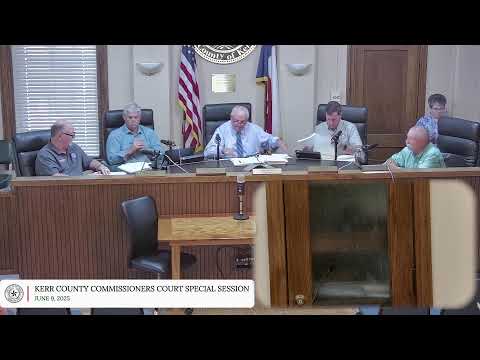
Kerr County to ask state comptroller for venue-tax fiscal study as part of possible referendum
Summary
The commissioners asked county counsel to draft a resolution seeking a state comptroller fiscal-impact study on a venue tax; the court agreed to pursue scheduling that could place a referendum on the November ballot if the county proceeds.
Kerr County Commissioners asked the county attorney and outside counsel to prepare a resolution requesting a fiscal-impact study by the Texas Comptroller to assess a potential venue tax, and discussed timing and estimated revenue if the county proceeds to a referendum.
Commissioner Jones moved that the court authorize counsel to draft the resolution. Court staff outlined timing constraints tied to the November election: orders to call an election would need to be in place by mid-August to meet ballot deadlines, and the comptroller would generally require 30 days to provide its fiscal analysis after receiving the resolution.
Why it matters: a venue tax — a tax on lodging and similar commercial venue activity — would be levied at a rate different from the county’s current hotel-occupancy tax and could include collections across the county (including incorporated cities) if voters approve. Commissioners said the measure could generate materially more revenue than the county’s earlier HOT proposal because it would include city jurisdictions; staff offered a staff estimate that last year’s collections under the proposed venue tax model could have brought roughly $523,858 versus prior estimates of $300,000–$350,000 under a county-only HOT.
County Treasurer (identified in discussion as Bob) and staff (Tracy) briefed commissioners about the scheduling and the comptroller procedure. “If we wanted to act on it within this current calendar year, it’d have to be on the ballot for the November election,” county staff said, noting the court would have to issue an order calling for an election on or before August 11 to make the November ballot.
Commissioners emphasized the decision would be placed before voters if the county moves forward. “We don’t put a lot in our capital improvement. That’s one of my greatest surprises,” one commissioner said, arguing that a designated venue tax could fund infrastructure and maintenance without raising the general property tax rate.
Next steps: counsel will draft the resolution for submission to the comptroller’s office. If the court chooses to proceed after the fiscal study, the court would need to adopt an order formally calling an election by the mid-August deadline to place a venue-tax referendum on the November ballot.
Ending: The court voted unanimously to pursue the fiscal-impact study and directed county counsel to prepare the formal submission to the comptroller; any tax change would require voter approval and further action by commissioners.