
Virginia Beach council weighs Rudy Loop Park design, parking and sponsorship plan
Get AI-powered insights, summaries, and transcripts
Subscribe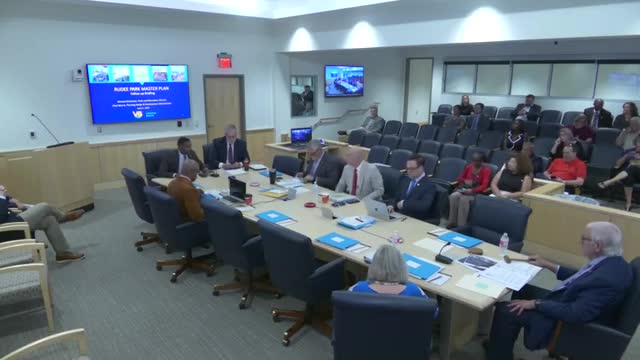
Summary
City staff presented a reimagined Rudy Loop Park master plan and asked the City Council for guidance on parking, a VBDA parcel at the site and whether to pursue philanthropic sponsorships.
Michael Kirschman, a city project lead, presented the Rudy Loop Park master plan and asked the City Council for guidance on three decision points—whether to include a parking deck, how to treat a small VBDA parcel inside the park footprint, and whether the city should pursue philanthropic sponsorships and naming rights.
The plan presented by Kirschman (who told the council the design team included Clay Dills & Associates, Sussex and Biederman Associates) shows a reimagined park with a beach village and overlooks anchoring the south end of the boardwalk, a jetty walk, a tide pool accessed by steps, a central water plaza with a spray ground, a community lawn and skate plaza, an event pavilion, and roughly 400 on-site surface parking spaces if the council declines a parking deck. Kirschman said cost estimates prepared by Sussex include a two‑year escalation to reflect the likely time before construction bidding; the full-build estimate with a parking deck is a little over $70 million and the surface-parking option is roughly $43 million.
The nut graf — why this matters: the project would reconfigure a prominent oceanfront parcel, affect resort-area parking and lease agreements, and create both capital and ongoing operating costs and revenue opportunities (sponsorships, food and beverage sales, event fees). Council members pressed staff for more detail before committing to the higher-cost parking-deck option and sought additional analysis of funding, operations and environmental resilience.
Council reaction and key details
Vice Mayor Wilson and several council members praised the design as “world class” and said the park could increase visits and support oceanfront businesses. Multiple council members said they favor surface parking now to avoid the approximately $30 million premium of the deck and to preserve flexibility for a parking structure later. Kirschman said staff’s working assumption is to proceed with surface parking but asked for council concurrence.
Kirschman said three existing parking lease agreements overlap the site and that the leases expire in about two years; staff recommended transferring the entire future surface parking area to the Virginia Beach Development Authority (VBDA) to simplify future deck construction should the city pursue it. He also outlined an approach to pursue philanthropic donations and naming rights once the design is approved: a menu of sponsorship opportunities ranging from several hundred thousand dollars to multiple millions to offset capital costs. Biederman Associates estimated earned revenues of $1.5–2.0 million per year after full build-out and programming and placed the park’s annual maintenance needs at roughly $1.5 million.
Timeline and staging
Kirschman and staff said the delivery timeline is multi‑year: approximately 18 months to finish construction drawings, additional months to go to bid, and then multi‑year construction—roughly a four‑year program from design approval to ribbon-cutting if “the stars align.” Staff suggested using alternates in bidding (for example, bid the park with optional high-ticket items such as the splash pad as add-on alternates) as a way to manage cost while keeping the overall design intact.
Council direction requested and follow-ups
Council did not take a final vote to adopt the plan. Instead members asked staff for more analysis before committing to a specific capital configuration. Specifically council asked staff to return in 45–60 days with: a parking plan for events and regional transit/connection options; an economic and cultural impact assessment comparing alternatives; a fundraising plan showing potential philanthropic and naming-right approaches; a TIP (tourism investment program) analysis that lists and prioritizes oceanfront projects; environmental and resiliency details for the landscape and shoreline work; and a cost breakdown for potential value-engineering (items that could be phased or bid as alternates). Several council members also suggested a “strategic pause” of a few weeks so staff could gather the supplementary information.
What was clarified on the record
- Cost estimates were prepared by Sussex with real contractor pricing and include a two‑year escalation factor. (Michael Kirschman)
- The surface-parking option yields roughly 400 on-site spaces; the parking-deck option would add rooftop commercial/restaurant uses that staff said could generate operating revenue. (Michael Kirschman)
- Existing parking leases within the park footprint expire in about two years and staff recommended transferring a future parking area to VBDA ownership to simplify future deck construction. (Michael Kirschman)
- Biederman Associates’ operating analysis projects earned revenue of $1.5–2.0 million per year and an operating budget need of roughly $1.5 million per year for maintenance and programming. (Michael Kirschman)
Next steps and outlook
Council consensus was to continue the design conversation rather than take an immediate vote to adopt the master plan. Staff was directed to prepare the analyses listed above and a fundraising plan; council members signaled broad support for pursuing sponsorships but wanted the fundraising strategy to be developed after the council affirms a final design. Staff estimated 45–60 days for the requested follow-up work. If council approves the final plan after that work, staff said a full construction‑drawing phase and bidding process would follow, with construction expected over multiple years.