Get Full Government Meeting Transcripts, Videos, & Alerts Forever!
Get email alerts on the Transportation Signage topic
No spam. Unsubscribe anytime.
Town launches traffic-signing and striping crew; council debates stop-bar policy in neighborhoods
Summary
Northlake began an in-house traffic signs and pavement-marking program, completed dozens of stop bars and centerline feet, and the council discussed whether to paint stop legends and striping in rural/residential subdivisions.
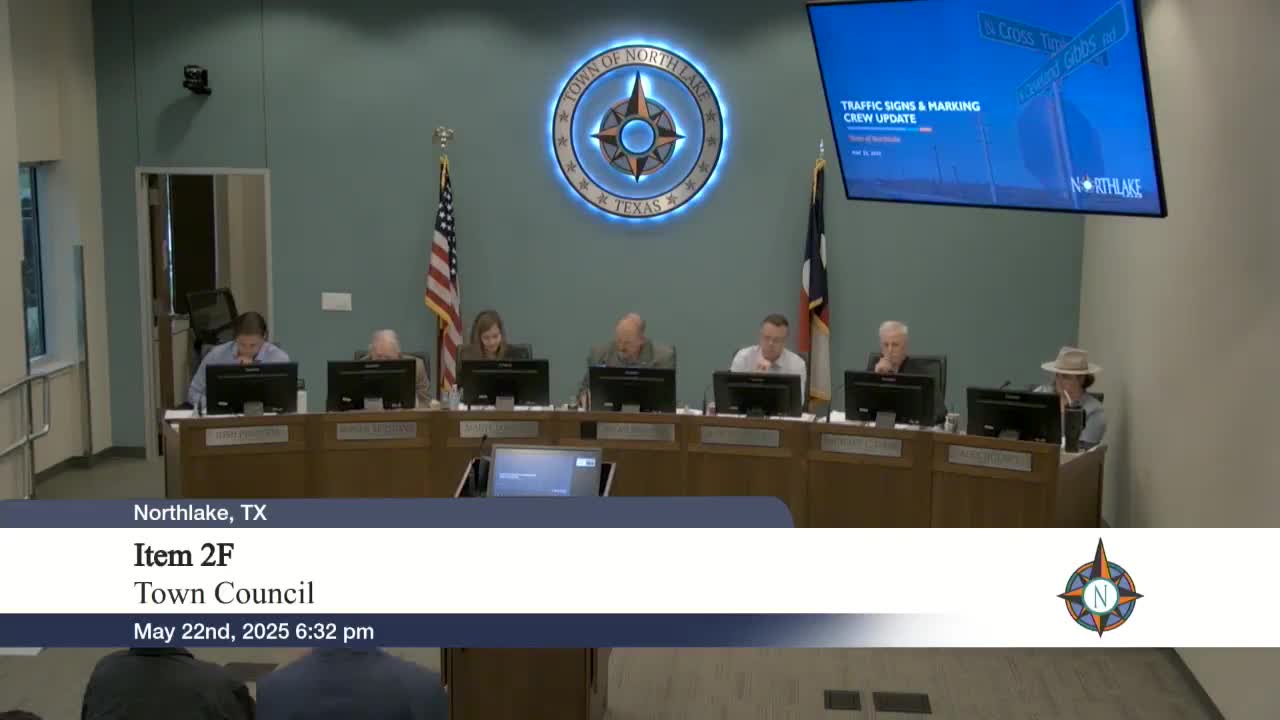
The Town of Northlake began in-house traffic-signing and pavement-marking operations after council approved equipment funding, and staff reported early progress and policy questions at the May 22 council meeting.
Public Works staff described purchases made last fall and early this year — a utility pickup with storage, a retrofitted trailer and a Graco line striper — and demonstrated the benefits for long-run striping projects and stop-marking. “So far we've done 14 stop bars, 14 legends and about 7,900 linear feet of centerline painting,” the crew's lead said, describing recent work and training.
Why it matters: visible pavement markings and stop bars can reduce rolling stops and improve pedestrian and vehicle safety on collectors and at intersections. Staff said stop bars are widely recommended and that the painted “STOP” legends are optional under the Texas manual.
Council debate and direction: Councilors and residents debated whether the town should place stop bars and painted legends across rural residential streets and master-planned communities. Some council members urged minimum, required stop bars at intersections and focused striping on collectors and major roads; others sought a lighter touch in rural residential areas to preserve the neighborhood character. Councilors asked staff to prioritize high-need locations (citing Elm and Pecan Parkway) and high-speed corridors (narrowing or “lane dieting” on Westbridge and Briarwood was suggested as a speed-management tactic).
Staff recommendations and next steps: staff said the crew will continue south-to-north work to update striping and delineators, coordinate with developers where internal streets were striped at build-out, and return with a prioritized program. Council asked members to submit priorities to staff for the next meeting and suggested consensus approval for stop bars at least on master-plan communities and major collectors.
Residents and staff also discussed public complaints and whether neighborhoods may opt out; staff said stop bars at stop signs are standard street-safety treatments and are required in some contexts, while painted legends are discretionary. Council indicated willingness to proceed with collector-focused striping and to develop a clear policy for residential and rural streets.