Commissioners push to reclassify Don Cesar/Boca Ciega stormwater work as top priority amid resident frustration
Loading...
Summary
St. Pete Beach commissioners and residents pressed staff on June 10 to elevate stormwater and resiliency work in the Don Cesar/Boca Ciega area to top priority after staff presented the city’s draft capital priorities and funding strategies.
St. Pete Beach commissioners and residents pressed staff on June 10 to elevate stormwater and neighborhood resiliency projects in the Don Cesar/Boca Ciega area to the city’s top funding priority, saying longstanding flooding problems have made daily life difficult for residents.
The dispute centered on a staff list that placed the Don Cesar/Boca Ciega Area Resiliency Adaptation work and related street reconstructions as priority 2 rather than priority 1. At the workshop, Finance Director Devin Schmidt said staff has sought design grants that could put design work in 2026 with roughly $600,000 in outside revenue and about $200,000 in city cost.
Residents and several commissioners said the projects should be priority 1 because flooding is chronic and has worsened after recent storms. “It’s number 1,” one commissioner said during the meeting, calling the priority 2 designation “beyond me” and describing repeated inability of neighbors to get in or out of their homes. Another commissioner urged staff and the commission to break large scope work into smaller, staged projects rather than presenting a single large-dollar figure for the neighborhood.
Schmidt and staff explained the difference between types of work: some entries are lower‑scope hurricane repair projects (concrete patching, tie‑backs) while others, such as full seawall replacements or full street reconstructions, require different engineering and higher costs. Staff told the commission they would revisit prioritization and break projects into funding phases so the commission can approve staged work.
Members of the commission and staff also discussed whether some street reconstructions—Boca Ciega Drive and Gulf Winds Drive—had grown from simple repaving jobs into comprehensive redesigns that include sidewalks and beautification elements. Commissioners suggested separating basic street and utility work from optional upgrades so the critical repair work can move faster. One commissioner said they would rather reallocate funds from lower‑priority beautification to resiliency work.
The workshop highlighted funding sources under consideration: grant programs (including Penny for Pinellas), FEMA reimbursements for hurricane damage, and potential bridge financing. Schmidt said FEMA reimbursements and other grant figures are fluid and may change as the city continues negotiations. Staff indicated they will return with more detailed breakdowns, refined priorities and a robust prioritization process for next year.
For now, staff signaled willingness to reclassify or refine priorities: “We can update this priority,” a staff member said in response to a commissioner’s question about whether full seawall replacement should be a different priority than patching repairs. The commission also received assurance that design work (not just study) is being advanced for the neighborhood: staff said they are pursuing grant funding and design steps, not only additional studies.
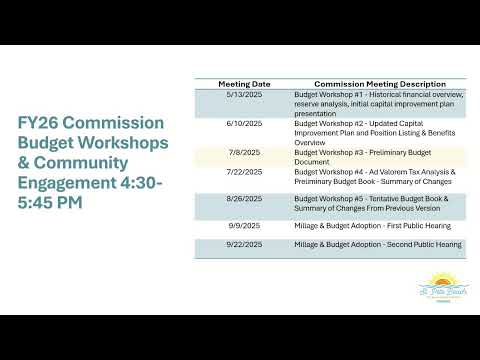
The commission and staff scheduled a follow‑up preliminary budget session for July 8, when the refined prioritization, funding sources and staged project breakdowns are expected to return to the commission for further direction.
Less urgent elements of the capital program were deferred to later sections of the budget process; commissioners repeatedly emphasized that the Don Cesar/Boca Ciega resiliency work must move from planning to implementation in staged increments.
The discussion concluded with a direction for staff to return with clearer cost breakdowns, grant status and a phased implementation plan to allow the commission to prioritize immediate, high‑impact repairs ahead of optional enhancements.