Get Full Government Meeting Transcripts, Videos, & Alerts Forever!
Get email alerts on the Impact Fees topic
No spam. Unsubscribe anytime.
Putnam County adopts impact‑fee ordinance; board chooses flat schedule and defers affordable‑housing waiver
Summary
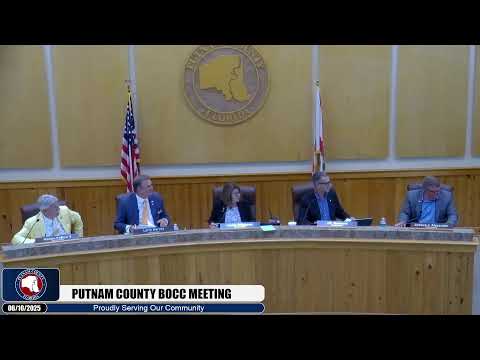
Putnam County Board of County Commissioners adopted an impact‑fee ordinance designed to make new development pay for public infrastructure, voting to use a non‑tiered (flat) fee schedule while leaving an affordable‑housing exemption to be addressed later.
Putnam County Board of County Commissioners adopted an impact‑fee ordinance designed to make new development pay for public infrastructure, voting to use a non‑tiered (flat) fee schedule while leaving an affordable‑housing exemption to be addressed later.
The ordinance, identified in the meeting as ordinance number 2025‑015, creates fees for fire protection, law enforcement, parks and recreation, transportation, county facilities and water and wastewater. County leaders said the water and wastewater fees would apply only when a property connects to the public system; properties using private wells and septic systems are not charged those utility fees unless they later hook up.
Why it matters: The ordinance moves the calculated cost of growth to new development rather than distributing it across existing taxpayers. Commissioners repeatedly framed the question as a choice among three outcomes: growth pays for itself; current residents subsidize growth; or levels of service drop.
Most important facts
The board approved the ordinance after an extended discussion about a tiered (size‑based) fee schedule versus a single flat fee. Supporters of a tiered schedule said it reduces the burden on buyers of smaller starter homes by charging larger houses a higher average fee; opponents said a tiered system could penalize long‑time residents who later add square footage to an existing home.
Consultants described a common three‑tier square‑footage approach (0–1,500; 1,500–2,500; 2,500+). Under the example discussed at the meeting, a new 2,000‑square‑foot home would face a total fee (excluding utilities) on the order of $7,700; moving from one tier to the next could require only a differential payment, roughly $1,300 in the example given. The commissioners elected a flat schedule instead of adopting the tiered example.
Exemptions and appeals
The ordinance text discussed a set of exemptions (identified in the packet as section 24.9). Exemptions described in the discussion include: alterations or expansions of an existing residential building that do not create additional impact units; accessory structures and temporary construction trailers; replacement of a residential land use where no additional impact units are created; and public and charter schools as provided by Florida law. The board noted that the Florida Impact Fee Act allows but does not require fee waivers or discounts for qualified affordable housing; the board directed staff to return with an affordable‑housing exemption or program at a later date.
The ordinance also includes an administrative role for a county coordinator (the official or designee who administers the chapter) and a process for appeals: applicants have 30 days from a coordinator determination to file an appeal under the ordinance language discussed in the meeting.
Timing and administration
County staff and the building official advised the commission that, as a practical matter, most fees are collected at permit issuance (not at the application stage) because by permit issuance the project has cleared plan review and is ready to begin construction. Commissioners and several speakers discussed a possible alternative of collecting fees at certificate of occupancy for large commercial projects; commissioners were told that collecting at permit issuance is the standard practice in jurisdictions the consultants cited and that collecting at issuance is administratively simpler and avoids later collection problems.
Who spoke
Speakers at the meeting included commissioners who led the debate, county staff and consultants who explained how schedules and appeals would work, and members of the public and the business community who urged either protection for existing residents or supports for small builders. Public comments included Michael Woodward, who urged protections for people already living in Putnam County and suggested exempting additions to existing homes from tiered charges; and builder Brandon Smiley, who described development costs in East Palatka and urged consideration of affordable‑housing incentives.
Board action
Commissioner Harvey moved to adopt the impact‑fee ordinance (ordinance 2025‑015) using the flat fee schedule with a directive that staff return with an affordable‑housing element to consider waivers or buy‑downs. The motion was approved by roll call vote; the chair announced, “Motion carries.”
What the ordinance does not do (right now)
The board did not adopt a countywide policy requiring existing properties to hook up to public water or sewer where lines are available; commissioners noted that forcing mandatory connections would be a separate policy decision. The ordinance likewise does not automatically implement an affordable‑housing waiver; that waiver was left as a matter for a future ordinance or program.
Next steps and implementation
Staff explained that finance and development services will implement the fee schedule and bookkeeping. The board asked staff to return with details about fee rates and the practical mechanics of collection, and to draft the separate affordable‑housing waiver or incentive program if the board wishes to adopt one later.
Ending
Adoption of the ordinance concludes a multi‑meeting discussion that commissioners said they undertook to shift growth costs to new development and avoid raising property taxes for current residents. The board moved next to a separate mid‑year budget true‑up hearing during the same meeting.
Direct quotes (selected)
"I was a little disappointed ... that the only impact fee schedule I saw was the same old one we've been seeing," said Michael Woodward, a resident who urged the commission to consider a tiered schedule with protections for existing homeowners.
"If they connect to the water and wastewater system ... then an impact fee would apply. But if they are just on well or septic, that would not be applicable," said a county consultant during the discussion of utility fees.
"Motion carries," the chair announced after the roll call vote approving the ordinance.
(Article based only on transcript excerpts from the Putnam County commission meeting on the impact‑fee ordinance; meeting date not specified in the transcript.)