Lifetime Citizen Portal Access — AI Briefings, Alerts & Unlimited Follows
Alamogordo commission votes to seek management proposals for Desert Lakes Golf Course
Loading...
Summary
After months of public input and staff analysis, the Alamogordo City Commission on June 10 voted 6-0 to issue an RFP seeking private management proposals for Desert Lakes Golf Course while allowing a contract extension to permit an orderly transition.
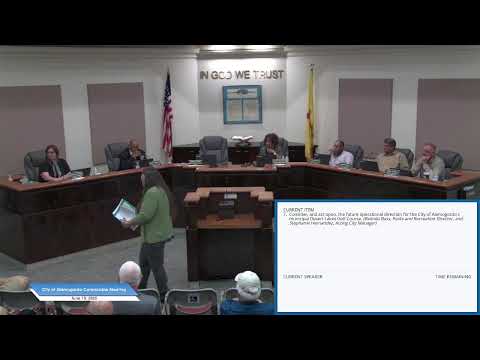
Alamogordo — The Alamogordo City Commission voted 6-0 on June 10 to authorize staff to issue a request for proposals for a management agreement for Desert Lakes Golf Course, while preserving a limited contract extension to allow an orderly transition.
City staff presented three options for the municipal course: bring operations fully in house, issue an RFP for an outside management company, or pursue sale or reversion tied to deed restrictions. “My job is to present a set of facts and to gather data and present options,” presenter Belinda Bass told the commission, summarizing financial data and capital needs including irrigation replacement and pond relining tied to regulatory permits.
The discussion followed public comments from golfers and the current operator. Grant Dows, who identified himself as the current contractor for the course under GNL Golf Inc., urged the commission to seek a private management firm, saying the private sector can operate with lower labor costs and greater flexibility: “The private sector can employ roughly for 20% less than the public sector, plus there are no employee legacy costs going forward.” Jason Baldwin, speaking for community interests that include local golf associations, said the city could always later bring the course in house and urged careful drafting of an RFP: “No matter what happens tonight … you can always come back to the idea of the city running the golf course.” Resident Stephen Bunt and Ron Griggs also addressed maintenance history and the need for outside review of staff proposals.
Staff reported that the course has accumulated deferred maintenance tied in part to the structure of the current contractor revenue-sharing arrangement. Bass described revenue and cost figures staff reviewed for planning: the management proposal presented to staff estimated roughly $1.8 million in total annual revenue, while staff’s five‑year average operating and maintenance costs approach $2.2 million, leaving a projected shortfall in the management scenario as presented of roughly $400,000–$500,000 a year. Bass also told the commission the city will have matching costs for an irrigation project this year, describing roughly $600,000 in required city matching funds for that work.
Staff also discussed capital priorities the commission would inherit under any model, including pond lining required under National Pollutant Discharge Elimination System (NPDES) permit obligations, a greens conversion approved in the Parks and Recreation master plan, cart-path repairs, driving-range upgrades and potential new programming to expand play and community use. Bass said some large capital projects have been delayed while the irrigation project proceeded.
Commissioners debated the tradeoffs of each approach: proponents of an RFP argued a qualified management company could bring golf-specific expertise, marketing, and vendor discounts; supporters of in-house management said municipal control would allow the city to prioritize reinvesting current subsidy dollars into capital work and programming. A staff memo noted state procurement rules require the city to issue a formal RFP because the existing contract term has ended, and that the state procurement office will allow a one-year extension to June 2026 to permit a transition and complete projects already underway.
Commissioner Crystal Guthrie moved to go out for an RFP for a management agreement; Commissioner Warren Robinson seconded. The motion passed 6-0 (Mayor Pro Tem Sharon McDonald, Commissioners Crystal Guthrie, Steven Burnett, Warren Robinson, Josh Bridal and Mark Tapley voting yes; Mayor Susan Payne absent). The commission did not adopt an in‑house conversion at this meeting.
Next steps announced by staff included drafting RFP language that will aim to protect the city’s ability to schedule capital work, define minimum service and reporting requirements, and solicit proposals that include plans for programming, marketing and capital investment. Staff also told the commission the city will seek grant funding and other external sources for some pond and irrigation work but cautioned that grant awards cannot be counted until secured.
With the RFP route chosen, the commission has left open the option to revisit an in‑house approach later if a management contract does not meet expectations.