Get Full Government Meeting Transcripts, Videos, & Alerts Forever!
Get email alerts on the Parking topic
No spam. Unsubscribe anytime.
Portsmouth council advances plan for one free 15‑minute resident parking session via ParkMobile; debate over impacts continues
Summary
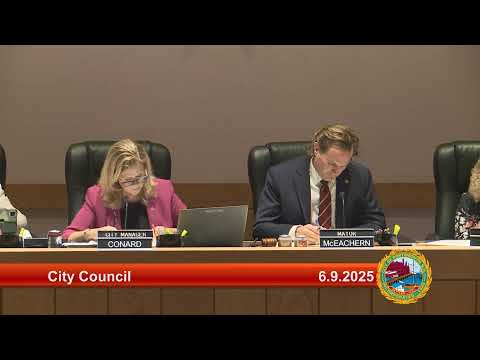
Portsmouth City Council moved forward Monday night on an amendment to a proposed parking ordinance to give residents one free 15‑minute metered session per day through the ParkMobile app, and scheduled a public hearing for July 14.
Portsmouth City Council moved forward Monday night on an amendment to a proposed change in limited downtown parking, directing staff to return the revised ordinance for reading and a public hearing on July 14.
The amendment replaces an earlier proposal to convert selected 15‑minute meters to 30‑minute resident‑only spaces with a program that would let Portsmouth residents claim one free 15‑minute parking session per calendar day anywhere on city metered streets using the ParkMobile smartphone app. Councilors framed the change as a way to let residents “pop in and out” of downtown businesses without searching for quarters or risking paying for longer minimum increments on the app.
Why it matters: The debate touched on three city priorities—supporting downtown businesses, keeping turnover for short‑term parking, and limiting costs to city parking funds. Business groups and the city’s technical advisory panels urged more study before altering parking rules; proponents said a single daily 15‑minute session tied to ParkMobile would be simple and encourage resident patronage without removing short‑term spaces.
Council debate and committee input The measure followed weeks of discussion in the Parking, Traffic & Safety Committee (PTS) and the Economic Development Commission (EDC). PTS voted to recommend further study, and the EDC reported mixed results from a low‑response survey of downtown businesses: roughly a third said a change would help, a third predicted no impact and about 28% said it could harm business. The EDC suggested pilot ideas such as 15‑minute free parking via ParkMobile and off‑season garage discounts.
At the council meeting, resident speakers said the change could help people running quick errands or picking up curbside orders. Tyler Garza, 62 McKinley, urged the council not to treat short‑term resident parking as “a PR stunt,” and warned that the proposal could cannibalize spaces residents already use. Eric Anderson of 38 George’s Terrace said the step should be studied alongside the parking plan consultant’s recommendations.
Councilors who backed the mayor’s amendment said tying the free session to ParkMobile matters because users can extend time from their phones if they stay longer, and because the app already handles the city’s resident discount. Opponents cited PTS and EDC concerns that the change could reduce turnover and cost the city in transaction fees.
Costs and mechanics City staff and councilors discussed technical details: the ParkMobile per‑transaction processing fee (discussed in hearing as roughly 25¢–35¢ per initiation) and an early staff estimate that implementing the revised resident free‑15 program at current signup levels could cost roughly $400,000 annually; staff said they would refine that estimate for the July meeting.
Key action and vote Councilor action began with an amendment to strike the 30‑minute resident concept and replace it with the ParkMobile‑tied 15‑minute resident session once per day. On a roll‑call vote the mayor’s amendment passed 7–2 (Yes: Mayor McCachern, Councilors Tabor, Denton, Blaylock, Bagley, Monroe, Lombardi; No: Councilors Cook and Assistant Mayor Kelly). A second amendment to codify free metered parking of up to three hours for veterans, active military and Gold Star families passed 8–1; that provision was added to the package. The council then voted to move the main ordinance as amended to reading and a public hearing on July 14.
What’s next Staff will provide a more detailed fiscal analysis (including likely transaction fee impacts and potential offset strategies) and a notice for the July 14 reading and public hearing. Councilors and committee members asked staff to return cost scenarios and possible pilot designs so the council can evaluate alternatives before final adoption.
Ending note The proposal highlights competing priorities in Portsmouth’s dense downtown: encouraging resident access for quick trips, preserving turnover for businesses, and protecting parking revenues that subsidize resident tax credits. The council’s July hearing will give business groups, residents and advisory committees another opportunity to weigh in.