Get Full Government Meeting Transcripts, Videos, & Alerts Forever!
Get email alerts on the Water Infrastructure topic
No spam. Unsubscribe anytime.
McDowell commissioners press for more funding as water project hits booster-station cost hurdle
Summary
County staff told commissioners the East End/West Marion water extension faces a funding gap after engineers identified a needed booster station; commissioners voted to ask state and federal representatives for additional assistance.
McDowell County commissioners were told June 2025 that a multi-phase water extension intended to serve West Marion, Providence and West Marion Elementary is on hold after engineers determined a booster station will be required and pushed the project over available funding.
County staff described the scope and funding status and the board voted to ask state and federal legislators for additional money to complete the project.
Why it matters: the extension is intended to provide public water to a school, a fire substation and nearby residences and businesses; the county says those anchor commitments are tied to state and ARC funding and that failure to reach the school could cause partners to withdraw their contributions.
William, county staff, summarized progress on several projects the county has underway: the East End project (around Marion Lake Club), Phase 2a/2b nearing completion, and Phase 3 awaiting NCDOT encroachment approvals. He told the board the engineering team concluded that, because of elevation in the West Marion area (about 1,600 feet), any route to the school will require a booster station. "So in order to have adequate pressures for residential users... we're gonna have a need for a booster station," William said. He added an overall estimate for the booster and related work "could be $75,800,000".
William walked commissioners through the county's committed funding: about $500,000 in Appalachian Regional Commission money, "an appropriation of almost $4,000,000 from the General Assembly," and $500,000 the school system had committed — roughly $5 million in hand, which the staff said is short of the revised cost. He also said ARPA-funded portions must be completed and reimbursed by December 2026.
On financing options, staff said they submitted a brief letter of interest to the state revolving fund (SRF) to place McDowell on the list of impacted communities seeking SRF assistance. "I submitted on our behalf a, essentially, a letter of interest," William said; he described that filing as a preliminary step ahead of formal SRF applications in July.
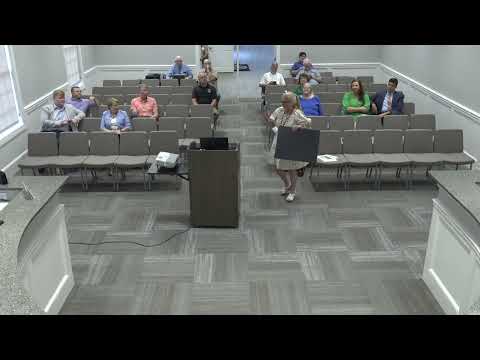
Commissioners underlined priorities and next steps: get public water to West Marion Elementary remains the board's top objective; completing the larger loop that would include Zion Hill, Sugar Hill and Marlow Road is desirable but contingent on securing more funding. Commissioner Wing asked the congressman's office representative to look for funding; Commissioner Wing later moved for staff to seek legislative assistance. The motion passed on a voice vote.
Discussion vs. decision: commissioners directed staff to pursue legislative outreach and federal/state funding programs (SRF and other sources); the board did not appropriate additional county funds at the meeting.
Timeline and constraints noted in the meeting: ARPA-funded work must be complete and reimbursed by December 2026; SRF applications open in July; engineer cautioned cost and permitting remain outstanding items.
What’s next: staff will provide more detailed cost breakdowns (county asked staff to return with the specific estimate to run water "just to the school" and the incremental cost to complete the full loop) and pursue SRF/federal contacts and legislative outreach that the board authorized.