Get Full Government Meeting Transcripts, Videos, & Alerts Forever!
Get email alerts on the Timber Management And Litigation topic
No spam. Unsubscribe anytime.
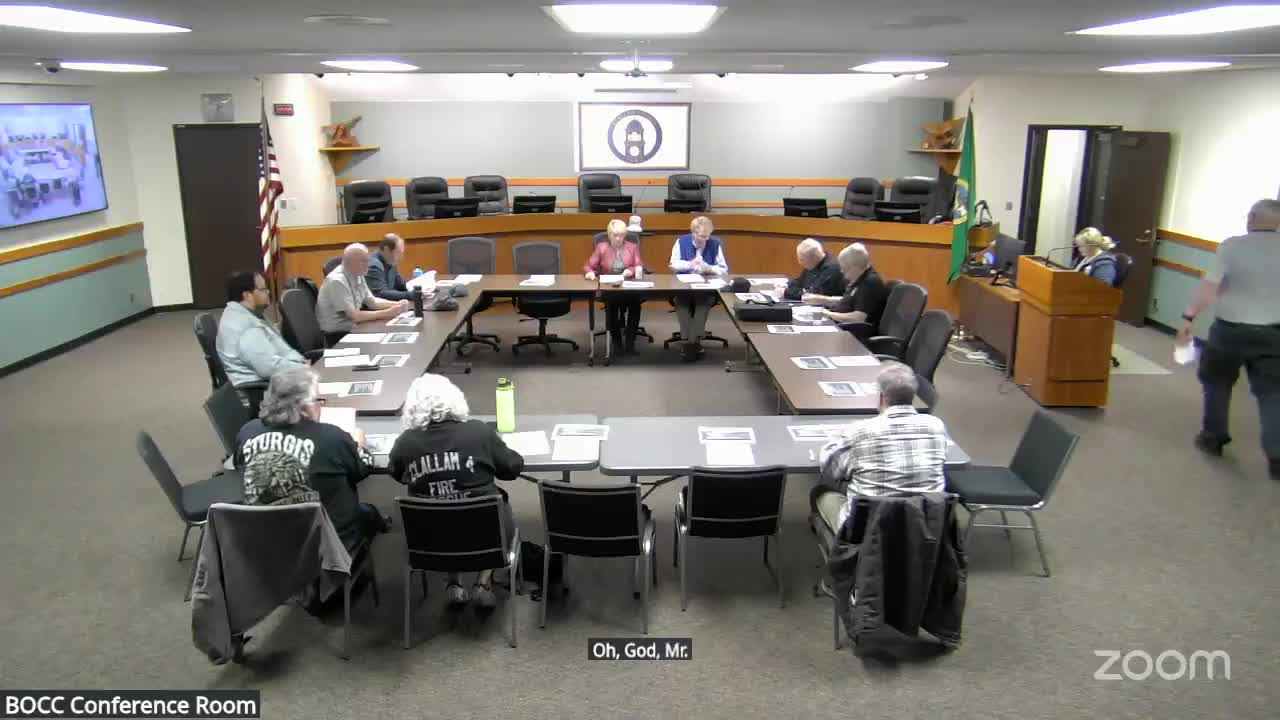
Clallam advisory committee hears DNR update on timber sales, litigation and how revenue may reach junior taxing districts
Summary
County and Department of Natural Resources staff reviewed planned and active timber sales, recent court victories and injunctions, and discussed how state purchases and litigation affect revenue shared with Clallam County taxing districts.
Clallam County advisory committee members and Department of Natural Resources staff discussed a series of active and planned timber sales, recent litigation over harvest decisions and how state land purchases and litigation delays affect revenue for local taxing districts.
Committee members heard that the state has purchased timberland parcels intended to generate revenue shared among encumbered counties, but distribution of that revenue to individual taxing districts depends on detailed allocation work the DNR must complete. County staff said the legislature has allocated money in recent tranches to purchase timberland for encumbered counties; a recent allocation cited in the meeting was roughly $10,000,000 (a committee speaker said the current tranche was “a little bit more than $10,000,000”).
The discussion centered on three linked topics: which lands are being set aside when DNR purchases timberland, how proceeds from sales are distributed to junior taxing districts (fire, school and other local districts), and the effect of litigation that has paused or delayed harvests on revenue timing.
Why it matters: many junior taxing districts in Clallam County receive a portion of DNR timber revenues and excise taxes. Committee members and county commissioners said they rely on those funds for fire equipment, schools and other local services. When parcels are set aside or sales are delayed by legal challenges, local budgets can be affected.
Most important facts - DNR staff described a mix of sales types: standard harvest sales that require road work, smaller direct sales that require immediate payment, and salvage sales (alder and cedar salvage) that have begun to generate receipts. Direct sales were highlighted as offering faster cash flow because payment is due at the time of sale and funds are typically distributed to counties within weeks. - Litigation has been widespread: dozens of cases across multiple counties were described. Some parcels have been subject to temporary restraining orders (TROs) and preliminary injunctions; others proceeded after hearings. Meeting participants were told that one recent superior-court hearing on the merits produced a favorable ruling for DNR, but the written judgment had not yet been issued at the time of the meeting and an appeal window could follow. - The Parson/TreeWell area and related sales were specifically discussed as examples of parcels under litigation; the meeting referenced a TRO and the prospect of a preliminary injunction hearing. - For one timber sale described in the meeting as “Parched,” the original proposal encompassed 348 acres; DNR staff said 201 acres would be harvested, 61 acres were within riparian or wetland management zones, 73 acres were newly designated old growth and 10 acres were legacy/lead-tree areas, meaning more than 42% of that sale’s original acreage was to be permanently deferred from harvest. - Committee members pressed staff about how much acreage in Clallam County had been set aside; speakers repeated that the county had roughly 22,000 acres set aside in prior transactions and that DNR analysis identifying how those acres fall inside specific tax-code areas was still pending.
Discussion highlights and staff direction - County staff and DNR said the county can support DNR in litigation by preparing declaration statements describing local fiscal impacts and by attending hearings; participants asked for a template that each junior taxing district could fill out with its own numbers. The county attorney was reported to be reviewing possible legal options regarding trust-land matters, but no formal legal action by the committee was recorded. - DNR described a multi-decade Habitat Conservation Plan (HCP) and an internal sustainable-forests policy that use different language (for example, expected outcomes versus goals). Lawsuits generally allege that DNR did not follow its own policies or procedures when authorizing sales; DNR staff said most lawsuits hinge on whether procedures and policy language were followed, not on a single common technical error. - DNR staff said they are developing a “detector” model to map structurally complex and maturing forest conditions across sustainable-harvest units; the commissioner present requested county- and unit-level breakdowns so Clallam will not be disproportionately impacted when sequencing sales to meet policy targets.
Budget and revenue details discussed (clarifying points) - Direct sales: require payment day of sale; DNR staff said counties often receive money from direct sales within 2–4 weeks. - Standard sales: require harvest and completion before final distributions; purchasers typically put down 10% at sale signing, which is held until final completion and audits. - Excise tax and distribution: meeting presenters noted the excise tax on timber harvests is an additional revenue stream distributed to counties and junior districts; DNR described it as an important, often under-recognized source of predictable revenue that comes from having a functioning timber industry.
Other points raised - Committee members raised carbon and ecosystem-services markets as potential new revenue streams for trust lands, but DNR staff cautioned carbon projects are complex, may require long-term commitments and ongoing inventory, and—depending on program rules—may not be additive to timber harvest revenues. - Participants asked whether DNR can plan to smooth annual revenue to junior districts; DNR staff said sustainable-harvest units are managed for relatively even output but that modeling and allocation at the small (tax-code) scale is difficult because the junior land base is small and variable.
What the committee directed or planned - County and DNR staff agreed to circulate updated sale prices and to provide the county with harvested-sale results so that declaration templates (if used) could include current numbers. The county attorney and DNR counsel were coordinating to determine how junior taxing districts could provide declarations in support of DNR responses to litigation.
Ending Committee members requested DNR provide the new detector-model results and county- and unit-level data in coming months so local officials can assess which taxing districts are most affected and consider budget and capital-planning options. Several participants asked to be notified when preliminary-injunction hearings are calendared so they can attend or submit statements of impact.