Get Full Government Meeting Transcripts, Videos, & Alerts Forever!
Get email alerts on the Public Camping Ordinance topic
No spam. Unsubscribe anytime.
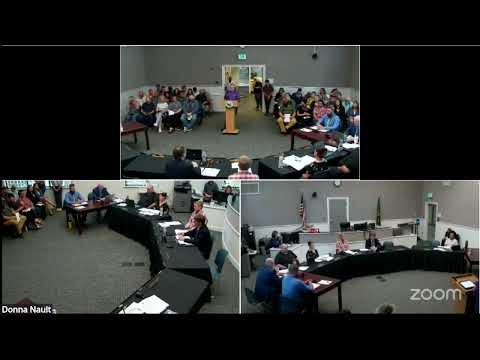
Shelton council approves ordinance tightening ban on camping in public spaces after hours of public comment
Summary
The Shelton City Council on June 5 voted to approve Ordinance 2029-0525, amending Chapter 8.74 of the Shelton Municipal Code to prohibit camping on public property.
The Shelton City Council on June 5 voted to approve Ordinance 2029-0525, amending Chapter 8.74 of the Shelton Municipal Code to prohibit camping on public property. Council members recorded in the roll call included Council Member Bloesch, Deputy Mayor Sherman and Council Member Sapp voting in favor and Council Member Gilmore and Mayor Nesco voting no; other votes were not specified on the record.
City Manager Mark Ziegler told the council the ordinance rewrites the code’s definition of “camping” and adds an enforcement framework. The new definition says camping means “to reside or sleep in a tent, hut, lean-to or other temporary shelter or structure,” replacing previous language that used the phrase “remaining overnight.” Ziegler said the change was made to give clearer guidance to staff that may have to enforce the rule.
The ordinance creates a misdemeanor penalty — up to 90 days in jail and a fine of up to $1,000 — but specifies that the city will not charge the crime if law enforcement has offered resources to a person camping on public property and the person accepts the offer or agrees to relocate. The ordinance also designates the city manager to develop implementation policies consistent with constitutional and case-law developments; the code will not be enforced until those policies have been finalized.
Why it matters: supporters said the change gives law enforcement tools to address public safety and sanitation problems downtown; opponents warned the ordinance criminalizes people experiencing homelessness, risks legal challenges, and will not solve the underlying problems without shelter beds and additional services.
Public testimony was lengthy and sharply divided. Colleen Carmichael, executive director of New Horizon Humanities, urged caution and cited research on costs and recidivism: “Jail is better than homelessness. That is not true,” she said, arguing evidence favors housing and supportive services over criminalization. Danielle Bland, a Salvation Army-affiliated outreach worker who said she works directly with people experiencing homelessness, told the council that “criminalizing the homeless population … is not being a good neighbor” and urged first addressing housing and health services.
Aaron Myers of Community Lifeline said the ordinance would make outreach and relationship-building harder. “I don’t agree with this ordinance,” Myers said. “I think it really harms the opportunity we get when we’re trying to connect with people and demarginalize the homeless population that we’re dealing with.”
Business owners and some residents urged the council to act. Holly Cahoon, a downtown business owner, said the ordinance was intended to “restore order and balance,” adding that public parks and sidewalks should be “safe, clean, and accessible for everyone.” Other speakers described safety, sanitation and repeated drug-related calls at Brewer Park and in downtown areas.
Council discussion emphasized both the need for public safety and the lack of immediate placement options. Ziegler and the city attorney told the council the code change reflects recent federal and state case-law shifts; Ziegler noted a 2024 United States Supreme Court decision had altered the legal landscape for local camping prohibitions and that enforcement policies would be written to align with constitutional limits.
The council adopted the ordinance after a motion to act on the measure failed once, then passed on a subsequent motion to take action that evening. The ordinance requires the city manager to finish related enforcement policies before the city begins charging violations; the council did not set an enforcement start date.
The debate made clear the council lacks a ready, funded shelter alternative for people displaced from public spaces. Multiple speakers and council members urged the city and county to accelerate shelter, mitigation-site and supportive-housing plans already under discussion, and several asked the council to reopen or fund transitional shelter options while policies and services are built.
What happens next: the ordinance is adopted as written but not enforceable until the city manager finalizes the required implementation policies and procedures. Council members and community groups indicated they expect further discussions on mitigation sites, a county-level homelessness response plan and grant-funded housing options in the coming weeks.