
Cochise County health staff outline foodborne-illness surveillance, inspection duties
Get AI-powered insights, summaries, and transcripts
Sign Up Free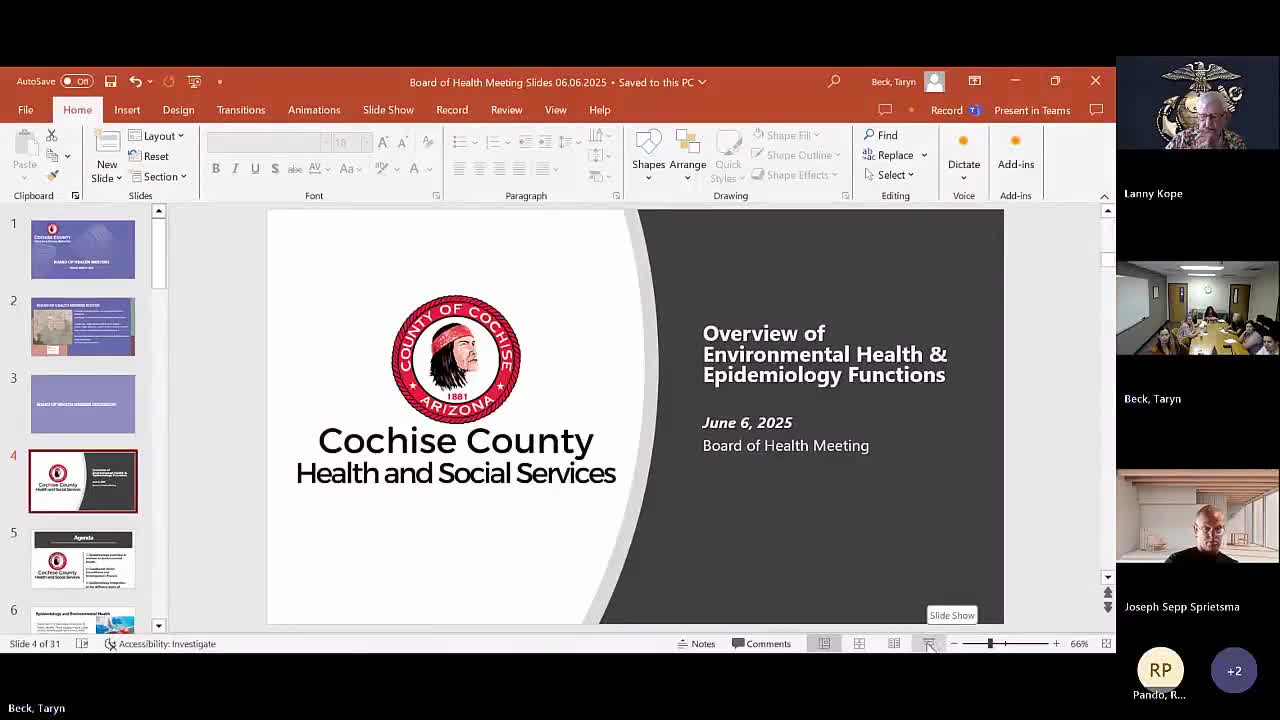
Summary
At a Cochise County Board of Health meeting, epidemiology and environmental health staff described how the county tracks and responds to suspected foodborne illness, the department's inspection workload and staffing, and coordination with state and federal partners.
At a Cochise County Board of Health meeting, epidemiology and environmental health staff described how the county detects and responds to suspected foodborne illness, inspects food and lodging establishments and supports community food-safety outreach.
The presentation explained why surveillance, laboratory testing and coordinated inspections matter for public health in Cochise County, which relies on state labs and cross-jurisdictional coordination for many investigations.
"Epidemiology itself analyzes the patterns or exposures, and we come up with hypotheses on what the cause of the agent for disease might be," said Axel Lopez, Cochise County epidemiologist, describing how the county combines case interviews with sample collection and lab sequencing to identify likely sources. Lopez walked the board through three surveillance types the county uses: passive (laboratory and provider reporting), active (case finding and outreach), and syndromic surveillance based on emergency-department visit coding.
Natalie Johnson, division director for environmental health, described the department's staffing and duties. "There's eight total staff members. Five of us are registered sanitarians," Johnson said, and she listed responsibilities that include plan review for mobile food units, inspections of public pools and spas, lodging and RV park inspections, temporary-event oversight and on-site wastewater (septic) permitting and complaints.
Johnson told the board Cochise County has adopted the 2022 FDA Food Code and uses a risk-based inspection frequency: at least once annually for lower-risk retail outlets, twice annually for fast-food operations, three times for full-service restaurants, and four times a year for high-risk settings such as hospitals, long-term-care facilities and child-care centers.
Staff emphasized partnerships with state and federal agencies. Lopez said the county relies on Arizona Department of Health Services (ADHS) and state laboratory support for pathogen identification and sequencing that link cases to larger multijurisdictional outbreaks; for cross-border concerns staff meet with epidemiologists in neighboring Mexican jurisdictions. Johnson said the county works closely with the Arizona Department of Agriculture, the U.S. Department of Agriculture and the Arizona Department of Environmental Quality on matters outside county authority, such as commercial produce shipments and air-quality issues tied to concentrated animal feeding operations.
Speakers also described community outreach efforts: bilingual technical assistance for food-cart operators, a pamphlet for prospective food businesses and partnerships that brought produce vouchers and WIC information to farmers-market events. Johnson noted epidemiology staff time is shared across programs: "We get to utilize [Axel] 10 hours a week," she said.
Board members praised the teams' community-focused approach and asked staff to make outreach materials available electronically and in print for local distribution.
The county's epidemiology and environmental-health teams said they will continue inspections, complaint investigations and community education and will coordinate with state partners for laboratory testing and multijurisdictional outbreaks.