Get Full Government Meeting Transcripts, Videos, & Alerts Forever!
Get email alerts on the Flood Control topic
No spam. Unsubscribe anytime.
Cochise County Flood Control staff outline projects, studies and grant funding; no formal votes taken
Summary
Engineering staff updated the Cochise County Board of Supervisors on flood-control projects across the county, describing grant-funded work at Coyote Wash, studies for Wilcox and Douglas basins, property-acquisition plans and concerns about water-quality contaminants in recharge plans.
Cochise County Engineering and Natural Resources staff briefed the Board of Supervisors on June 10 on a slate of flood-control and groundwater-recharge projects, several in design or study phases and several relying on state or federal grants. Staff described plans and funding sources for Coyote Wash, a Bisbee-area recharge project, watershed studies for Wilcox and Douglas basins, and localized projects in Bay Acres, Leslie Canyon and Pomerene Road. No formal board votes were recorded during the work session.
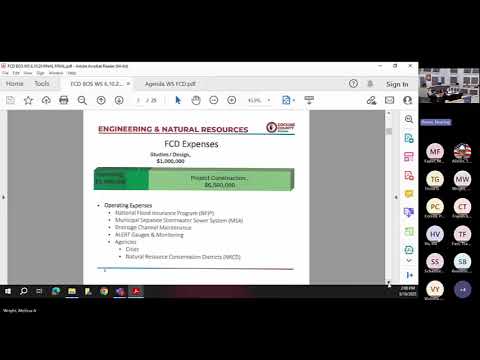
The board-held work session focused on countywide flood-control goals and how projects intersect with road flooding, watershed health and groundwater recharge. "The priority for the board is flood control projects that help minimize the flooding," said Skye Watkins, Engineering and Natural Resources staff, explaining the district’s mix of operating programs and capital projects. She added the district funds National Flood Insurance Program (NFIP) permit work, a municipal separate storm sewer system (MS4) program administered under ADEQ rules, maintenance of dedicated drainage channels, and a network of 21 alert gauges used in real-time reporting with the National Weather Service.
Watkins outlined several active or planned projects. Coyote Wash, a multi-phase project upstream of Sierra Vista, is in final design and scheduled for construction advertising at the end of the month. Staff said the project has a mix of grant funding — a REPI grant from the Army and a WIFR state grant reportedly totaling about $1.5 million — plus $50,000 in Flood Control District funds; it is intended to infiltrate an estimated 150–200 acre-feet per year by diverting low flows into an old gravel pit and releasing water slowly to increase infiltration.
Staff described a Bisbee-area project (presented as a district priority and in 30% design) that would place treated effluent into a retention pond to recharge aquifers rather than directly discharge to the San Pedro River; Watkins said the project has a REPI Challenge grant of $1.8 million and that the county is discussing an endowment to pay future maintenance, for which the city would act as fiscal agent. The briefing prompted questions about trace contaminants in treated effluent. "We'll have to research that more," Watkins said of pharmaceuticals and other compounds; she added staff would ensure compliance with ADWR and ADEQ requirements and noted federal and regional agencies also test for such compounds.
Watkins also described a proposed watershed study for the Douglas Basin similar to the Wilcox Basin work and said staff had money in the Flood Control District budget to begin a nearly $300,000 Wilcox Basin watershed study, with a draft due in September and final in October. The Wilcox study aims to map where recharge projects could both reduce flood velocities and increase groundwater infiltration across a basin that crosses county lines. Staff said the Douglas Basin study would use the same approach if the board approves use of district funds.
Other project highlights and cost estimates discussed during the session included: a Leslie Canyon dam remediation and outlet lowering intended to remove the facility’s designation as a jurisdictional dam (staff estimated a potential construction cost of approximately $3.5 million and said ADWR is involved in permitting); a Bay Acres diversion/ditch concept to reduce flooding in that colonia with a rough order-of-magnitude construction estimate presented as about $15 million; and smaller watershed studies such as Rucker Creek and Pomerene Road to identify targeted recharge or detention locations.
Staff emphasized regulatory and permitting constraints: projects using federal funds must complete NEPA clearances; some stream or dam features involve ADWR jurisdiction; and work on private property requires appropriate rights or agreements. Watkins said the county can partner with Natural Resource Conservation Districts (NRCDs) to implement on-the-ground watershed measures such as small check dams, because the county cannot directly give funds or materials to private landowners. She noted the NRCDs receive limited state funding and an intergovernmental agreement could be used to leverage district funds and local labor or donated materials.
The briefing touched on broader policy intersections. Multiple speakers referenced the Endangered Species Act and Fort Huachuca mission-area designations as factors affecting land-use and funding options, and staff noted the Gila River adjudication and 100-year water adequacy certificates are influencing development and recharge planning in the Sierra Vista area. Multiple county members and participants also discussed partnerships and Memoranda of Understanding with agencies including BLM and the Department of the Army to seek endowment funding for long-term maintenance of projects on public lands.
Board members asked about cost controls, rights-of-way and whether property acquisition should proceed. Watkins said the county is exploring property purchase (a 97-acre parcel was discussed for a potential recharge basin), and that grants such as REPI could reimburse acquisition costs. Staff recommended completing design and permitting steps before large construction commitments and said several projects already have consultant-led design work or borehole and resistivity studies (staff reported boreholes of 20–60 feet for subsurface characterization on some sites).
The meeting concluded with staff asking for direction to continue design, studies and grant pursuit; no formal motions or votes were recorded during the work session. The board moved to an executive-session agenda item after the public portion of the flood-control briefing ended.
Looking ahead, staff said they would return with final study reports, refined cost estimates and any formal requests for board action on property acquisition or construction funding once NEPA and permitting requirements are clearer.