Get Full Government Meeting Transcripts, Videos, & Alerts Forever!
Get email alerts on the Septic To Sewer Policy topic
No spam. Unsubscribe anytime.
Cocoa adopts ordinance enabling mandatory septic-to-sewer hookups; council keeps provision allowing assessments for cost overruns
Summary
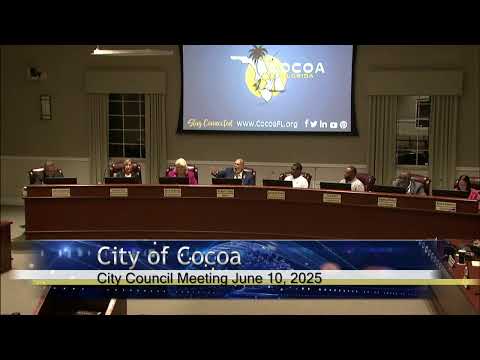
The Cocoa City Council on June 10, 2025 adopted Ordinance 03-20-25, creating a framework that allows the city to require septic-to-sewer connections for specific sewer-line expansion projects and retaining a clause that permits assessments to affected homeowners for certain project costs.
The Cocoa City Council on June 10, 2025 adopted Ordinance 03-20-25, creating a city-code framework that allows the council to require property owners to disconnect, "discontinue and abandon or remove" functioning septic tanks and connect to the city sewer when the council approves a sewer-line expansion project it deems financially and practically feasible. The final vote was 4–0 with Councilwoman Kos recused under a Florida Commission on Ethics advisory opinion.
The ordinance creates a new Section 22‑5.2 of the city code that applies on a project-by-project basis (the ordinance text and staff presentation describe it as a "framework" or road map rather than a specific construction plan). City attorneys and staff said the section is intended to let the city qualify for state and federal grants tied to mandatory hookups and to define assessment methods and payment structures if the council later decides to use special assessments or homeowner charges on a particular project.
Why it matters: The measure responds to county and state efforts to reduce nutrient pollution in the Indian River Lagoon by replacing septic systems near the lagoon with centralized sewer. Council and staff repeatedly said grant eligibility often requires a mandatory-connection policy for the project area; opponents warned that shifting cost risk to a small set of homeowners would be unfair and could depress property sales in the affected neighborhoods.
What the ordinance says and the changes adopted - The ordinance authorizes the council to require an existing residential house, building or property to discontinue and abandon or remove a functioning septic tank and connect to the city sewer when the council designates a sewer-line expansion project area and finds the project is financially and practically feasible. The council adopted staff’s recommended wording to add "discontinue and abandon or remove," so abandonment (filling in a tank) is explicitly allowed. - The ordinance preserves a clause—widely discussed in public comment and labeled "section F" during the meeting—that authorizes the city to establish assessment methodologies and, in some circumstances, pass some portion of project costs or overruns to affected property owners. The council left that clause in the ordinance as adopted. - The ordinance also updates cross‑references in Section 22‑5 of the city code clarifying connection conditions for existing functioning septic systems.
What council members and staff said City Attorney Anthony Garganese summarized the legal situation and told the council that the Florida Commission on Ethics had issued an advisory opinion finding a voting conflict for Councilwoman Kos related to the J and K project; Kos announced she would submit a Form 8B and recuse herself from the matter. "The Florida Commission on Ethics concluded that she has a voting conflict of interest," Garganese said.
Utility and finance staff described the grant landscape and preliminary funding figures the city is pursuing: staff repeatedly referenced Save Our Indian River Lagoon (SOIRL) funds and additional state DEP and water-quality grant sources. Staff said the city has identified roughly $1.2 million of the city’s $6.7 million sales‑tax allocation as a potential contribution for the homeowner side of connections and that a $3.19 million DEP grant (with a required match, in staff’s estimates) was being pursued for private-side connection work. Utility staff estimated a wide per-household cost range in the engineering-level estimates and warned costs could be much higher on properties with retaining walls, pools, long setbacks or pump installations.
Public comment and main points of opposition Approximately two dozen residents who live in the J and K/Indian River Drive study area and other neighborhoods addressed the council. Common themes: - Strong concern about the possibility that cost overruns could be assessed to the 87–88 affected homeowner parcels in the project area, burdening a small group for a benefit they said accrues citywide. Multiple speakers asked that language allowing assessment of "all or a portion" of project overruns to affected homeowners be removed or capped. - Several residents asked that homeowners who recently installed permitted advanced septic systems not be required to connect or to pay removal costs; speakers argued advanced septic systems remove a portion of nitrogen and are an alternative when sewer connection is costly. - Requests for clearer hardship and financial‑hardship exemptions, caps on homeowner assessments, and regular public updates on grant status and estimated costs.
Representative remarks (direct quotes used only from meeting speakers): - Councilwoman Kos, explaining her recusal: "I am recusing myself based on the ethics commission’s ruling. I'll step down. I'm submitting my 8b form." (Councilwoman Kos) - City Attorney Anthony Garganese on the ethics finding: "The Florida Commission on Ethics concluded that she has a voting conflict of interest with respect to the ordinance." (Anthony Garganese, City Attorney) - Resident Janice Smith: "Why is this shift where homeowners east of U.S. 1 are being asked to shoulder the full financial risk? ... It's not consistent with how the city has treated other neighborhoods." (Janice Smith, resident) - Resident Greg Henry proposed excluding affected property owners "from infrastructure installation and related costs when the purpose of the sewer system expansion is to safeguard general public health and ... environmental protections." (Greg Henry, resident)
Council debate and final action Council members debated three linked choices: (1) keep a mandatory-connection framework so the city can pursue sewer-expansion grant funds that commonly require 100% connection in the project area, (2) remove the clause allowing assessment of cost overruns to affected homeowners (section F), or (3) pursue advanced septic grants and alternatives instead.
After extended public comment, several votes and a brief recess, the council voted to reconsider the ordinance and then adopted Ordinance 03‑20‑25 on final reading with the manager's recommended edits: adding the word "abandon" (so tanks may be abandoned rather than removed) in the specified code sections and retaining the assessment/assessment-methodology clause (section F). The final recorded action was adoption of the ordinance; Councilwoman Kos remained recused for the vote. The council instructed staff to return with project‑level implementation plans, assessment methodologies and updated cost estimates before any special assessments would be levied.
Implementation, funding and next steps - Staff said available grant pools tied to SOIRL and DEP make mandatory hookup language necessary to qualify for some funds; staff also warned that some grant programs include "clawback" provisions that require a project area to achieve a specified connection rate (staff cited the risk of losing grant dollars if a project does not reach full connection). - Staff described potential funding components discussed in the meeting: roughly $6.7 million in sales‑tax proceeds identified for lagoon projects (the city pledged $1.2 million toward the homeowner side during discussion); a DEP/private-side grant request of about $3.19 million; and an anticipated $1.8 million local match figure discussed by staff as part of preliminary funding scenarios to get to a $3 million estimate for homeowner connection work. Utility staff also cited an $18,000-per‑lot SOIRL grant cap for advanced‑septic conversions (an alternative funding route discussed by residents and some council members). - The council directed staff to return when cost estimates, grant awards and assessment methodologies are known. Any special assessment would require a future council action and formal methodology; the ordinance itself does not immediately levy assessments.
Context and risks Council members and residents framed the ordinance as a balance between restoring water quality in the Indian River Lagoon and protecting homeowners from unforeseen costs. Staff and at least one council member noted that other local utilities and municipalities have mandatory hookup ordinances and high connection rates; residents argued those cases differ and urged protections for older or fixed‑income homeowners.
Next steps: staff to refine project-area boundaries, seek or confirm grant awards, develop assessment methodology and timeline, and return to council with firm cost estimates and implementation options.