Get Full Government Meeting Transcripts, Videos, & Alerts Forever!
Get email alerts on the Environment Climate topic
No spam. Unsubscribe anytime.
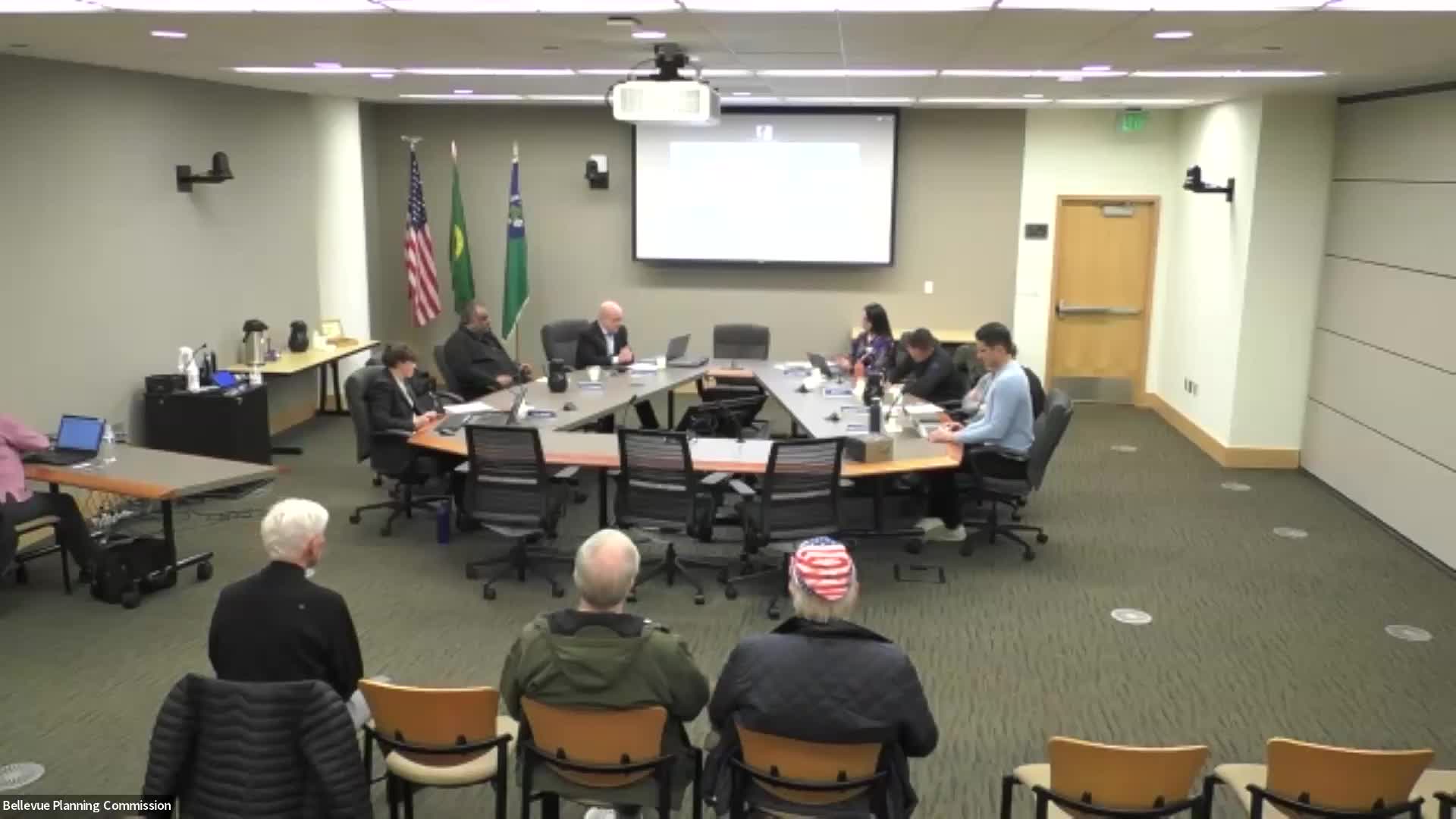
Planning Commission reviews Sustainable Bellevue plan update, weighs targets for transit, resilience hubs and EVs
Summary
City planning staff presented an update to Bellevue’s Sustainable Bellevue Environmental Stewardship Plan and sought Planning Commission feedback on land‑use and mobility goals, greenhouse‑gas targets and a proposed climate resilience program that could include distributed "resilience hubs."
City planning staff on Wednesday presented an update to Bellevue’s Sustainable Bellevue Environmental Stewardship Plan and sought feedback from the Planning Commission on land‑use and mobility goals, greenhouse‑gas targets and a proposed climate resilience program that could include distributed “resilience hubs.”
The plan update, presented by Justin Stewart, Bellevue’s sustainability program manager, and Jennifer Ewing, environmental stewardship manager, is a five‑year review that will set goals and targets for 2030 and 2050 and develop strategies staff will implement in 2025–2026. “This is for information only, but we are really interested in your input and your feedback,” Stewart said.
The plan matters because it lays out the city’s roadmap for meeting its climate goals, and staff told commissioners the city is not currently on track to meet its 2030 greenhouse‑gas reduction target. Stewart said the city’s 2030 greenhouse‑gas target is a 50 percent cut from a 2011 baseline and noted that while community emissions have fallen in recent years, they are not yet trending toward the 2030 goal. “We are not currently on track for the 2030 greenhouse gas emissions reduction goal,” Stewart said, summarizing staff analysis.
Staff described the update process as having three phases: (1) revising goals and targets through January, (2) drafting strategies and actions beginning in February, and (3) drafting and adopting the plan with adoption expected in the fourth quarter of 2025. Stewart said the current plan contains 78 actions; staff marked many as complete or incorporated into ongoing programs, about 19 as started but requiring more work and roughly 10 as part of the 2025 work program.
Public commenters urged clearer, time‑bound mobility targets. Chris Bridal, speaking for Complete Streets Bellevue, told commissioners the city needs “concrete targets for system completion of our pedestrian, bicycle, and transit networks by 02/1930” and offered performance figures from the city’s MIP data portal: 58 percent of the pedestrian network meets performance targets, 54 percent for bicycling, 31 percent for transit speed and 97 percent for vehicle speed performance. Bridal said specific completion targets would “signal to the community that Bellevue was serious and holding itself accountable.”
Another member of the public, David Ketchum, who identified himself as an engineer who works on heliports and air transport, urged the commission to consider “advanced air mobility” — electric short‑range aircraft — when planning landing or terminal sites. “These are electric aircraft that are able to bring transit to people as opposed to people going to transportation,” Ketchum said.
Commissioners focused much of their discussion on the mobility and land‑use metrics staff presented. Staff noted two land‑use metrics are expressed as the share of jobs and housing within a quarter‑mile of frequent transit: the proposed targets on staff slides were 75 percent of jobs near frequent transit by 2030 and 85 percent by 2050, and a lower target for housing (staff indicated housing targets are lower, reflecting different baselines). Several commissioners asked staff to clarify whether the percentages referred to all jobs/housing or only new development; in answer staff said the targets are citywide percentages tied to the comprehensive plan growth expectations.
Commissioners raised recurring concerns: 1) the slides and goal language sometimes lacked clarity and context, making it hard to tell whether a given metric should increase or decrease; 2) some ambitious targets (for example, a staff slide showing a 100 percent electrified vehicle fleet by 2050) risked setting aspirational goals that staff may not be able to control without additional implementation measures; and 3) many targets depend heavily on regional transit and private development decisions outside city control, so commissioners asked staff to mark which actions are under city control and which rely on external partners.
Commissioner comments urged staff to add or clarify measures that are more directly under local control. Commissioner Lou suggested tracking whether the quarter‑mile areas actually provide sufficient services and human services providers, not only counting proximity to transit. Commissioner Vargava recommended adding additional distance bands (half‑mile, one‑mile) so the city can see broader regional accessibility trends. Several commissioners asked staff to identify which actions will have the largest greenhouse‑gas impact so the commission and council can prioritize those “high‑impact” strategies.
On climate resilience, staff proposed adding a dedicated resilience strategy to the plan that would include “resilience hubs” — community spaces equipped to provide power, cooling or clean air during heat waves and smoke events, and that also serve day‑to‑day community needs. Stewart described resilience hubs as “a combination of space, infrastructure, equipment, [and] supplies to protect community members against extreme weather events” and suggested the city could adapt existing community facilities or, in some cases, build new purpose‑built spaces.
Commissioners asked staff to consider land‑use and code implications of resilience hubs, and whether zoning or other regulatory tools would be needed to enable distributed facilities outside downtown. Commissioner Farris noted many of the city’s most vulnerable areas are in neighborhoods beyond downtown and said the city should plan hubs so they are geographically distributed and outside likely flood areas when appropriate.
Staff also briefed the commission on progress in several strategy areas: an EV roadmap completed late in the prior year (staff noted about 7 percent of registered vehicles were electric in Bellevue in 2022, a figure staff described as high relative to other U.S. cities but far below long‑term targets), an ongoing effort to reengage Bellevue’s sustainability leaders group, partnerships with community organizations such as Eastside for All and Little Masters Club for outreach to underrepresented communities, and a planned public town hall in January as part of Phase 1 outreach.
Commissioners and staff agreed on next steps: finish the Phase 1 goals and targets by the end of January, enter Phase 2 work on strategies in February, and return to the Planning Commission for a strategy‑level discussion in the spring (staff indicated Q2, likely April, was the target). Staff said they will provide written follow‑up answers to specific questions raised at the meeting and will work with the chair and vice chair to refine the format and scope of future study sessions.
The presentation and discussion were informational; the commission did not take a formal vote on the plan update at the hearing. Staff will return with draft strategies and actions later in 2025 for further commission review and public outreach.