Get Full Government Meeting Transcripts, Videos, & Alerts Forever!
Get email alerts on the Energy Storage topic
No spam. Unsubscribe anytime.
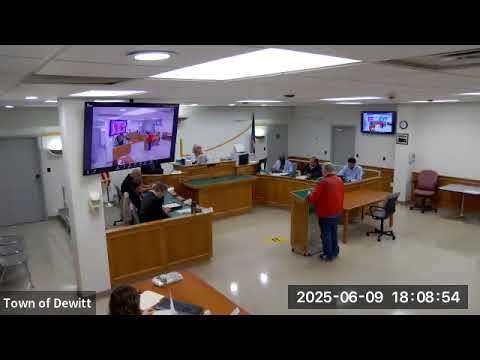
DeWitt adopts six-month moratorium on large battery energy storage while code is drafted
Summary
The DeWitt Town Board on June 9 approved a six-month moratorium on review and permitting of most battery energy storage systems to allow the town to draft local regulations after recent out‑of‑state fires and state guidance; developers and an industry attorney urged permitting conversations continue informally.
The Town of DeWitt on Monday adopted a six-month moratorium that temporarily prohibits the review and approval of most battery energy storage systems while the town drafts local rules to address safety and siting.
The moratorium, approved after a public hearing, repeals a prior local law about smoke shops and establishes a new Article 23 in the DeWitt Town Code to pause formal permitting for battery energy storage systems (BESS) so the town can prepare regulations and apply model guidance.
Why it matters: officials said the pause will let the town use state model language and expert review to reduce the risk of fires and ensure spacing, setbacks and other safeguards are appropriate for DeWitt’s mix of residential and industrial zones.
At the hearing, Alex Riley, director of development for energy storage at Nexamp, asked the board to reconsider a formal moratorium. “Ultimately, for very similar reasons that have been discussed already, we really encourage the town, to not necessarily, respond with a moratorium in this instance,” Riley said, urging the board to allow permitting pathways and special‑use reviews to proceed under existing standards.
Kevin McCullough, an attorney with Barclay Damon representing developers, also urged a different approach and recommended using the NYSERDA model code and the planning board’s application review process to test real proposals. “The best way you're going to explore this is not just in a vacuum, but someone coming in and presenting a particular situation,” McCullough told the board.
Town officials said their intent is not to block conversations with developers. Planning and zoning staff will accept informal presentations and information, the board said, but will not open formal application clocks that trigger statutory review timetables while the moratorium is in effect.
Board members cited three New York BESS fires in 2023–24 and state guidance as the rationale for moving cautiously. The drafted moratorium includes small residential exceptions: standalone residential battery systems with a capacity of 80 kilowatts or less in residential zones are not included in the pause. The town indicated it will start from NYSERDA and state model codes when preparing local rules.
During the hearing the planning department confirmed it had not received any complete applications for BESS; it had received inquiry letters and calls. The board committed to an expedited, targeted rule‑making schedule and said it would solicit input from developers, fire professionals and the planning board while the moratorium is in effect.
The board approved the moratorium by voice vote after the hearing closed; the clerk’s reading of the public notice cited Section 20, subdivision 5 of the Municipal Home Rule Law and section 264 of the New York State Town Law as the legal basis for the hearing.
Looking ahead: the moratorium was adopted to allow the town to craft rules tailored to DeWitt’s zoning and emergency response needs; officials said they hope to use model language and to incorporate planning board input before the temporary ban expires.