Get Full Government Meeting Transcripts, Videos, & Alerts Forever!
Get email alerts on the Neighborhood Planning topic
No spam. Unsubscribe anytime.
Draft Crossroads and Newport neighborhood policies stress trails, parks access and partnerships; Parks Board offers targeted feedback
Summary
City planning staff reviewed draft policies for Crossroads and Newport under the Great Neighborhoods program. Drafts emphasize localized park access, trails and natural‑area protection; staff will revise policies to reflect board comments before a June Planning Commission study session.
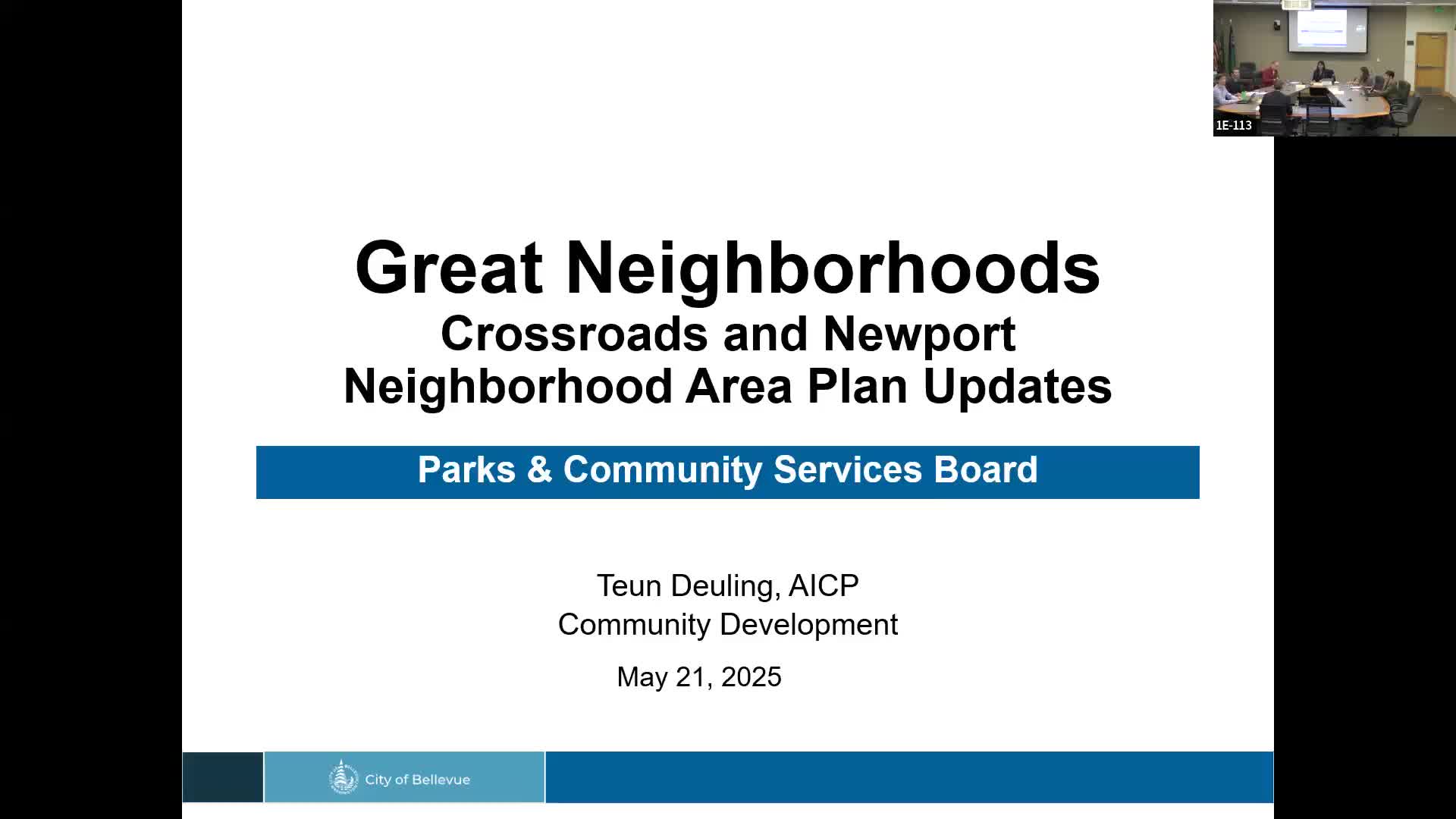
Tom (Ton) Dooling, senior planner in the Community Development Department, briefed the Parks and Community Services Board on draft neighborhood area plan policies for Crossroads and Newport under the city’s Great Neighborhoods program.
Dooling said the program localizes citywide comprehensive plan policies and provides long‑range policy guidance and capital investment direction for individual neighborhood areas. He told the board staff seeks feedback on parks, recreation and open‑space elements before the draft goes to Planning Commission in June.
For Crossroads, draft policies emphasize neighborhood identity, improved access to green spaces, wayfinding and enhanced community gathering places. The draft calls for locating neighborhood‑scale parks in currently underserved areas (particularly the western portion of the Crossroads planning area), strengthening trail and pedestrian connections, and coordinating with Bellevue School District campuses to expand community use where appropriate.
For Newport, the draft similarly prioritizes neighborhood parks to fill identified gaps, a stronger trail network and preserving and enhancing the area’s natural resources (Coal Creek, Mercer Slough and other riparian corridors). Dooling noted two school properties in Newport (the former Jing Mei and Ringdahl school sites) are not currently used as active school campuses; staff will continue to coordinate with the district about future uses.
Board members raised technical and policy clarifications for staff to incorporate. Comments included replacing the word “visibility” with terms such as “awareness,” “wayfinding” or “connections” when referring to creek and natural‑area access (Kelsey Creek was cited); clarifying shelter/pavilion sizes and rental expectations for park gathering spaces; requests to identify whether specific named trails (Eastrail, Coal Creek Trail, pipeline trail) are included in the narrative maps; and the need to account for multilingual wayfinding and signage in Crossroads’ diverse community.
Several board members asked how partnerships with the Bellevue School District function in practice and noted that, while school sites can serve as community gathering places, district staffing and scheduling constraints limit guaranteed access. Staff said such arrangements are collaborative and vary by site; parks staff and Community Development will continue outreach to the district and other external partners.
Board members also recommended calling out cultural and historical interpretation in signage for Newport’s natural areas, expanding references to programming at community centers and commercial gathering places (Crossroads Mall and Bel‑Red), and ensuring pedestrian and bicycle connectivity is emphasized in neighborhood‑scale policies.
Dooling told the board staff will incorporate the input and bring a revised draft to the Planning Commission in June, with the commission scheduling a public hearing and forwarding a recommendation to City Council as part of the comprehensive plan volume 2 update.