
Utilities present Bellevue watershed management plan update and environmental monitoring program showing mixed stream‑health trends
Get AI-powered insights, summaries, and transcripts
Subscribe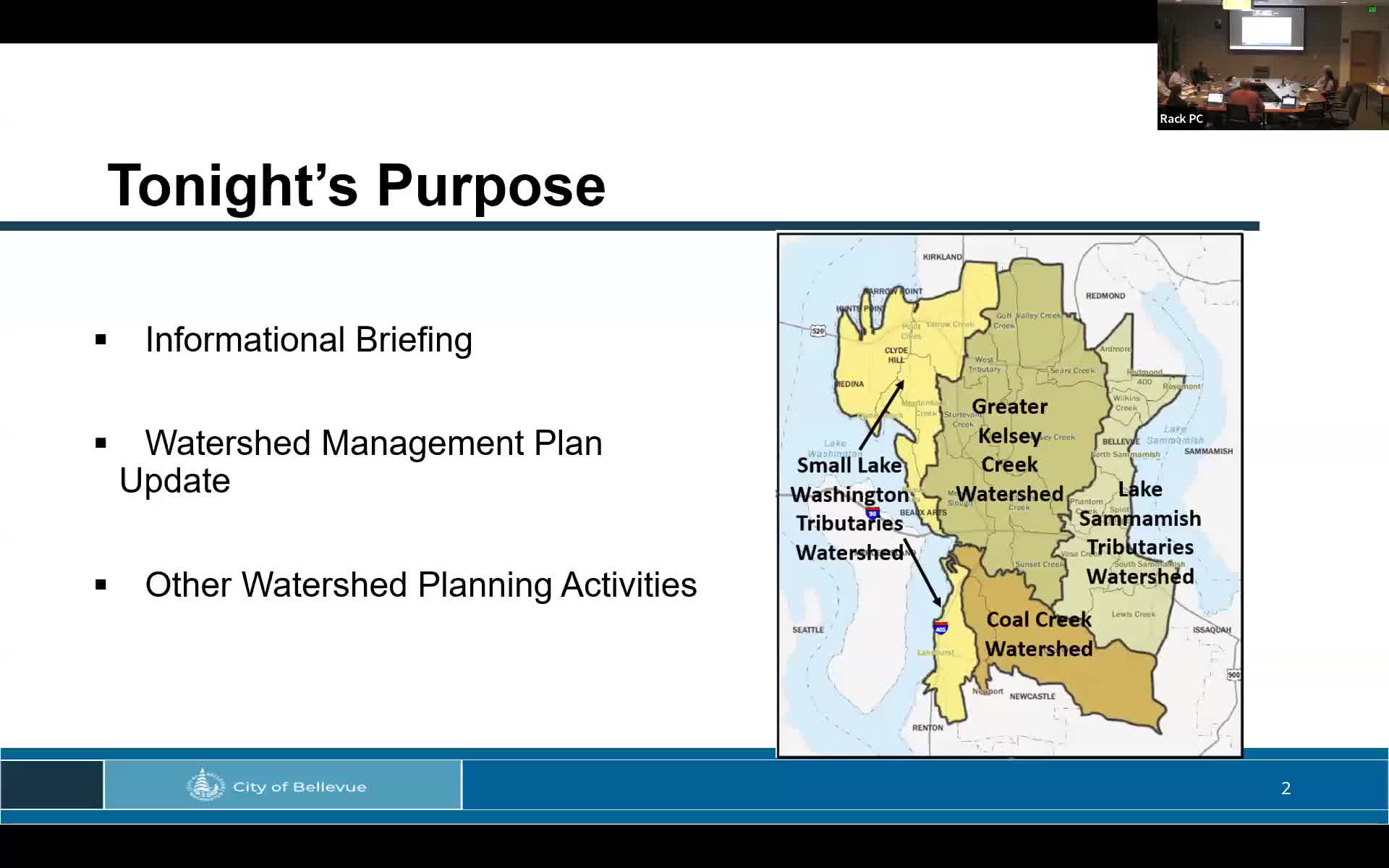
Summary
Utilities planning staff briefed the Environmental Services Commission on the draft watershed management plan, the related storm and surface water system plan and a newly formalized environmental monitoring program; staff reported some long‑term monitoring sites improving while most urban streams still score poor to very poor.
Bellevue utilities staff updated the Environmental Services Commission on progress toward a watershed management plan and on the city’s environmental monitoring work, describing the monitoring framework, recent findings and how the watershed recommendations will feed a larger storm and surface water system plan.
“The goal of the watershed management plan was to improve stream health,” said Brianna Pierce, senior environmental technician and environmental data scientist, summarizing the program that feeds the plan’s recommendations.
Utilities planning manager Bridal LaFrance said the watershed management plan builds on a 2015 storm and surface water system plan and a recent open‑stream condition assessment. Staff have cataloged watershed‑specific improvement strategies and are now integrating those recommendations into the broader storm and surface water system plan because the system plan is the venue where funding, competing infrastructure needs and policies are balanced.
Pierce described the environmental monitoring program, which was formalized in 2022 to provide a structured, multi‑metric approach to assessing stream health across Bellevue. The monitoring uses a tiered framework (hydrology, geomorphology, chemistry and biology) and collects continuous streamflow and temperature records, monthly water‑quality samples, annual benthic macroinvertebrate surveys and periodic fish and habitat surveys.
Pierce said the city monitors roughly 33 benthic macroinvertebrate stations across 18 streams and several hydrology and water‑quality stations in priority watersheds. She explained that benthic macroinvertebrate indices are used as a regional metric of stream condition because the presence or absence of certain species provides long‑term signals of ecological health.
Pierce reported mixed results from historical data: “Even though we have overall some poor scores, if we look at the sites that we've been surveying for long enough to be able to establish some trends, there were 9 of those sites, and 6 of those had no discernible trend,” she said. “Three of those actually did have a significant increasing score,” Pierce said, highlighting an upper Coal Creek site that has moved from “poor” toward “fair/good” conditions over decades of monitoring.
LaFrance and Pierce said the environmental monitoring data have helped shape watershed improvement strategies and will be used for adaptive management and to prioritize investments in capital projects, operations and maintenance. Pierce noted the city partners with King County and others for portions of monitoring and has used a King County waterworks grant to help build a data pipeline to integrate and analyze the monitoring datasets.
LaFrance emphasized the difference between the watershed management plan and the storm and surface water system plan: the watershed plan zeroes in on stream health and environmental recovery, while the system plan must reconcile those environmental priorities with capital‑replacement, regulatory mandates (the city’s MPDES permit was cited) and service‑level choices. The storm and surface water system plan will run through 2026 with an expected finish in early 2027.
Staff also summarized the city’s participation in the National Flood Insurance Program Community Rating System; LaFrance said Bellevue’s floodplain regulations and annual certifications yield a 25% premium discount for roughly 200 properties that purchase flood insurance.
The commission asked a range of technical questions about cause analysis and effectiveness monitoring. Pierce said the monitoring program is primarily designed to gauge stream health and infer causes, but the program can be adapted to do effectiveness monitoring for specific projects if staff budget and design a targeted study around a capital retrofit.
This briefing was informational; no formal commission action was requested or taken. Staff said they will return to the commission in the fall with system‑plan materials and with a public outreach plan that will engage residents about prioritization and funding choices.