Get Full Government Meeting Transcripts, Videos, & Alerts Forever!
Get email alerts on the Housing Homeownership topic
No spam. Unsubscribe anytime.
Committee hears briefing on homeownership assistance; counselors urge steady funding and reporting
Summary
County housing staff, HOC and HUD-certified counseling agencies briefed the Planning, Housing and Parks Committee on down-payment programs and counseling services. Counselors said counseling reduces foreclosure risk and speakers urged sustained funding as programs are quickly expended.
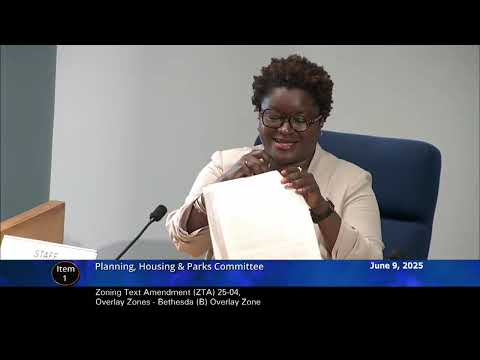
Montgomery County housing staff, the Housing Opportunities Commission (HOC) and HUD-certified counseling agencies briefed the Planning, Housing and Parks Committee on June 9 on the county's homeownership assistance tools, including three down-payment programs and local counseling services. Committee members heard that counseling reduces foreclosure risk and that down-payment funds have been exhausted quickly when available, prompting a committee request for regular spend-down reports.
Summer Cross, chief of housing at the Department of Housing and Community Affairs, led an overview of the home-buying process and the tools available to first-time buyers. "Any conversation about the home buying tools and processes needs to take it step by step," Cross said, summarizing the sequence from HUD-certified homebuyer education and lender preapproval through purchase and post-purchase counseling.
Two HUD-certified housing counseling agencies operate in Montgomery County: Housing Initiative Partnership (HIP) and the Latino Economic Development Center (LEDC). Mary Hunter, director of housing counseling and services at HIP, said the agency provided classroom education and one-on-one counseling in 2024. "We are a HUD approved housing counseling agency," Hunter said, and HIP reported that 132 county residents attended its homebuyer class in calendar year 2024 and 34 received individual mortgage-readiness counseling.
LEDC representatives described bilingual services and a local team dedicated to Montgomery County. Guadalajon, housing programs director at LEDC, said the agency helped homeowners and first-time buyers during the foreclosure crisis after expanding into the county in 2008; LEDC reported 14 households avoided foreclosure and 17 households became homeowners in fiscal 2024 with LEDC assistance.
Speakers reviewed three county-funded down-payment assistance (DPA) programs: the state-administered Maryland Homeownership Program (MHP, administered by the Maryland Department of Housing and Community Development); the Montgomery County Homeownership Assistance Fund (MacAF, administered by HOC); and MedPal, a Montgomery County employee down-payment loan administered through the state program but reserved for county and specified public employees. All three programs fund down payment and closing costs and are capped at $25,000 per household under current terms; MHP and MacAF also include an eligibility cap tied to household income (program materials cited limits expressed as a percentage of area median income), while MedPal is limited to eligible county employees and requires a 1% buyer contribution.
DHCA presented program data showing that most DPA recipients in recent years are earning under 70% of area median income, that the typical recipient is aged 30 to 40 and that most purchases are condos or townhomes with average sale prices in the $300,000'$400,000 range (well below Montgomery County's countywide median purchase price). Speakers said most borrowers have taken the full $25,000 available.
HOC officials said MacAF funding is typically exhausted within five to six months after new fiscal-year allocations; HOC officials and counseling providers told the committee the programs successfully help lower-income buyers but can be undersized for the county's need. Mike Somerville, HOC vice president for mortgage finance, noted HOC historically issues dozens of loans annually through its mortgage purchase program and that MacAF is highly utilized.
Maryland Department of Housing and Community Development director for the Maryland Mortgage Program, Maddie Silu, said the state program offers a range of mortgage and DPA products statewide and partners with local initiatives; she described SmartBuy, a statewide program that pairs mortgage products with student-loan assistance for eligible buyers.
Counseling agencies emphasized foreclosure prevention work and outcomes. Hunter cited state foreclosure data showing notices of intent increased between 2022 and 2025 (for example, notices of intent in May rose from roughly 331 in 2022 to about 538 in 2025 in a monthly snapshot presented), while actual foreclosures registered remained small in the snapshot (about five in both May 2022 and May 2025). Counseling agencies cited HUD and Urban Institute research showing counseling improves mortgage performance and increases the likelihood of loan modifications for borrowers in default.
Committee members pressed for clearer performance reporting and considered how to target funds to larger families and households that need higher assistance. Counselors suggested models used elsewhere (for example, tiered DPA by household income or scaled awards for lower-AMI households). Several presenters recommended prioritizing reaching more households with the current $25,000 cap rather than increasing the per-household maximum, arguing broader reach produces more new homeowners.
Committee members asked the Department of Housing and Community Affairs to provide quarterly spend-down updates for the DPA programs. Councilmember Bridal and staff agreed to schedule two near-term reports: one showing spend-down as of Oct. 31 and a follow-up as of Jan. 31, timed to inform budget discussions.
Why it matters: counseling agencies and program administrators described a fast-moving market where down-payment funds are quickly exhausted and where HUD-certified counseling significantly reduces foreclosure risk. Committee members said regular reporting and consideration of program design changes will help the county target limited funds to households most likely to sustain homeownership.
The committee did not change eligibility rules during the briefing; it requested additional data and quarterly spend-down reporting to inform potential future policy or budget changes.