Get Full Government Meeting Transcripts, Videos, & Alerts Forever!
Get email alerts on the Zoning Bethesda Overlay topic
No spam. Unsubscribe anytime.
Committee backs changes to Bethesda overlay ZTA, forwards amended ZTA 25-04 to full council
Summary
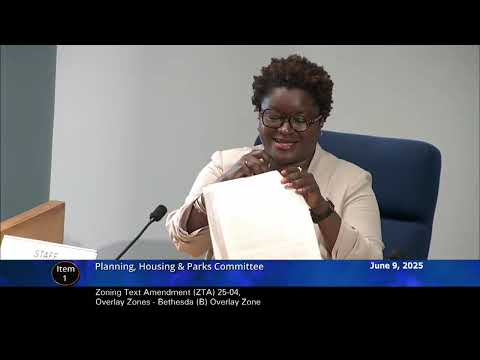
At its June 9 work session the Planning, Housing and Parks Committee agreed to staff-recommended amendments to Zoning Text Amendment (ZTA) 25-04 for the Bethesda overlay zone and voted to forward the amended ZTA to the full County Council.
The Planning, Housing and Parks Committee on June 9 agreed to a package of amendments to Zoning Text Amendment 25-04 (Bethesda overlay zone) and will forward the amended ZTA to the full County Council for consideration. Committee members said the changes implement decisions made during the Bethesda Master Plan process and aim to remove outdated provisions while preserving public benefits and review safeguards.
The ZTA revisions endorsed by the committee include allowing existing Moderately Priced Dwelling Unit (MPDU) incentives to apply to family-sized units (typically three or more bedrooms) and to deeply affordable units; changing the rules for purchasing additional residential density so applicants can use either the commercial or the residential allotment rather than being required to consume both; and removing the “use-or-lose” permit-deadline provision tied to a density cap that the county has eliminated.
The committee also approved replacing a revised height-incentive map with the prior map after committee members said the planning board altered the map late in the process without sufficient opportunity for stakeholder input. That amendment removes language that would have expanded the height-incentive area a few blocks east of Arlington Road.
Council staff explained changes to public-benefit and energy-efficiency standards contained in the ZTA: instead of requiring a fixed number of public-benefit points for additional density, the amendment requires projects to exceed the applicable building or energy codes, allowing the county to update codes without repeatedly amending the overlay language.
The ZTA adds the Bethesda Urban Partnership and the Bethesda Arts & Entertainment District as recipients eligible to accept payments that satisfy public art obligations under the overlay. It also includes incentives intended to encourage a new recreation center in the overlay: the Planning Board may reduce public-open-space requirements if a developer provides land or space for a recreation center, and may permit up to 24 additional feet of height in exchange for provision of a new center.
Committee members and council staff clarified technical edits. Council staff proposed a definition for a “stand-alone” privately owned public space (POPS) and amended the park-impact payment (PIP) language to allow that payment to be split into stages (for example at building permit and at use-and-occupancy), with payment required “no later than issuance of” the listed permit so Department of Permitting Services can continue current inspection scheduling practices.
Council staff also presented a proposal responding to written testimony from Washington Property Company and developers of two affected projects, Avondale and Hampton East. Because ZTA 25-04 removes the prior cap and the associated use-or-lose deadlines, staff recommended a case-by-case reinstatement process for site plans that lapsed before the ZTA’s effective date rather than an automatic, 12-month retroactive reinstatement. Council staff read proposed language giving the planning director authority to approve a request to remove the condition that caused a site plan to be revoked if the applicant shows the failure to obtain a building permit was due to “practical difficulty or undue hardship” and the preliminary plan remains valid. Council staff said the approach is intended to avoid reopening full site-plan approvals while allowing limited relief when adequate public facilities remain in place.
"The planning director may approve a request for an amendment to remove a condition that resulted in the site plan being revoked due to failure to file an accepted building permit or obtain a building permit within 2 years if the preliminary plan is valid," council staff read during the discussion.
Planning staff indicated agreement with the director-level approval approach while noting staff can refer cases to the Planning Board if circumstances warrant. Elsá Heissel McCoy, chief of Downcounty Planning, described the change as bringing Bethesda into parity with other central business districts like Downtown Silver Spring and Wheaton, which do not have the same use-or-lose trigger that previously applied in Bethesda.
Committee chair Bridal closed debate after members agreed the package reflected prior committee work and recent technical refinements. "So without objection, we'll accept that change," the chair said, and the committee voted to forward the amended ZTA to the full council.
Why it matters: the ZTA implements revisions tied to the Bethesda Master Plan and removes a dated cap-and-deadline regime that committee members said could lock up developable land. The document balances new development flexibility with continuing public-benefit requirements and a director-level path to reinstate certain expired plans when public facilities remain adequate. The committee's action moves the amendment to the full County Council for final action.
The committee did not take separate formal votes on individual amendments beyond endorsing staff recommendations and forwarding the package; the matter next goes to the full council.