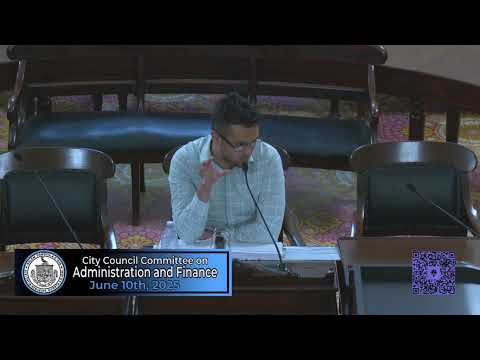
Committee recommends FY26 operating budgets as Salem enters mandatory property revaluation year
Loading...
Summary
The Salem City Administration and Finance Committee recommended approval of Fiscal Year 2026 department budgets on June 10, 2025, including an assessing budget increase tied to a state-mandated revaluation, health-department spending and opioid-settlement planning, and several enterprise assessments and debt schedules.
The Salem City Administration and Finance Committee, meeting as a committee of the whole, recommended approval of Fiscal Year 2026 operating budgets for multiple departments on June 10, 2025, advancing line-item votes on the assessor, health department, collector, purchasing, treasurer, finance and enterprise funds.
The committee’s actions carry immediate effect for budget review and signal the city’s preparations for a state-mandated property revaluation next year and continuing work on use of federal and settlement funds. Committee Chair Merkel said the meeting was posted June 4 and opened the hearing on the city’s proposed FY26 operating budget, with department presentations and subsequent recommendation votes.
The most substantive policy item during the hearing was the assessing department’s presentation about a scheduled state-mandated revaluation year. Steven Cortez, director of assessing, said the department "follows an annual cycle, with property inspections as a key routine task per Mass General Law requirements" and explained that Salem will enter a full revaluation in FY26 required by the Department of Revenue and the Board of Local Assessors. Cortez told the committee that the revaluation involves comprehensive market-data analysis, field inspections and state oversight and noted that contract services requests in his office rose largely to support that work.
Cortez said the city’s assessing software vendor, previously Patriot Properties now called Catalyst, "will be required to produce more in-depth reports, summaries, and be available to respond to the BLA representative inquiries while the assessing staff is out on the field." He described a $39,099 increase in the contract services line driven primarily by the revaluation; he also cited a prior revaluation assistance cost of $52,500 for reference. After discussion about exemptions and how residential taxpayers learn about abatement and work-off programs, Councilor Davis moved to recommend approval of the assessor’s FY26 budget totaling $516,006; the motion was seconded by Councilor Harvey and recorded as carrying (committee members present indicated support by raising hands).
The health department presentation included staffing and grant details and questions about opioid-settlement funds. Health Agent Dave Greenbaum described the department’s divisions and said a regional public-health-excellence grant funds about a dozen staff who serve eight North Shore communities. Greenbaum said the department has not requested major new funding beyond contract increases and cost-of-living adjustments, but he confirmed an increase to the MACPAC contract of $1,000. On opioid-settlement funds, Greenbaum said the city worked with MAPC to solicit public input and that the department "intend[s] to report out to the community, probably at a board of health meeting, in either probably in the fall, probably September, about what those recommendations were and how best we can use those funds." He added that some settlement dollars were used for Narcan boxes placed downtown at the discretion of the police department and that a planned hire funded by settlement proceeds had not yet been made. The committee recommended the health department budget (personnel $653,614; expenditures $127,139; department total $780,753) on a motion from Councilor Davis, seconded by Councilor Harvey.
Departmental budget presentations for the collector, purchasing and treasurer’s offices emphasized operational continuity and the effects of recent union settlements. Anna Friedman, finance director covering for the absent collector, said upgrades to the city’s centralized software (Unis) and rollout of a new residential-parking passport platform required staff flexibility; the collector’s FY26 total recommended by the committee was $306,897. Anthony Delaney, chief procurement officer, summarized purchasing duties and noted the nonunion compensation adjustments reflected in the personnel line; the committee recommended the purchasing general-administration budget as presented. Kristen Lindberg, city treasurer, described payroll and contract-related workload stemming from a busy year of contract settlements and presented the treasurer’s general-administration budget, which the committee recommended.
Finance-office highlights included the city’s completion of US Treasury ARPA obligation requirements, ongoing development of a personnel-accounting integration to move payroll-based budgeting into the city’s Munis system, and a required full actuarial valuation of the city’s OPEB liability in FY26. Finance Director Anna Friedman said the OPEB full valuation occurs on a multiyear schedule and is the main driver of a contracted-services increase for FY26. Friedman also told the committee that staff are separating city and school-related long-term debt in the budget documents for greater transparency and that work on analysis and financing options for the high-school building project will be a near-term priority. The finance department budget was recommended by the committee.
Several cross-cutting fiscal items and enterprise budgets were also advanced. The committee recommended long-term debt service totaling $8,513,363 and short-term debt service of $184,020 for the general fund. The Cherry Sheet state-assessment line was presented at $11,630,030. The contributory retirement line was shown at $16,600,787; the noncontributory pension line remained $10,625. Medicare and municipal-insurance lines were advanced at the amounts presented. For enterprise funds, the Sewer Enterprise’s regional treatment assessment was reported as Salem’s share of just over $5,010,255; sewer long-term debt and short-term notes were advanced per the schedule, and a $10,000 enterprise insurance-deductible line was recommended. Water enterprise votes included long-term debt of $2,034,759, short-term debt of $79,415, the Salem Beverly Water Supply Board assessment of $3,157,597 and a $5,000 insurance-deductible line.
Councilors asked clarifying questions throughout—on exemptions and solar valuation effects for property tax filings, on the timing and use of opioid-settlement dollars, on how registry nonrenewal surcharges are passed through to the state, and on why some debt lines were reallocated between city and school columns. Staff generally answered those clarifying questions in the meeting; for example, the treasurer’s office explained that RMV nonrenewal surcharge fees collected from taxpayers are passed through to the state rather than retained by the city.
Motions to recommend approval of each departmental or expenditure line were made primarily by Councilor Davis and seconded by Councilor Harvey; committee members present indicated approval by raising hands and the chair recorded each motion as carried. The meeting record shows routine, unanimous committee recommendations at the committee-of-the-whole level and concluded with a motion to adjourn that the committee approved.