Get Full Government Meeting Transcripts, Videos, & Alerts Forever!
Get email alerts on the Sustainability Budget topic
No spam. Unsubscribe anytime.
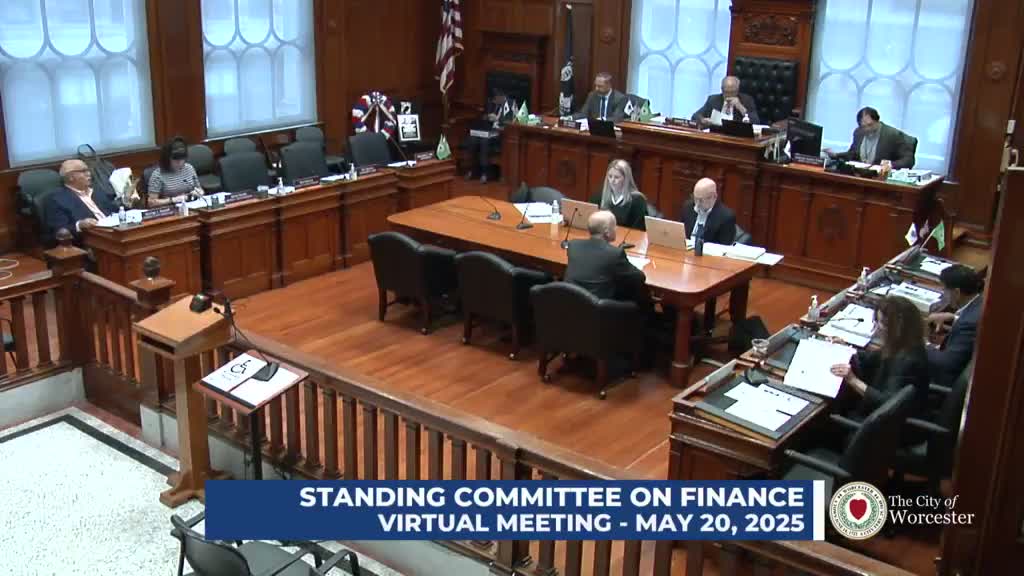
Council reviews sustainability budget focusing on public bins, solar revenue and watershed work
Summary
City officials described a $621,000 sustainability appropriation and answered questions about a new public bin program (150 paired receptacles with $300,000 acquisition cost and about $330,000 in FY26 operations), regular solar renewable energy credit revenues and watershed/blue-space initiatives.
Worcester City Council members on the budget hearing panel were briefed on the city’s sustainability and resilience request, a recommended $621,000 tax-levy appropriation that officials said represents about a 6% increase from the prior year.
Chief Sustainability Officer John O’Dell and budget staff described several new and continuing programs within that line: a pilot public bin program, continued development of the city’s solar portfolio and a multi-pronged lakes-and-ponds (“blue space”) effort paired with community volunteer programs.
The most immediate item drawing council attention was the public bin program. Councilor Russell asked for the costs and operational plan for the 150 paired receptacles planned for installation. “The bins are being acquired in this fiscal year,” O’Dell said. “The funding for the acquisition is in sustainability. However, the operation of the bins will be through DPW’s budget.” O’Dell said the city budgeted about $300,000 to acquire the new units and included roughly $330,000 in the FY26 budget to cover servicing, with Casella contracted to manage pickup.
City finance staff gave a unit-level estimate: about $2,000 per unit for purchase and placement. O’Dell said the bins will be placed in clusters where studies show they are most likely to be used: “if bins are more than roughly 50 paces, so about 120 to 150 feet away from you, people will not use it,” he said, adding that clustering also aids collection operations.
Councilors pressed on procurement and siting. Wardell said the city obtained vendor quotes rather than a formal bid because the purchase did not fall under the city’s formal 30B trash-and-recycling procurement threshold; staff chose a quote that met the city’s specifications. O’Dell said staff will evaluate the pilot through FY26 and consider moving, adding or purchasing additional units if operating costs can be reduced.
Separately, Budget Director Timothy McGurthy summarized the city’s solar renewable energy credit program as a steady revenue source. “In ’22, we made about $1,600,000. In ’23, we made about $2.1 million. In ’24, we’re about $1.7 million. This year, we’re looking at about $1.5 million,” McGurthy said. He said the line-item is tied to the city’s entire solar array (not a single site), including the landfill installation, and that the city sells credits generated by its solar production.
O’Dell also outlined the watershed and “blue space” work. He said the city is completing a watershed‑based plan integrating the three main watersheds that feed Worcester’s lakes and ponds, with the goals of reducing pollutants, limiting recreational closures and lowering treatment costs. The lakes-and-ponds volunteer program has expanded, O’Dell said: volunteers are servicing 20 in-city water bodies and six outside — 26 in total — and recent public meetings drew higher attendance than expected. He said the program has helped revive neighborhood watershed associations.
Councilor Ijida and others asked about outreach and energy-efficiency services. O’Dell described the city’s energy-advocate program — a grant-funded position set to continue under a new three-year grant — and credited advocates with helping residents reduce utility bills and access audits.
The council voted, by roll call on the sustainability pages of the budget, to approve the department’s recommended appropriation as part of the broader budget packet.
Looking ahead, O’Dell said staff will assess the pilot bins and operating contract in the later part of FY26, and that future purchases or relocations would follow that evaluation.