Get Full Government Meeting Transcripts, Videos, & Alerts Forever!
Get email alerts on the Housing Economic Development topic
No spam. Unsubscribe anytime.
Economic development staff describe ARPA‑funded pilot to preserve naturally occurring affordable housing and plan zoning rewrite
Summary
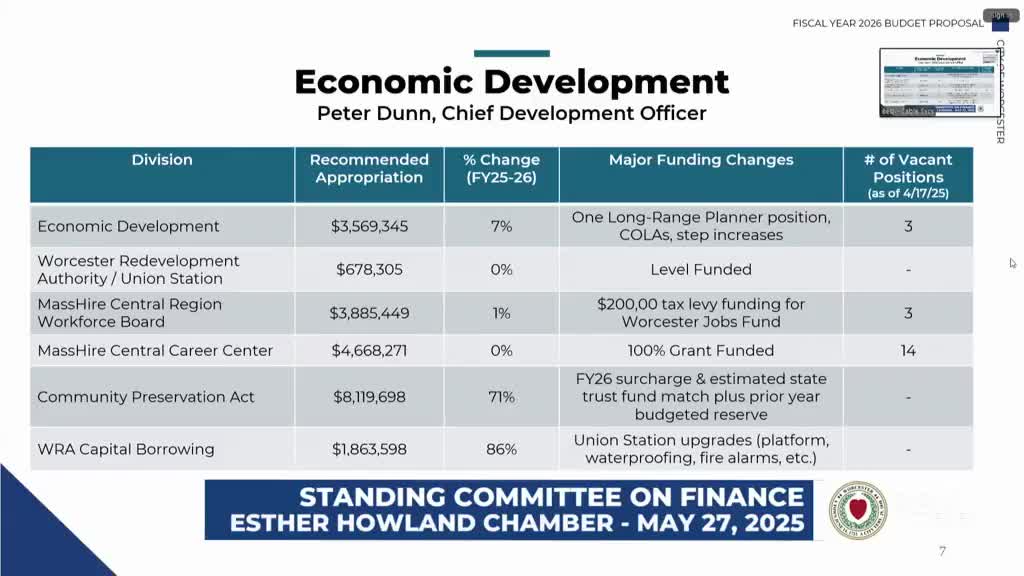
Economic Development reported a small‑scale ARPA pilot to preserve NOAH with deed‑restriction payments to landlords, and said the department will add a long‑range planner to begin implementation and prepare a zoning‑rewrite request for proposals.
WORCESTER, Mass. — Economic Development Director John Dunn told the finance committee on Tuesday that the city used roughly $1 million in ARPA funds for a pilot designed to preserve naturally occurring affordable housing (NOAH) by offering payments to landlords who agreed to deed restrictions limiting rents for a set number of years.
Dunn said the city expended a modest portion of the pilot — “somewhere between $100,000 and $200,000” — and that per‑unit incentives ranged roughly from $10,000 to $20,000 depending on the number of units enrolled and the duration of the restriction; the city tested 15‑ and 10‑year terms and ultimately reallocated some funds to rental assistance to meet ARPA deadline constraints.
On zoning, Dunn described an intent to add one long‑range planner position in the planning team (shifted from another department) to help implement NowNext recommendations, manage accessory‑dwelling‑unit (ADU) changes, MBTA communities compliance, and to prepare a request for proposals for a full zoning rewrite expected to be issued in the fall. Dunn emphasized that a complete rewrite requires outside consulting assistance in addition to in‑house staff time.
Committee members asked about tracking ownership changes, LLC ownership and flips of multifamily properties. Dunn said the rental registry provides owner contact information and can help city staff and councilors identify ownership trends; he said further analysis of deeds, corporate filings and tax records could be done but would be resource‑intensive and would need a defined policy purpose to justify the work.
Why it matters: The ARPA NOAH pilot and the planned zoning work address housing affordability and long‑standing planning goals. The rental registry is an operational tool the city can use to monitor ownership and housing transformations if resources are allocated to do so.
What’s next: The finance committee advanced the economic development budget; staff will proceed with hiring the long‑range planner if approved and prepare a zoning rewrite RFP for the fall.