Get Full Government Meeting Transcripts, Videos, & Alerts Forever!
Get email alerts on the Cpa Budget Appropriation topic
No spam. Unsubscribe anytime.
Worcester CPC approves FY2026 Community Preservation budget recommendation to City Council
Summary
The Community Preservation Committee approved a recommended FY2026 appropriation — reflecting projected CPA revenue of about $5.17 million and roughly $8.1 million available including reserves — and will forward the recommendation to the City Council for final approval.
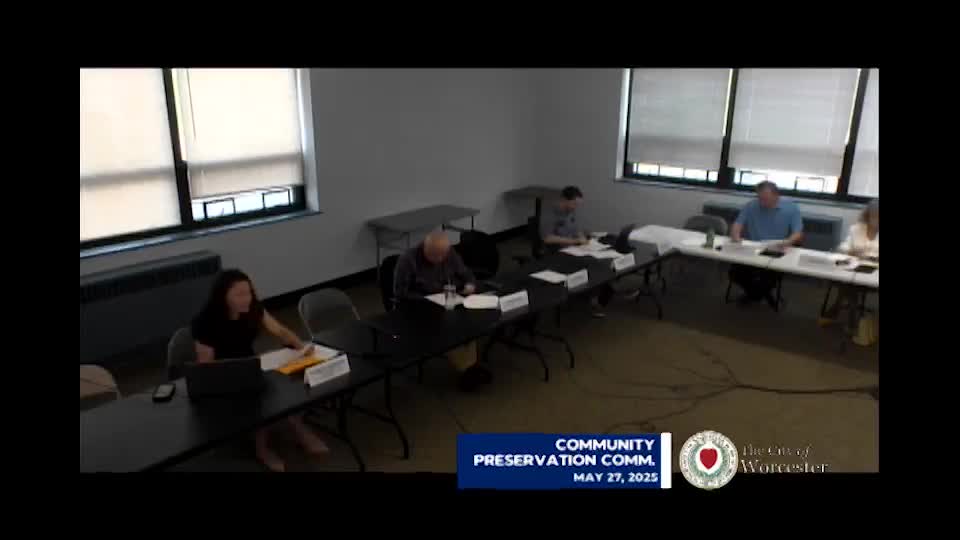
The Community Preservation Committee voted May 27 to approve a recommended fiscal year 2026 Community Preservation Act (CPA) budget appropriation and send the recommendation to the City Council for approval.
The committee’s recommendation is based on projected CPA revenue of "about $5,173,626," and a combined available allocation of "about $8,100,000," according to city staff.
The recommendation matters because CPA statute requires minimum set-asides for certain categories and because the amount the committee recommends becomes the pool the City Council will review and may reduce, approve or reject. "This budget identifies each of the category reserve accounts to receive 10% of this revenue," a city staff member told the committee, referring to the statutory minimum reserve allocations for historic resources, open space and recreation, and community housing.
Committee members discussed holding back some funds from immediate allocation to preserve capacity for large projects or purchases that might arise during the year. Chair William Eddy urged the committee to weigh project stability and viability when deciding how much to commit now versus reserve for later rounds. City staff reiterated that bonding against anticipated future CPA revenues is permitted under the Community Preservation Act, allowing larger projects to be financed over multiple fiscal years. "The legislation allows for bonding," a city staff member said.
The committee’s approval authorizes staff to forward the recommended appropriation to the City Council, which has three options under the process explained at the meeting: approve, lower funding amounts for individual projects, or reject recommendations on a project-by-project basis. Committee members noted the recommendation does not obligate spending all of the projected revenue in FY2026; the committee retains discretion over which projects to fund when applications are scored and selected.
The committee approved the FY2026 appropriation recommendation by voice vote and moved on to the next agenda item.
Next steps: staff will transmit the recommendation to the City Council as the committee directed. The council will take the final vote under its established procedures.