Get Full Government Meeting Transcripts, Videos, & Alerts Forever!
Get email alerts on the Finance Operations topic
No spam. Unsubscribe anytime.
City auditor says Workday ERP transition strained office capacity; proposes more audit work after implementation
Summary
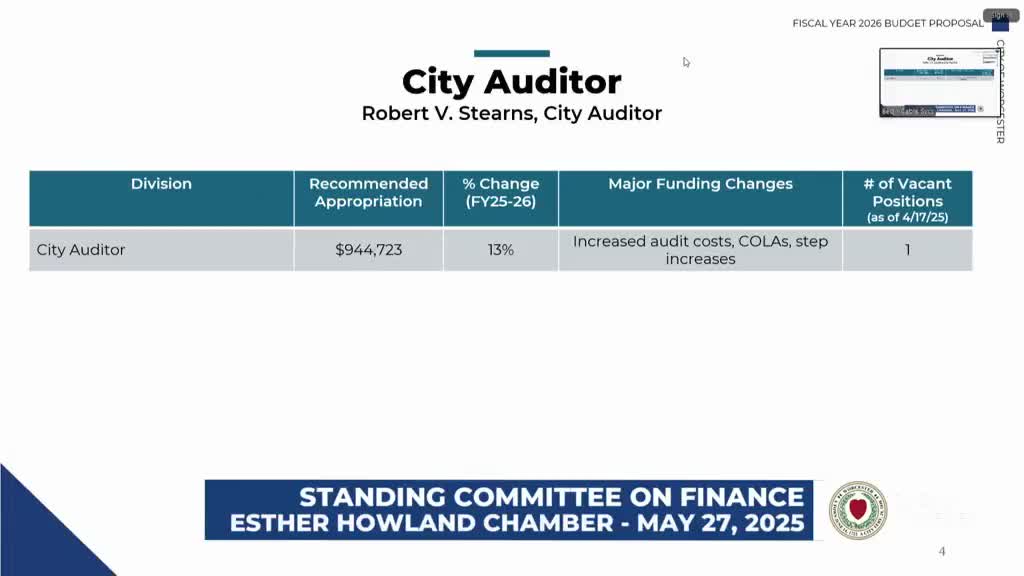
City Auditor Bob Stearns told the finance committee Workday implementation consumed much of his office’s time and constrained special audits; he said the auditor’s office plans more operational audits once ERP phases complete and noted $200,000 aggregate contracted audit costs for multiple engagements.
WORCESTER, Mass. — City Auditor Bob Stearns told the finance committee on Tuesday that adoption of the new Workday enterprise resource planning (ERP) system has consumed a large share of his office’s capacity and limited the department’s ability to complete special audits during implementation.
Stearns said his office has been heavily involved in the Workday rollout, which he described as a multi‑year implementation covering financials, payroll (HCM), HR and benefits across the city and schools. He said “the work needed to implement the ERP system … takes up about 50% of the work week” and at times much more during go‑live phases.
Stearns told the committee that outsourcing has been used where necessary: the city’s outsourced financial statement audit and related engagements amount to roughly $200,000 in aggregate, with the city audit itself about $85,000 on the city side and additional allocations to enterprise funds and pension audits. He said contracted work for a body‑camera scope and overtime follow‑up work from a prior audit were each in the “about $45,000” range.
Officials explained the relationship among Workday (the subscription product), consultant Accenture (implementation partner) and the city. One presenter said Workday provides the product while Accenture builds configurations and the city auditor’s office plays a critical role explaining existing city workflows so the new system produces correct payroll, vendor and grant accounting.
Stearns and the city manager told the panel the auditor’s office plans to resume more operational audits “in a couple of years” once the major financial and HR modules are fully implemented and staff time is freed by a newly hired deputy auditor.
Why it matters: The auditor’s office is the statutory pre‑audit function for payments and payroll; reduced capacity for special projects during the ERP transition means some operational audits were delayed and the city used external firms for targeted follow‑ups. The city is bearing a multi‑million dollar Workday subscription and consultant costs while seeking to realize improved reporting and grant closeout oversight over time.
What’s next: Officials said the city will continue Workday implementation across HR/HCM and budget modules, publish improved grant‑reporting outputs, and expect the auditor’s office to ramp up special audits as the ERP implementation stabilizes.