Get Full Government Meeting Transcripts, Videos, & Alerts Forever!
Get email alerts on the Homelessness Evictions topic
No spam. Unsubscribe anytime.
Worcester committee hears data showing 1,200 eviction filings, near-total lack of tenant counsel; providers warn shelter limits could worsen crisis
Summary
City committee reviewed eviction and homelessness data from Central Mass. Housing Alliance and providers, heard pleas from a resident and shelter operators, and discussed access-to-counsel limits, rental data gaps and a proposed biannual snapshot of eviction-related data.
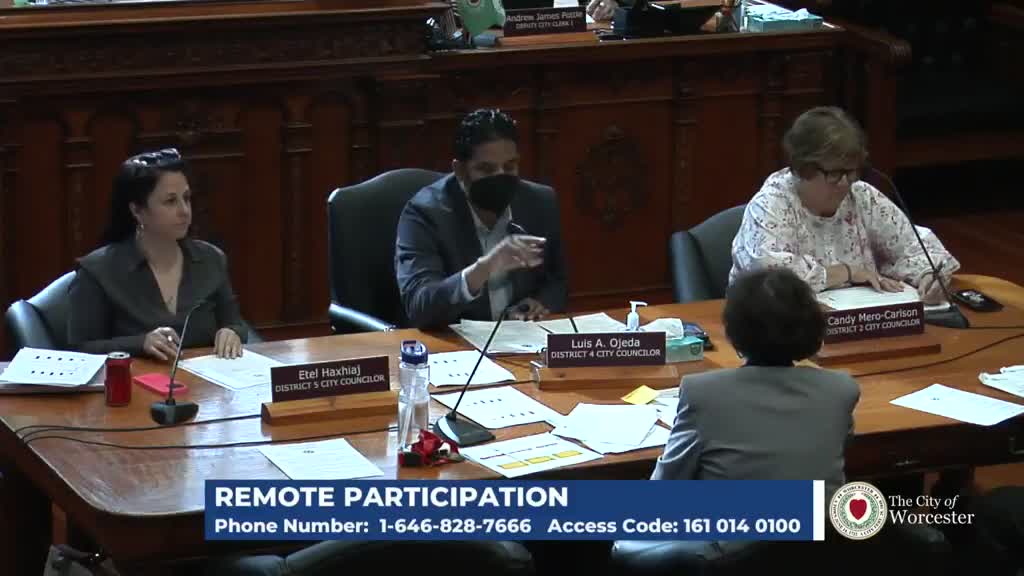
A City of Worcester committee on public health and human services heard data Tuesday showing more than 1,200 eviction cases filed in the last 12 months for Worcester addresses and that nearly all defendants in those cases appear in court without legal representation.
The committee’s update, delivered by Jack Moran of the Central Massachusetts Housing Alliance, also said the typical rental listed in the market is roughly $2,200 a month, countywide there are about 120,000 rental units with nearly 60,000 renters considered cost-burdened (paying more than 30 percent of income for rent), and the local homelessness system reported 142 people using the triage center and 120 unsheltered individuals the prior night.
Those figures come amid other indicators Moran presented: the average episode length for people using emergency shelter reached about 212 days this year and the rate of exits to permanent housing was about 24 percent for the year, the committee heard.
The numbers, committee members and providers said, help explain sharply rising demand for legal assistance and shelter resources.
"The tenant, does not in 95% of non payment cases," said Blair Komar Bates, senior supervising attorney for the housing unit at Community Legal Aid, describing the imbalance in housing court when landlords are typically represented and tenants are not. "The cases we represent frequently we're able to preserve tenancies and even if we're not, we're able to get the tenant enough time or financial resources to transition more smoothly to a different housing situation."
Providers described operational limits as the city and state shift shelter rules. Tim McMahon of Catholic Charities said his agency runs a 15-bed family facility and that a potential reduction of the typical family shelter time limit from six months to three months would be "very concerning," noting limits on capital funding and potential cuts to other programs that Catholic Charities administers.
The committee also heard a public comment from a resident who identified themself as a formerly homeless person and who described conditions at a Worcester building on Irving Street where they live: "I've watched 13 people die," the resident said, and described widespread health and housing instability among building occupants.
Committee members pressed staff and partners for better data to target interventions. Councilors asked whether the city can obtain eviction filing data from the state housing court and discussed pursuing a biannual snapshot of eviction-related data compiled from local partners pending state information. Moran noted that during the pandemic the city received more regular housing-court data and that a similar arrangement would be helpful now.
Community Legal Aid and other providers discussed a state-funded access-to-counsel pilot program the legislature approved, but said the pilot’s six-month grant period limits the ability to hire and train attorneys for sustained eviction defense. "It is challenging the grant because it is only 6 months," Komar Bates said, adding that a short-term grant constrains expansion of representation.
Committee action: members voted to file agenda items related to homelessness (items 3B and 3C) and the zoning-related prevention discussion (item 4B) and to hold items requesting direct meetings with shelter and legal providers (items 4A and 4C) for later discussion. Councilors recorded their support on the record.
The committee asked staff to work with CMHA, Community Legal Aid, Central West Justice Center, Catholic Charities and state partners to produce a biannual summary of eviction and shelter-related indicators from local data sources while seeking housing-court data from the state.
The meeting closed with the committee recommending filing the specified information items and holding the two discussion requests for future sessions.