Get Full Government Meeting Transcripts, Videos, & Alerts Forever!
Get email alerts on the Utilities Underground Hdd topic
No spam. Unsubscribe anytime.
Utility contractor wins approval for underground conduit; commission adds conditions on HDD contingency plan
Summary
Massachusetts Electric Company’s contractor described a horizontal directional drilling (HDD) project to replace underground conduit at Twin Oaks Condominiums; the commission approved the notice of intent with conditions including a spill-prevention requirement and a contractor contingency plan before pre-construction.
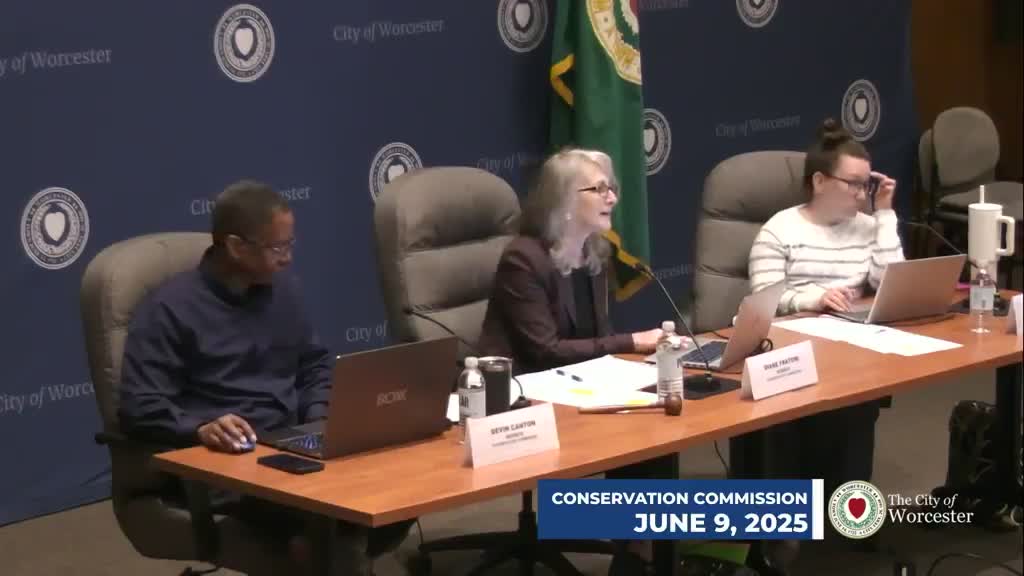
The Worcester Conservation Commission on June 9 approved an application from the Massachusetts Electric Company to replace underground electrical conduit at Twin Oaks Condominiums, 1195 Grafton Street, with conditions requiring a contractor HDD contingency plan and spill-prevention measures.
Sam Kefferstan of BSC Group, representing Massachusetts Electric Company, told the commission the work includes replacing conduit and installing three manholes and several pad-mounted transformers, and using horizontal directional drilling (HDD) in two locations beneath a perennial on-site stream. Kefferstan described the HDD method and said the drill alignment will be about "five feet below grade" beneath the stream to avoid disturbance of the channel.
City staff reviewed the filing and told the commission that the project is small, will not increase impervious surface, and provided an erosion-control plan. Staff recommended conditions including a spill-prevention plan and that the contractor prepare a site-specific HDD contingency plan to be submitted before the pre-construction conference. Staff also noted the project was filed as a limited project under 310 CMR 10.53(d) for utility work, which provides some flexibility on certain performance standards but does not remove requirements to avoid wetland impacts.
Commissioners asked technical questions about HDD risks, dewatering, groundwater depth and the fate of abandoned conduit. Kefferstan described the HDD process to the commission: crews drill from an entry to exit pit, enlarge the bore to the required diameter and then pull the conduit through; bentonite slurry is used during drilling and an "inadvertent return" would appear as slurry at the surface, he said. Kefferstan said contingency measures and BMPs would be available to respond if drilling fluid reached the surface.
The commission voted to issue orders of conditions with staff-recommended special conditions including: pre-construction submission of a contractor HDD contingency plan to the commission office, a condition for spill prevention and ongoing wetland permit conditions. The motion to issue the orders carried on unanimous aye votes from Commissioners Canton, Kirschner, Nystrom and Chair Diane Fattoni.
Why it matters: the work replaces aging utility infrastructure that serves the condominium complex; HDD reduces direct stream excavation risk but requires strict onsite measures to manage drilling fluid and potential inadvertent releases.