Get Full Government Meeting Transcripts, Videos, & Alerts Forever!
Get email alerts on the Planning Policy topic
No spam. Unsubscribe anytime.
Planning commission advances land use plan update under SB 382; narrows focus on preferred housing strategies
Summary
City staff updated the Planning Commission on the Kalispell land use plan rewrite to comply with Montana Senate Bill 382 and sought direction on required housing strategies; commissioners expressed broad support for ADUs and higher‑density near transit while flagging concerns about lot‑size reductions and potential unintended consequences.
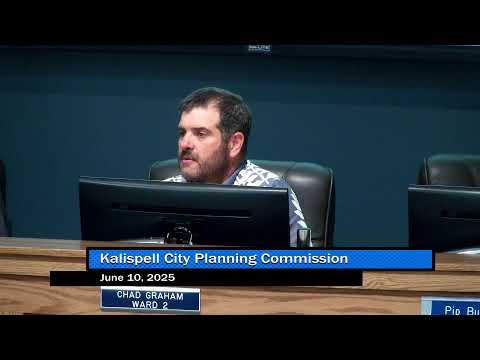
City planners told the Kalispell City Planning Commission on June 10 that the city is updating its land use plan to comply with Montana Senate Bill 382 (SB 382) and the Montana Land Use Planning Act. Staff described progress on public outreach and the housing element and asked the commission for guidance on the required housing strategies the city must select under state law.
Planner staff said the update replaces the City’s Growth Policy Plan 2035 and that public engagement has included workshops, drop‑ins and online tools through EngageKalispell.com. Staff reported the housing element is in draft form and that community input prioritized walkable neighborhoods, affordable housing, preserved open space, traffic management and downtown revitalization.
SB 382 requires that local plans address several core elements including housing and land use; as part of the process the state requires communities to select at least five housing strategies from a prescribed list. Staff presented a “preferred” set and a “non‑preferred” set based on public input and internal review. Preferred strategies the commission discussed included allowing duplexes and ADUs where single‑family homes are allowed, permitting higher density near transit, reducing parking requirements for new development, allowing single‑room occupancy housing, and reducing minimum lot sizes by up to 25% in select contexts. Non‑preferred strategies included broad reductions to setbacks, wholesale removal of design standards for apartments and allowing unlimited multifamily density everywhere.
Commissioners debated details and tradeoffs. Several members favored allowing two units on a lot (ADU or duplex) and making apartments permitted uses in office and commercial zones, while expressing caution about lowering minimum lot sizes in older single‑family neighborhoods. The commission and staff discussed Appendix Q of the building code (tiny house standards); staff noted the city already allows homes down to 400 square feet under current building code but would need to adopt Appendix Q to explicitly authorize smaller factory‑built tiny homes under building‑code provisions.
On geotechnical and safety topics, staff and commission noted that some recent PUD proposals require specific engineering, foundation and floodplain review before final approvals. Staff emphasized that the plan is policy guidance and that any selected housing strategies would be implemented through subsequent zoning and subdivision code updates, which would themselves undergo public review.
Ending: Staff asked the commission for informal direction; commissioners generally endorsed the preferred list with some qualifiers and requested further work on ADU implementation and potential safeguards in older neighborhoods. Staff will continue drafting and expects a public draft plan celebration and formal public hearing later this summer, with a target for plan adoption in 2025 and submittal to the Montana Department of Commerce.