Get Full Government Meeting Transcripts, Videos, & Alerts Forever!
Get email alerts on the Municipal Finance Grocery Tax topic
No spam. Unsubscribe anytime.
DeKalb council debates keeping 1% grocery tax after state repeal
Summary
City Manager recommended that DeKalb adopt a local 1% replacement for a statewide grocery tax the legislature eliminated, warning the city would lose roughly $800,000 a year and likely have to cut services or delay hires if it does not. Council members split; staff will return with scenarios and an ordinance option before the deadline.
DeKalb — City officials on June 9 debated whether to put in place a local 1% “replacement” grocery tax after the Illinois Legislature repealed the statewide 1% tax effective Jan. 1, 2026.
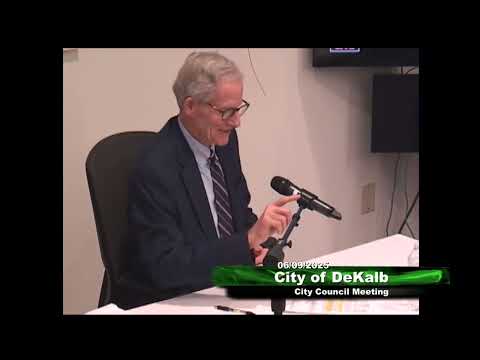
City Manager told the City Council that he recommends the council “pass a local tax as a replacement tax, not an additional tax” before the statutory deadline, arguing the city currently collects about $800,000 a year from the 1% tax and losing that revenue would force hard budget choices.
The recommendation came during an extended explanation of who benefits from the tax and who does not. The City Manager noted households receiving Supplemental Nutrition Assistance Program benefits (SNAP) generally do not pay the 1% on food-at-home purchases and that national studies suggest the lowest-income families would save about $36 a year from a 1% cut on groceries, not the larger savings some public messaging suggested.
Why it matters: Council members framed the choice as one between maintaining services — notably public safety and human services funding — and reducing costs for shoppers. The City Manager said the $800,000 would fund roughly six to seven full-time public safety positions (firefighters or police officers) and support human-services grants the city has been increasing.
Council reaction split. Mayor Barnes argued the tax is not a new tax and called it “status quo,” saying keeping the 1% locally would let the city continue investments in public safety, roads and social services. Alderman Larson and others described the political difficulty of asking residents which services to cut; some members said they wanted more scenarios showing specific budget trade-offs. Alderman Carlson referenced a recent referendum in another municipality in which voters rejected a replacement tax.
Next steps: Council members did not take a final vote. The City Manager said staff will prepare scenarios for the FY2026 budget process, present revenue and expenditure options to the Finance Advisory Committee and return to council with an ordinance or resolution before the deadline to act.
What was not decided: Council did not adopt a replacement tax at the June 9 meeting and did not set a final date for a public vote or referendum. The City Manager noted it is possible the administrative relationship with the state (and any state administrative fee) could change in later legislation; council members discussed that uncertainty but did not direct staff to assume any particular state action.
Context: The discussion followed staff analysis included in the council packet about who pays the tax and how much households at different income levels would save. The City Manager and council referenced state deadlines and Municipal League research during the discussion.