Get Full Government Meeting Transcripts, Videos, & Alerts Forever!
Get email alerts on the Facility Consolidation topic
No spam. Unsubscribe anytime.
Board continues discussion on proposed Westwood closure, DSC relocation and Greenwood repurpose; no final vote
Summary
District leaders presented a multi-part proposal to close Westwood, move Lola del Lago into Westwood, repurpose Greenwood for district services and special programs, and relocate the DSC. The board discussed capacity, costs, timing and open-enrollment effects; no closure vote was taken and staff were directed to return with updates.
District leaders presented the board with a multi-part proposal to close Westwood Elementary, relocate Lola del Lago to Westwood, move Greenwood programs and the District Services Center (DSC) to alternate space, and explore repurposing Greenwood as a combined district-services and program hub.
Doctor Thomas (Executive Director for Facilities) opened the review of revised slides and a facility transition matrix that compared scenarios for closing Westwood, moving Lowell and relocating the DSC. "When we take a look at Westwood and then move the DSC to Westwood, we could create building efficiencies," Thomas said, and the presentation concluded that moving Lowell and the DSC to other campuses would better meet the board’s prioritized criteria: operational efficiency, minimized remodeling, support for program growth and potential additional revenue.
Executive Director Emily Herman summarized instructional-space capacity calculations used to model the effects of closing one or two elementary schools. She said the district counted actual instructional classroom spaces (excluding hallways and bathrooms) and estimated that closing two elementary schools would push multiple grade levels above the district’s discussion cap for class size.
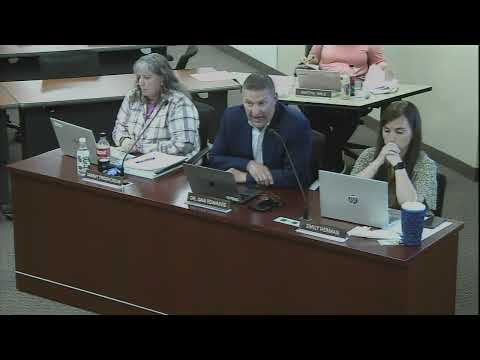
Herman and Doctor Dan Edwards addressed alternatives for housing the DSC. Herman said the DSC currently employs about 56 staff and occupies roughly 22,000 square feet, which includes roughly 1,500 square feet of hallways and 600 square feet of garage/storage space. She cautioned that distributing DSC staff across multiple sites would "be very inefficient in terms of our daily operations" and could degrade customer service for families who visit for multiple supports.
Board members and staff looked at potential alternative campus capacity. Doctor Edwards reported projections of seven middle-school classrooms becoming available (five at Hidden Oaks and two at Twin Oaks) and about six high-school classrooms available after program shifts; the district uses a working estimate of roughly 950 square feet per typical secondary classroom. The presenters concluded that the distributed classroom spaces across multiple campuses would total just under 13,000 square feet but said that would still be insufficient to fully meet DSC needs without efficiency and service tradeoffs.
Edgewood and preschool operations were discussed in detail. Director Joel Dahl reported Edgewood has 24 spaces listed as classrooms (some used as offices) and about 91 staff assigned; morning utilization averages roughly 85% and afternoon utilization roughly 60% in the preschool programs. Preschool enrollment was stated as 296 students; the meeting clarified that the figure of 73 shown in some reports referred to ADM (average daily membership) for certain early-childhood special education (ECSE) and VPK programs rather than total students served.
District real-estate valuations and potential proceeds were discussed. Director Powers said initial valuations from Saron Properties aligned closely with county assessed values. Powers reported preliminary numbers of approximately $7.6 million for Greenwood and about $7.86 million for the 5 Hawks site (per-square-foot values vary by location) and said time-on-market and buyer restrictions (for example, limiting sale to non-school uses) can reduce price and lengthen sale timelines. Powers estimated comparable school sales typically take from 1½ to 5 years in some cases; the district office market can show 6–12 months on average.
Finance director Frederickson outlined projected one-time and ongoing budget impacts tied to closure and consolidation. The district projected potential ongoing staffing reductions of between roughly 22.5 and 28.5 FTEs, producing estimated annual savings between $1.9 million and $2.7 million (dependent on boundary changes and enrollment). One-time moving and remodeling costs were estimated at $475,000 to $625,000; sales of an existing building were projected to net between $2.6 million and $3.5 million (figures presented as ranges). Transportation and utility savings were described as possible but contingent on final boundary decisions and forthcoming transportation RFP results.
Information-technology and remodel costs for relocating district functions were reviewed by Marcus Malazo (Director of Technology) and Director Powers. Malazo cited roughly $300,000 for updated security camera servers and phone systems, $50,000–$100,000 for conference-room AV, $50,000–$100,000 for IT moving/setup logistics, and $75,000–$125,000 to create office/security modifications and ADA/fire-code compliant exits and restroom upgrades at a receiving site. He noted some costs could qualify for E-rate reimbursement depending on category and bids.
Timing and process constraints were emphasized: board members noted state notification requirements and the statutory process for closing an elementary school require advance notice and mean changes would not take effect immediately. Staff said any building closure notification must follow required timelines (a one-year advance notification was cited) and that moves would happen in summer windows after year-end to align with the required notification and closing schedule.
Open-enrollment implications were discussed. Staff said current open-enrolled students would be offered priority placement options if boundary changes affect them; final rules for accepting new open-enrolled students would depend on post-boundary capacities and were not yet determined.
Several board members requested additional, building-level enrollment projections and more granular cost comparisons for program relocations (for example, the potential financial and programmatic impact of bringing a transition program now run through Southwest Metro back to the district). Doctor Thomas and staff indicated follow-up analysis would be provided.
What the board directed: staff were asked to continue analysis, engage real-estate advisors for valuation guidance, refine cost estimates (including moving/remodel and transportation RFP impacts), and return with an update at the July 14 meeting where the board may be asked to take action on a next step. No formal motion to close any building or to sell property was made during this session.
Quotations from the meeting were limited to presenters and staff during the discussion. The board’s conversation combined enrollment capacity, operational impact on specialized services, real-estate timing, and one-time versus ongoing fiscal trade-offs without reaching a final decision during the meeting.