Get Full Government Meeting Transcripts, Videos, & Alerts Forever!
Get email alerts on the Land Use And Zoning topic
No spam. Unsubscribe anytime.
Council holds public hearing on Orange Hill rezoning; plan would reduce homes, require tree mitigation and developer payments
Summary
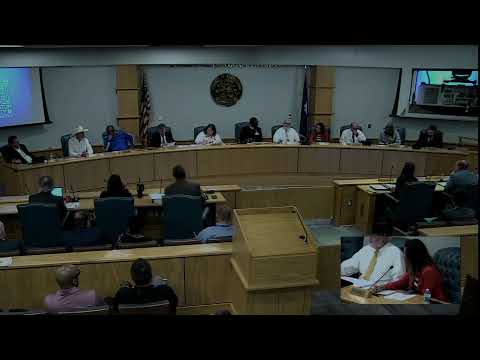
Charleston County Council held a public hearing Tuesday on a request to amend the long‑standing Orange Hill plan development and rezone three parcels on Johns Island to Planned Development PD‑191.
Charleston County Council held a public hearing Tuesday on a request to amend the long‑standing Orange Hill plan development and rezone three parcels on Johns Island to Planned Development PD‑191.
The county presentation said the three subject parcels total about 933.097 acres, about 427 acres of which are wetland, and described proposed modifications to tree protections, roadway requirements and a 10‑year development agreement between Kiawah Resort Associates and Charleston County. Planning staff said the agreement would cap certain habitat and housing payments, require a left‑turn lane on River Road at the primary entrance and permit one conditional plat tied to a wastewater treatment facility and public water provisions.
The hearing drew developer representatives, local task‑force leaders and neighbors who debated density, trees, traffic and stormwater. A developer representative said the proposal reduces the number of homes from the earlier plan’s 181 to 120 and cuts about 2.8 miles of roadway, arguing those changes preserve more natural areas. “By shifting the road entrance to River Road, we believe that we haven't added to the complexity of traffic on Bohicket Road,” the developer representative said.
Why it matters: the proposal changes permitted uses and local zoning rules for a large Johns Island tract and would allow the removal or encroachment on hundreds of the county’s regulated trees under the development agreement; it also includes multi‑hundred‑thousand‑dollar commitments that county staff said would be held in escrow or paid to specific local services.
Key facts and commitments
- Planning staff identified the property as located between River Road and Bohicket Road and said the total development area is about 933.097 acres with roughly 427 acres of wetland. (planning presentation)
- The development agreement would run for 10 years unless extended by both parties and would modify the ZLDR only for this project on tree protection, plant development and road construction requirements. (planning presentation)
- Developer changes from prior approvals include a reduction in allowable residential lots from 181 to 120 and the elimination of approximately 2.8 miles of roadway, the developer representative said.
- Tree impacts cited in the staff presentation: total grand trees proposed to be removed, 312; total grand trees proposed to be encroached upon, 448. The agreement would allow certain removals or encroachments without Board of Zoning Appeals approval but would require mitigation; mitigation standards described include inch‑for‑inch replacement for Grade A and B trees with a minimum 2.5‑inch caliper, monitoring of trees in Crochet Pond for five years by an arborist, and options for on‑site, on‑Johns Island off‑site plantings or payments to a Johns Island tree fund. (planning presentation)
- Developer financial commitments in the presentation included: $1,000,000 over five years to be held in escrow for preservation and development of workforce/affordable dwelling units; up to $500,000 (cap) for sea‑island Habitat for Humanity affordable housing initiatives; roughly $215,000 (about 50% of an ambulance cost) and $450,000 (about 50% of a new fire engine) toward Saint John’s Fire District public safety equipment. (planning presentation)
Public comment and stakeholder positions
- Johns Island Task Force representative John Zloga said the revised plan was “far superior to what was originally proposed” in 2005, noting the reduction of 61 homes and fewer impervious surfaces. He thanked the developer for community outreach and highlighted that tree mitigation funds would be spent on Johns Island. “These are all wins for John’s Island,” Zloga said.
- Several nearby residents, including Cindy Haynesworth and Kathleen Duncan, expressed concerns about drainage monitoring, reductions in buffer widths along Bohicket (Bow) and River roads, and traffic safety at nearby intersections. Duncan said the county’s and SCDOT’s ability to address an existing hazardous intersection at Malmar and Orange Grove is limited and urged the council to consider children’s safety when weighing new houses.
- The developer and project team said stormwater will be engineered to current county standards and that DHEC has approved the engineered stormwater plan. The developer also said short‑term rental units proposed for the project would be limited to club members and that traffic studies counted those units as full‑time residents.
Staff and commission recommendations
- The staff and the planning commission recommended approval of the plan development request with the condition that the Johns Island Task Force be consulted when determining placement of off‑site tree mitigation. The deputy county administrator requested that the receiving entity of housing initiative fees be changed from the Charleston County Community Development and Revitalization Department to the Charleston County Community Services directorate.
Process status
- The hearing provided public comment and a staff presentation; no council vote on the rezoning or development agreement was taken during the hearing. Planning staff and several public speakers requested corrections to exhibit 14.1 and an accompanying table in section 14 identifying a small number of trees whose printings did not match the summary table; staff asked the council’s planning and public works committee to revise the exhibit to correct those anomalies.
What comes next
- The public hearing record will remain part of the zoning process and council will consider the ordinance and development agreement in subsequent committee and council sessions as required. Staff asked that exhibit and table corrections be made before further action.