Get Full Government Meeting Transcripts, Videos, & Alerts Forever!
Get email alerts on the Hazard Mitigation Plan topic
No spam. Unsubscribe anytime.
Kalispell council reviews regional hazard mitigation plan, delays adoption pending corrections and coordination
Summary
Kalispell councilors reviewed the Western Montana regional hazard mitigation plan at a work session, flagged mapping and data errors and agreed to collect edits and coordinate with Flathead County and other jurisdictions before considering formal adoption.
Kalispell city councilors reviewed the Western Montana regional hazard mitigation plan at a recent work session and agreed not to adopt it immediately while staff and Flathead County collect corrections and coordinate with neighboring jurisdictions.
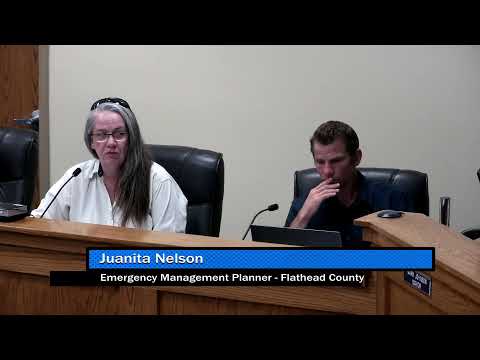
The plan matters because, as Flathead County facilitator Juanita Nelson explained, if Kalispell does not adopt the plan before the state’s November review the city would need to rejoin a revised annex later and would be ineligible for federal hazard-mitigation grant funding tied to the current plan. "If we do not adopt the plan before November, then the whole annex will have to go through a revision," Nelson said.
Council discussion focused on accuracy and attribution in the annexes, local responsibility for specific road segments, and the regional process used to prepare the document. Council members identified multiple typographical errors and data gaps and questioned specific site references. Council member Jared asked about the immediate consequence of delaying adoption; Nelson said the state Division of Emergency Services (DES) had warned of the November deadline and described steps jurisdictions must take to remain eligible for some federal funding programs.
Council members and staff flagged a handful of mapping and data issues for correction. Council member Nelly questioned whether the city would be financially liable for any mitigation projects if it chose not to participate; Nelson replied that jurisdictions that do not participate in the regional plan would not be eligible for federal mitigation grants tied to the plan. Councilors identified specific problems in the annex, including missing entries in annex E (pages 43–45), a likely contractor typo referring to "Summit Drive" where "Summit Ridge Drive" appears to be intended, and unclear responsibility for improvements on Evergreen Drive and Fourmile Road.
City staff and Flathead County officials discussed which jurisdiction owns particular road segments. Nelson said some stretches identified as county responsibilities are in fact city-owned or partly within the city’s growth boundary and recommended clarifying the lead-agency entries in the annex. Council member Jared and other councilors said they would forward page-specific edits to staff for incorporation.
Several councilors said the regional process had reduced opportunities for in-person coordination among cities and counties. Council member Dowd said the plan preparation had been "a missed opportunity" to convene all the local jurisdictions at once and to spot cross-jurisdictional issues earlier. Nelson described how the shift to regional planning and virtual meetings after 2014 and during the COVID-19 pandemic had helped smaller counties produce compliant plans but also limited jurisdiction-specific detail.
On process and next steps, Nelson said DES expects each jurisdiction to sign a letter of intent, designate a point of contact and bring local stakeholders to meetings, and that the regional plan will continue to be updated on a multi-year cycle. She said staff will start planning for the next regional-plan cycle in early spring 2028 for adoption by 2029. In the near term, councilors asked staff to collect the edits identified in the session, share corrected pages with the council, and schedule a local coordination meeting with Flathead County and neighboring jurisdictions before any formal adoption vote.
No motion to adopt the plan was raised or voted on during the session. Councilors directed staff to gather corrections and to facilitate further meetings; a formal adoption vote was left for a future council agenda.
Additional context from the session: participants cited wildfire and flood responses during 2023 (Ridge Fire, East Fork Fire) and coordination with neighboring counties and organizations such as the Red Cross as background for how the plan has been used in recent emergencies. Nelson said experience from those events informed a push toward more regional planning and noted that several smaller jurisdictions had dropped participation at later stages, leaving county emergency managers to finalize some entries.
What's next: staff will accept and circulate page-level edits, coordinate a local meeting with Flathead County and other jurisdictions (potentially in the evening to accommodate officials), and return a corrected annex or an adoption proposal to the council for a future vote. The state DES November review deadline remains a factor in calendar planning.