Get Full Government Meeting Transcripts, Videos, & Alerts Forever!
Get email alerts on the Tax Increment Financing topic
No spam. Unsubscribe anytime.
Port Washington holds council education session on TIF/TID mechanics for proposed development
Summary
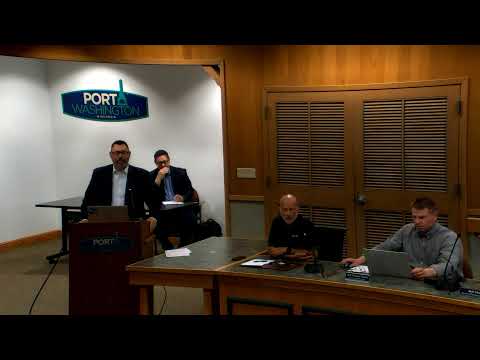
Port Washington aldermen held a special work session on June 10 to receive a presentation on tax incremental financing and tax incremental districts, an educational meeting in which no formal action or votes were taken.
Port Washington aldermen held a special work session on June 10 to receive a presentation on tax incremental financing and tax incremental districts, an educational meeting in which no formal action or votes were taken.
The session focused on how a TID/TIF would allocate new property-tax revenue to pay project costs for a proposed development covering roughly 2,000 acres. "A TID keeps the costs associated with a specific project away from the rest of the city and contained within the TID," said Chris Smith, an attorney at Von Bridal and Roper who described how a project’s incremental tax revenue is captured inside a district to repay infrastructure and related costs.
The presentation explained key mechanics and statutory constraints. The base value that taxing jurisdictions continue to receive is the assessed value on the effective date of the district (the presenters said that, depending on timing, the base could be set as of 01/01/2025 or 01/01/2026). Todd Toews, senior municipal adviser with Eller's, said Act 12 (state legislation referenced in the presentation) altered how net-new construction affects levy limits: "You receive 90% of the benefit of that as it occurs," Toews said, with the remaining 10% realized as a one-time adjustment when a TID closes.
Presenters stressed that only incremental (new) value above the frozen base is captured by a TID for the purpose of repaying project costs; base-level property taxes continue to flow to the school district, technical college, county and other taxing jurisdictions. Smith and Toews outlined typical project costs eligible to be paid through a TID if the items are identified in the project plan and approved by the joint review board, including public utilities (water, sewer, stormwater), roads, transmission lines and outside consultant fees. The consultants noted a statutory limit that municipal buildings and general administrative costs generally are not eligible.
Consultants discussed how costs are financed. The preferred approach described was a pay-as-you-go reimbursement in which a developer or end user finances infrastructure up front and is reimbursed from the project’s own tax increment; alternatives include municipal borrowing with repayment from future increment. The presenters said developer protections and risk allocations are negotiated in a development agreement. Smith described "minimum guaranteed value" clauses and parent-company guarantees as common protections, citing the Mount Pleasant/Foxconn example where a shortfall payment mechanism required payments when assessment values fell below guaranteed levels.
The presentation included quantitative examples the consultants used for context: the presenters said tax revenue from the publicized project area in 2024 was just over $16,000 and that a Town of Port Washington agreement will obligate the city to pay roughly $133,800 annually (statutory additions bring that to about $150,000) for five years starting in 2026. The Microsoft project cited in the presentation had 2025 assessments of roughly $800 million for buildings in an early phase; the Foxconn example described a modeled threshold of $1.4 billion in assessed value versus roughly $600 million actually realized, with the development agreement mechanism used to collect shortfall payments.
Other points explained to the council: expenditures for utilities can be made outside a TID when necessary; non-utility projects may be financed within one-half mile of a district if the expenditure is in the city and is necessary to implement the project; territory may be removed from a TID after creation; and pending state legislation would limit the ability of a strong-performing TID to serve as a "donor" to other TIDs within the same municipality. Toews noted TID duration is project-specific, governed by statute and by the time required to recover project costs, and could close earlier or run toward its statutory maximum depending on costs and realized incremental value.
Mayor (unnamed) opened and closed the session, and aldermen asked clarifying questions about timing of base-value assessments, outside consultant cost expectations, levy-limit interactions with net-new construction, and negotiation priorities for protecting taxpayers. The presenters repeated a preference for structuring agreements so the developer carries upfront risk and the city is reimbursed rather than the city borrowing and assuming financing risk.
The council did not take any formal action; the meeting was an informational session. The mayor and aldermen indicated future public council deliberations and negotiated developer agreements will follow when an end user is identified, and that council members expect contract language to protect the city, seek guarantees from developers and avoid upfront city costs where feasible.