Get Full Government Meeting Transcripts, Videos, & Alerts Forever!
Get email alerts on the Traffic Safety topic
No spam. Unsubscribe anytime.
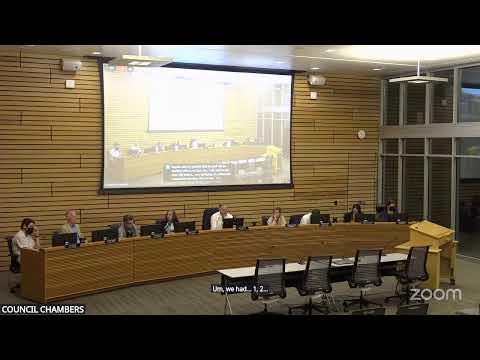
Kenmore to expand photo-enforcement with mobile cameras; council approves intermittent deployments but delays site list
Summary
Staff recommended expanding the city’s automated photo enforcement (CAPE) program using transportable cameras to improve safety, limit multiple fines via a 30-minute infraction window, and fund safety projects; council approved intermittent enforcement but tabled a final site list until June 23.
Kenmore staff recommended expanding the city’s automated photo-enforcement (CAPE) program on Monday, proposing a mix of fixed and transportable camera deployments, a 30-minute limit on repeat infractions, and use of program revenue for sidewalks and safety projects. The council approved intermittent (transportable) camera use but postponed approval of the full site list to June 23 for further staff prioritization.
Traffic engineer Tobin Benagold summarized two years of program data, saying the city has observed large mean-speed reductions where CAPE operates. Benagold told the council that school-zone enforcement reduced mean speed from about 36 miles per hour to 16 miles per hour in active school zones and that citywide regulatory enforcement had reduced mean speeds in 30-mph zones from roughly 37 mph to about 25 mph. He framed the program’s goal as crash- and fatality-risk reduction and described a complementary approach that pairs engineering and enforcement.
Key safety and fiscal points presented by staff
- Reported safety effects: Benagold said the school-zone mean-speed reduction “reduces our risk of fatal crash by 95 percent” and a regulatory-speed mean reduction from 37 to 25 mph reduces crash risk and “our risk of fatal crashes by nearly 3 quarters.” He emphasized the preventive role of school-zone enforcement. - Violation and revenue trends: ticket volumes fell quickly after warning periods; staff use a long-term projected violation rate of 0.2% to plan sustainable program revenue. Benagold said the program’s financial plan assumes a long-term violation rate of 0.2% and would be at risk to meet financial sustainability targets if violations fell below about 0.16%. - Costs: staff reported approximate fixed camera costs of about $57,000 per camera per year and variable per-violation costs roughly in the range of $20 per paid citation. - Program investments: CAPE revenue has funded sidewalks, school-zone upgrades, pavement management and other safety projects; Benagold outlined projects and proposed continued investment in capital and maintenance items. - Equity measures: staff proposed a 30-minute “limited infraction window” to prevent a single trip from creating multiple fines if a driver crosses several enforcement sites in a short span; they also proposed extensive warning periods and outreach.
Council actions and outcome
- Motion 1: Council voted 5–2 to approve the use of intermittent (transportable) enforcement cameras and the program policy changes described by staff, including the limited infraction window. According to the roll call in the meeting transcript, Council members voting in favor cited the program’s safety record and the 60‑day warning period that precedes active enforcement. Two council members voted no, citing concerns about camera-based enforcement generally and surveillance. - Motion 2: The council tabled a separate motion asking approval of the specific recommended sites and asked staff to return a prioritized list and schedule; council agreed to revisit the site list at the June 23 meeting.
Why this matters: the CAPE program is intended to reduce speeds and severe crashes, fund further safety upgrades, and reallocate public-safety spending. Staff presented data showing large speed reductions and lower crash risk in camera zones; council and public discussion focused on staffing and court processing capacity, outreach and geographic equity of enforcement sites.
Clarifying details and next steps
- Staff will prepare a prioritized rollout schedule and clarify staffing/court-review impacts for the June 23 meeting. - Council asked staff to preserve the proposed 60-day warning period for new sites, provide a public dashboard showing active camera locations and to include CAPE in outreach events.
Speakers (key)
- Tobin Benagold — Traffic engineer, City of Kenmore (staff presenter) - Chief Moen — referenced by staff (not present) - Multiple council members questioned program staffing and priorities; Deputy Mayor O’Kane and Councilor Culver voiced concerns about surveillance or staff capacity during the discussion.
Authorities and constraints
- Washington state photo enforcement statutes and RCW provisions were cited by staff to explain where cameras may be placed and numerical limits when sites are more than a mile from schools (statutory constraints limit cameras outside school-mile buffers). Referenced_by: Tobin Benagold.
Actions recorded
- Motion approved: authorize intermittent (transportable) CAPE deployments and program policy changes including a 30-minute limited-infraction window (vote: 5–2; yes votes: Council members Shrubnick, Marshall, Lutzes, Sassen and Mayor Herbig; no votes: Council member Culver and Deputy Mayor O’Kane; clerk roll call in the transcript supports the 5–2 outcome). - Motion tabled: approval of the recommended site list postponed to the June 23 council meeting (unanimous motion to table to June 23, 2025).
Discussion vs. decision
- Discussion: staff presented data on speed reductions, crash risk and program finances; council raised questions about police review workload, court capacity and outreach. - Direction: council approved the program changes and asked staff to return with a prioritized, phased site list and staffing/court workload analysis. - Decision: approval to use intermittent enforcement cameras and to implement the limited-infraction window; site implementation schedule deferred.
Searchable tags
["CAPE","photo enforcement","speed enforcement","transportable cameras","Kenmore traffic"]
Provenance (transcript excerpts)
- topicintro: {"block_id":"block_7418","local_start":0,"local_end":90,"evidence_excerpt":"Hi. Good evening, mayor and council. Thanks for staying up late with me. I'm, very excited to talk to you about this. I think we have some some great opportunities here, to build out our photo enforcement program..."}
- topfinish: {"block_id":"block_13658","local_start":0,"local_end":85,"evidence_excerpt":"Opposed? Okay. The motion to table, to the 20 third is passed unanimously, which I think also by default, means that we can have the conversation about the motion at the 20 third also. Okay. Then we don't need a motion to do that because it is not a live motion yet."}
Ending
Council approved the staff-recommended policy changes enabling intermittent enforcement cameras, including a 30-minute limit on repeat infractions and strong warning- and outreach-periods, but postponed final site approvals to give staff time to provide a prioritized rollout and staffing/court-impact analysis for the June 23 meeting.