Get Full Government Meeting Transcripts, Videos, & Alerts Forever!
Get email alerts on the Housing topic
No spam. Unsubscribe anytime.
Kenmore holds public hearing on middle-housing zoning, ADU changes and 10% inclusionary proposal; councilasked for clarifications
Summary
Staff presented proposed middle-housing and ADU code changes required by state law and a 10% inclusionary requirement for developments in R4 and R6; public hearing produced questions about unit-size exemptions, fee-in-lieu details and timing ahead of the June 30 state deadline.
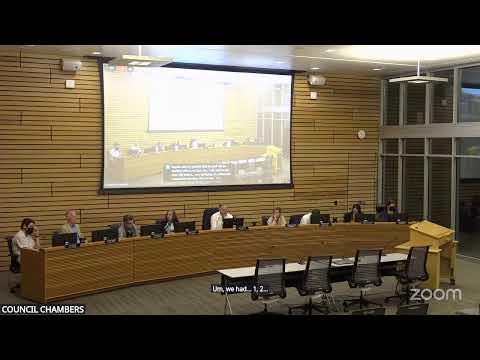
Kenmore staff told the City Council on Monday they are proposing amendments to allow middle housing types in single-family zones, update accessory-dwelling-unit rules and add an inclusionary-housing requirement for the R4 and R6 zones, and then opened a public hearing on the package.
Todd Hall, Kenmore principal planner, said the 2023 Washington law requires cities to allow middle housing and that Kenmore chose to plan to meet tier-2 standards because its population is near the 25,000 threshold. Hall and consultants from Kimberly Horne and ARCH outlined proposed changes affecting duplexes, triplexes, fourplexes, townhouses, stacked flats, cottage housing and ADUs; the presentation also described a proposed 10% inclusionary requirement for projects in R4 and R6 zones, with affordability set at 80% AMI for ownership units and 50% AMI for rentals.
Why this matters: the state’s middle-housing law requires local implementation; Kenmore’s choices—density calculations, unit-size exemptions and whether to apply inclusionary requirements—will affect how many new units appear where, which households can afford them, and the city’s compliance with the June 30 state deadline.
Staff presentation and key elements
- Middle-housing types proposed: duplexes, triplexes, fourplexes, townhouses, stacked flats and cottage housing; staff noted Planning Commission recommended inclusion of fourplexes and excluded five- and six‑plex prototypes. - Unit-density approach: a baseline of 2 units per lot with allowances for 4 units per lot near major transit corridors (e.g., the 522 corridor) or for projects that provide an affordable unit. - ADU rules summarized (House Bill 1337): allow up to two ADUs on a single-family lot; remove owner-occupancy requirement; cities cannot regulate ADUs under 1,000 sq ft; ADUs may be counted toward unit-density standards. - Inclusionary proposal: all residential developments in R4 and R6 would provide at least 10% of units as affordable (ownership at 80% AMI or rental at 50% AMI); units smaller than 1,750 sq ft would be excluded from the unit count for the inclusionary calculation; developments under 10 units may pay a fee in lieu; the proposed affordability requirement would be delayed to take effect Jan. 1, 2026.
Public comment and council questions
Speakers at the hearing urged both urgency and caution. Christina Schiefer (Kenmore resident) said middle housing “alone is not gonna solve our affordability crisis” and urged larger-scale apartment development in the downtown core. Randy Bannaker, on behalf of the Seattle-King County Realtors, urged focus on supply and cautioned that inclusionary requirements could raise market-rate costs and make small projects infeasible. Several residents and advocates supported inclusionary requirements but asked for stronger focus on lower AMI bands.
Council members asked detailed, technical questions about the proposal. Council member Shrevnick confirmed the Planning Commission recommended seven middle-housing types including fourplexes. Council member Culver and others pressed staff on the inclusionary exemption threshold (1,750 sq ft) and how the 10% requirement would be applied to projects mixing small and larger units: Mike Stanger of ARCH explained that units below 1,750 sq ft are excluded when calculating the denominator for the 10% requirement and that projects with fewer than 10 units would be expected to pay a fee in lieu if a fractional requirement resulted.
Next steps
- The council held the public hearing and closed it at the meeting’s end; staff said they will answer remaining questions and bring an ordinance back for adoption on June 23. - Hall reminded the council that if Kenmore does not adopt a local ordinance by the state’s June 30 deadline, the model ordinance for tier‑3 cities would automatically take effect on July 1.
Speakers relevant to this item
- Todd Hall — Principal Planner, City of Kenmore (staff presenter) - Mike Stanger — Senior planner, ARCH (Regional Coalition for Housing) - Kimberly Horne / Nick Chen — consultants to the city (presenters) - Christina Schiefer — Kenmore resident (public commenter) - Randy Bannaker — representative, Seattle-King County Realtors (Bellevue) - Jeffrey Pooley, David Dorian, Stacy Valenzuela and others — public commenters
Authorities and code references cited
- Washington State middle-housing legislation (2023); referenced_by: Todd Hall - House Bill 1337 (ADU legislation); referenced_by: Todd Hall - Proposed Kenmore Municipal Code amendments to Chapter 18.77 (affordable housing); referenced_by: staff
Actions recorded
- Action: Public hearing opened and closed; no ordinance adopted at this meeting. Outcome: hearing closed; staff directed to return final ordinance for council consideration on June 23, 2025.
Discussion vs. decision
- Discussion: substantive policy choices, technical clarifications and public testimony on trade-offs between housing supply and affordability requirements. - Direction: staff to revise and return final ordinance language and additional analysis, including fee-in-lieu rates and technical clarifications on unit counting and exemptions. - Decision: none at this meeting; adoption scheduled for June 23, 2025 unless the council changes the calendar.
Clarifying details captured from testimony and council questions
- Inclusionary requirement proposed: 10% of total units (ownership units at 80% AMI; rental units at 50% AMI). - Exemption: units under 1,750 sq ft excluded from the denominator for inclusionary calculations; staff said the bullet describing unit thresholds had a typographical error in the slide deck and corrected it during the presentation. - Effective date: proposed to be delayed until Jan. 1, 2026; if council does not act by June 30, state model ordinance for tier-3 cities would take effect July 1. - Density: default 2 units per lot, with up to 4 units per lot allowed near major transit stops or when an affordable unit is provided.
Searchable tags
["middle housing","ADU","inclusionary zoning","Kenmore Municipal Code","R4","R6","House Bill 1337"]
Provenance (transcript excerpts)
- topicintro: {"block_id":"block_4085","local_start":0,"local_end":120,"evidence_excerpt":"Right. Good evening, mayor, deputy mayor, council members. I'm pleased to be here with you again tonight... an overview for the proposed middle housing ADUs and inclusionary zoning amendments."}
- topfinish: {"block_id":"block_6858","local_start":0,"local_end":65,"evidence_excerpt":"With that, the public hearing is closed. Thank you very much. I appreciate, all the work that's gone into this, and we'll see you in a couple weeks."}
Ending
Staff will return with a final ordinance and any technical corrections requested by council; if the council does not adopt a local ordinance by the June 30 state deadline, the state model ordinance will take effect July 1. The council and public discussion emphasized trade-offs between accelerating housing supply and ensuring affordability, and asked staff for clearer economic analyses and fee-in-lieu rates before adoption.