Get Full Government Meeting Transcripts, Videos, & Alerts Forever!
Get email alerts on the Urban Forest Tree Ordinance topic
No spam. Unsubscribe anytime.
South Pasadena staff propose streamlined tree ordinance with clearer permitting, native-tree incentives
Summary
City staff presented recommended revisions to the tree ordinance aimed at simplifying permits, protecting native trees, reducing replacement burdens for hazardous removals and improving enforcement; commissioners and the Natural Resources and Environmental Commission urged incentives and coordination with fire officials.
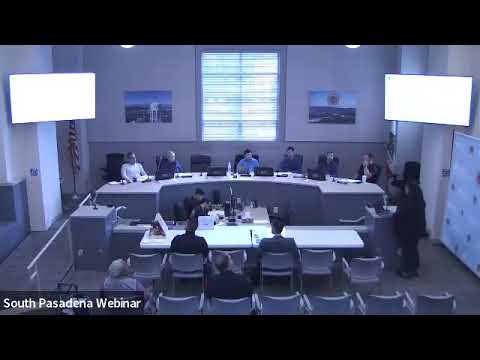
South Pasadena City staff presented recommended updates to the municipal tree ordinance on June 9, 2025, proposing clearer maintenance responsibilities, simpler permitting thresholds and lower replacement burdens for hazardous removals.
The revisions, presented by Danielle Garcia, water conservation management analyst, and Michael Bartanians, acting co‑director of public works, respond to a City Council direction to streamline permitting and to address contemporary urban-forest challenges. Garcia said the review compared South Pasadena’s code with neighboring cities and focused on maintenance responsibility, trimming/pruning standards, removal criteria, permitting and enforcement.
The changes aim to protect native trees while making the permit process faster and less costly for residents. Garcia said staff will “simplify the permitting process to ensure native trees are protected” and recommended removing subjective language so violations can be applied consistently. She also noted the city currently offers a water-conservation rebate: “you can get about a $100 per tree for up to 10 trees.”
The draft recommendations include: clearer definitions of city and resident maintenance responsibilities (including parkway/right‑of‑way trees), aligning development procedures with state and local standards, requiring certified arborists for work on protected trees, setting an ANSI‑based trimming threshold (roughly 10% of live foliage) to avoid over‑pruning, reducing replacement requirements when a tree is dead/dying/diseased or an imminent threat, and narrowing the 100‑foot notification requirement so it applies to removals rather than routine trimming.
Garcia described the current permitting costs and deposits: an initial $141 inspection fee, an additional $364 fee to cover staff time for application support and potential mapping/topography needs, and a $424 planting deposit that is refunded after the replacement requirement is satisfied. She said the city intends to change the municipal code so the appellant — rather than the original applicant — pays appeal costs. The staff recommendation would also require a 100‑foot radius notification for removal applications and GIS mapping to generate the notification list.
Commissioners urged stronger emphasis on native species and incentives. Commissioner Cervantes said, “I really think it is so important to emphasize how we need to plant native trees,” and called for possible discounts or nursery partnerships to increase native planting and canopy cover. Garcia responded that the city already has a rebate program for drought‑tolerant and native trees and will fold an updated native species list into that program.
Commissioners also pressed for clarity about responsibility for trees in the parkway (the strip between sidewalk and curb), and staff clarified that those trees are technically on the resident’s property and that residents are generally responsible for watering and basic care; the city may cover removal costs in some cases. Staff said city‑owned trees (for example on Mission Street and Fremont) are maintained by a contracted arborist (West Coast Arborist).
On emergencies, staff said the code already contains an exception that waives permits for trees damaged by storm, fire or other natural disasters; staff plan to include an expedited path in the revisions for large‑scale wind or storm damage affecting multiple trees.
Why it matters: the changes are intended to balance tree preservation and canopy goals with practical implementation, reduce time and cost burdens for residents, and clarify duties for private and city trees — all while integrating wildfire and storm resiliency considerations.
Staff said the draft will move through the Natural Resources and Environmental Commission review, then the Public Works Commission, with a City Council update planned for July 16. Staff anticipates preparing ordinance language for late summer readings, a fall hearing, and a possible ordinance effective date in winter 2026.