Get Full Government Meeting Transcripts, Videos, & Alerts Forever!
Get email alerts on the Business Privilege Tax Bill 11 38 topic
No spam. Unsubscribe anytime.
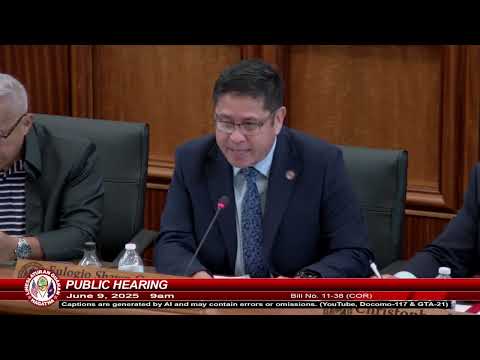
Guam hearing weighs rollback of business privilege tax as private sector presses for relief
Summary
Senators and dozens of private‑sector witnesses spent hours on May 20 at a Guam Legislature public hearing debating Bill 11‑38 COR, a proposal to restore the business privilege tax (BPT) rate from 5% to 4%.
Senators and dozens of private‑sector witnesses spent hours on May 20 at a Guam Legislature public hearing debating Bill 11‑38 COR, a proposal to restore the business privilege tax (BPT) rate from 5% to 4%.
The bill’s author, Senator Sean Gumata, opened discussion by describing the rollback as a way to return roughly $80–85 million a year to businesses and households that he said would be reinvested locally. “Businesses do not pay taxes. People pay taxes,” he said, summarizing testimony he has heard from small business owners across Guam.
Why it matters: The measure pits two fiscal priorities against one another. Government budget officials told the committee that reducing the BPT would create a material hole in projected revenues and could cut deposits to dedicated funds used for hospital pharmaceuticals and the government’s rainy‑day reserves. Private‑sector groups, medical providers and local business owners said the 1 percentage‑point rollback would relieve businesses still recovering from tourism losses and staffing pressures and would help retain clinic and hospitality staff.
Budget office presentation: Lester Carlson, director of the Bureau of Budget and Management Research (BBMR), and other administration witnesses walked senators through recent revenue history and the administration’s fiscal projections. Carlson noted that measured “excess” collections have been driven largely by income and withholding taxes rather than the BPT alone. BBMR reviewed fiscal years 2019–2024, showing years with excess revenues (for example, FY 2022 reported roughly $103.6 million in excess collections and FY 2024 about $149.3 million), but cautioned those totals reflected multiple tax sources, not just gross receipts.
Administration concerns: Edward Byrne, director of the Department of Administration, and Maria Lazama, director of the Department of Revenue and Taxation (DRT), said the rollback would reduce several dedicated revenue streams. Byrne pointed to an estimated $5.1 million reduction to the GMH pharmaceutical fund and a $1.5 million reduction to the rainy‑day fund as examples cited in internal analyses; the administration’s fiscal note estimated a roughly $81–82 million annual hit in some projections. DRT’s Carolyn Rivera told senators DRT counts about 15,382 licensed businesses on Guam and that 3,145 firms fall in the $50,000–$500,000 gross‑receipts bracket that currently gets the smaller‑business reduction under existing law.
Private sector testimony: A broad private‑sector panel—led by Catherine Castro of the Guam Chamber of Commerce, Mary Rhodes of the Guam Hotel & Restaurant Association, Dina Rendon Pangilinan of the Guam Women’s Chamber of Commerce and others—urged passage of the rollback. The Chamber submitted a petition with nearly 1,000 signatures and business leaders described how the extra 1% would be used: hiring, staff raises, inventory, repairs and small capital investments. Monte McDowell of the Guam Association of Realtors and Joe Roberto, a small business owner, said the rollback would improve working capital and help small firms qualify for larger contracts.
Healthcare providers: Several clinicians urged support for Bill 11‑38 on grounds it would help retain health‑care staff. Dr. Wen (private clinic) said her clinic serves “about 40‑something thousand patients” and has been open through typhoons and the pandemic but cannot match government pay increases; she said even a 1% return would help private providers offer modest raises. Dr. Hsieh, speaking for the Guam Medical Association, said the association “fully support[s] Bill 11‑38” and called the higher BPT regressive for many clinics that do not receive large exemptions.
Tourism and economic context: Witnesses and senators highlighted Guam’s slow tourism recovery. The Guam Visitors Bureau figures cited at the hearing showed arrivals in February 2025 at 126,519, a decline of about 55.6% compared with February 2019; witnesses said tourism‑related tax collections remain well below pre‑pandemic levels and that the island is losing direct visitor revenue that historically supported many local businesses.
Policy tradeoffs and unanswered questions: Senators pressed administration officials on where cuts would fall if the rollback passes. Byrne and BBMR officials said some choices would be needed; they named public safety, education and health funding as areas that could face pressure but said priorities and legislative choices would determine outcomes. Committee members also asked whether improved tax enforcement on certain contracts or clearer collection on exemptions could narrow the gap; DRT was asked to follow up on enforcement opportunities.
Requests for more analysis: Multiple senators asked for additional documentation and the fiscal note; the chair directed agencies to provide materials. Members also raised pending federal tax changes and potential federal funding shifts (federal tax law proposals and program changes such as Medicaid/SNAP or FEMA responsibilities) that could affect FY‑26 revenue projections.
What did not happen: The hearing recorded testimony and extensive questioning but did not include any committee vote or formal action on Bill 11‑38 during the session. Senators said the hearing would continue later and that all signed witnesses would be heard.
Where things go next: Committee members signaled they will hold additional Q&A with the government and private‑sector panels and review the administration’s fiscal note and DRT data before any committee vote. Several senators said they want to balance short‑term business relief with preserving core public services and reserves.
Context note: Witnesses and officials repeatedly framed the BPT discussion as part of larger fiscal decisions made since 2018, when the rate rose in response to federal tax changes. Participants invoked federal relief (CARES Act, ARPA) and the island’s military construction activity as factors that have influenced recent revenue flows and business activity.
Ending: The committee recessed for lunch with the hearing scheduled to continue; members said they expected to reconvene and complete all testimony later in the day and to review requested fiscal material from BBMR and DRT.