Get Full Government Meeting Transcripts, Videos, & Alerts Forever!
Get email alerts on the Healthcare 340b topic
No spam. Unsubscribe anytime.
Senate passes bill letting FQHCs use clearinghouse for 340B claims amid debate over transparency and PBMs
Summary
The Oregon Senate on the floor approved House Bill 3409 A, which allows—though does not require—Federally Qualified Health Centers and pharmacies to use a clearinghouse rather than a modifier when submitting claims for drugs covered by the federal 340B program.
The Oregon Senate on the floor approved House Bill 3409 A, which allows—though does not require—federally qualified health centers (FQHCs) and pharmacies to use a clearinghouse rather than a modifier when submitting claims for drugs covered by the federal 340B program.
Supporters said the change will reduce administrative work for clinics and pharmacies and align Oregon with proposed federal reforms; opponents said the bill lacks a definition of “clearinghouse,” may authorize a no‑bid transfer of sensitive pricing data to for‑profit parties, and could shift costs onto insurers and patients.
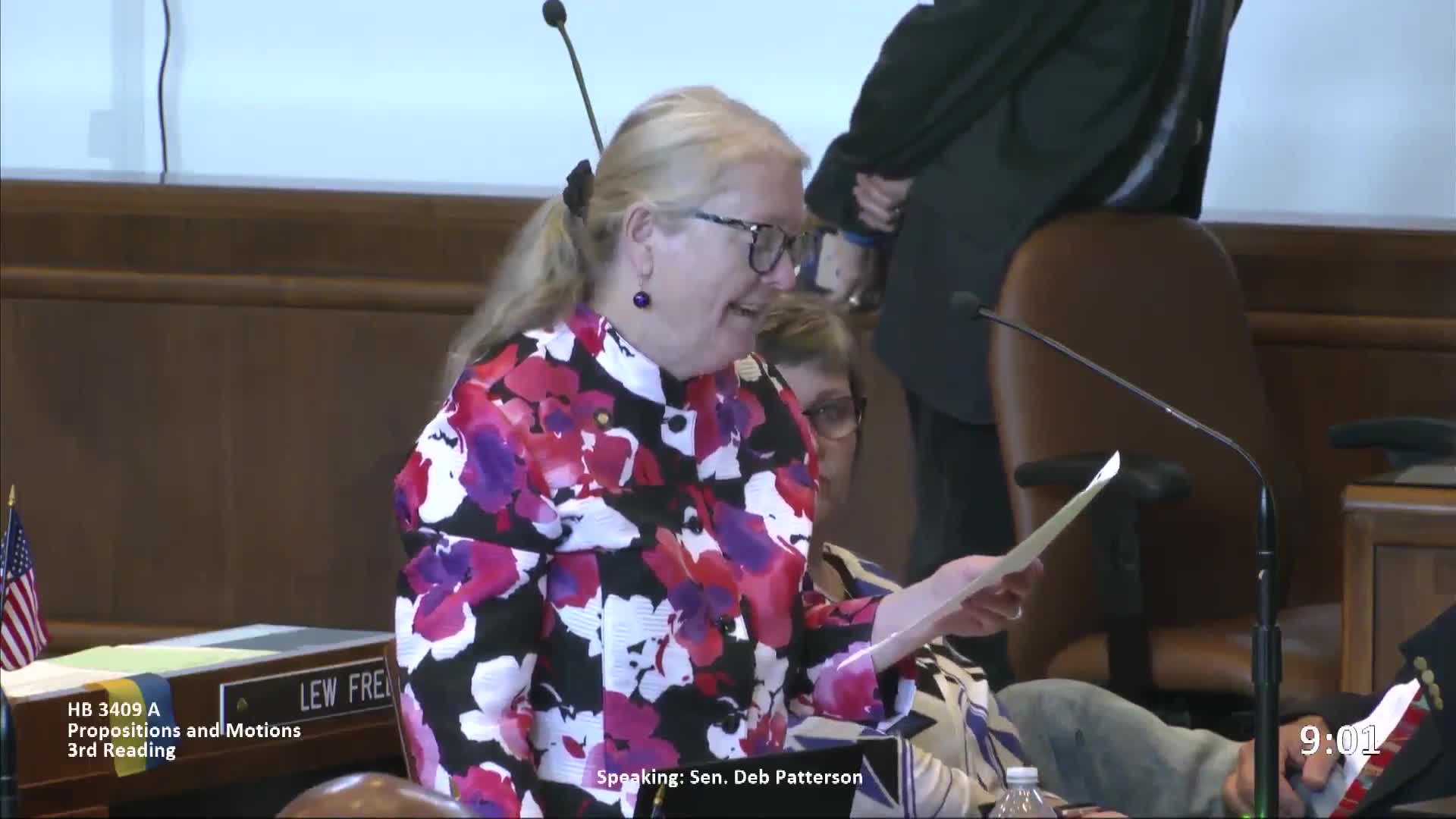
House Bill 3409 was described on the floor by Senator Patterson, who said the bill “simply allows, not requires, but allows” FQHCs to use a clearinghouse and explained how the current modifier workflow requires duplicate work by pharmacies and clinics. Patterson said pharmacies are often “2 to 3 days behind” and that the bill “lessen[s] the load” on providers serving low‑income Oregonians.
Opponents, led in floor remarks by Senator Linthicum, said the federal 340B program is administered by the Health Resources and Services Administration (HRSA) and that state changes should not ratify an existing private contract. Linthicum told colleagues HB 3409 “fails to define what a clearing house actually is” and raised concerns that a provisionally contracted for‑profit vendor could begin processing claims without public bidding or adequate transparency. Linthicum also cited pending federal proposals—the “Sustained 340B Act of 2024” and the “Rural 340B Access Act of 2025”—that include requirements for an independent clearinghouse, arguing Oregon should not preempt that federal work without guardrails.
Senator Hayden (floor minority comments) and others pressed proponents about who would benefit financially from routing 340B claim processing through a clearinghouse. Floor debate referenced a provisional contract with an entity identified in committee testimony as ParadigmRx (also heard in testimony as Rx Paradigm). Critics said advocates could not provide clear answers about contract terms, vendor fees, or the impact on the low‑income populations the 340B program is intended to help. Supporters responded that the statewide association of FQHCs had negotiated a provisional clearinghouse arrangement that would only take effect if the bill passed, and that the measure is designed to reduce administrative burden and help rural pharmacies stay open.
The Senate’s debate also included policy framing about how 340B funds flow. Opponents argued the bill could accelerate cost shifts from commercial insurers to public programs and to patients by changing how duplicate discounts and manufacturer rebates are managed. Proponents said the bill preserves existing federal protections and would give manufacturers and PBMs improved access to claims data through the clearinghouse, not reduce oversight.
After debate, the Senate voted and the clerk recorded that House Bill 3409 A “having received a constitutional majority is declared passed.” The roll‑call recorded multiple named votes in opposition; the minority substitution motion earlier in the day failed.
The bill takes effect under usual legislative processes; no implementation date was specified during floor remarks. The Senate did not adopt additional amendments on the floor and did not attach a requirement for a public procurement process or explicit state oversight of clearinghouse contracts during the session’s debate.
Supporters said the bill will streamline billing work for clinics and pharmacies caring for underserved Oregonians; opponents asked for more transparency on vendor contracts, fees and the potential downstream effects on premiums and senior benefits.
Legislators indicated further work at the federal level could change the regulatory landscape for clearinghouses; Senate discussion did not direct staff to prepare additional state oversight language or require notice of vendor contracts to the Legislature prior to implementation.