Get Full Government Meeting Transcripts, Videos, & Alerts Forever!
Get email alerts on the Capitol Restoration topic
No spam. Unsubscribe anytime.
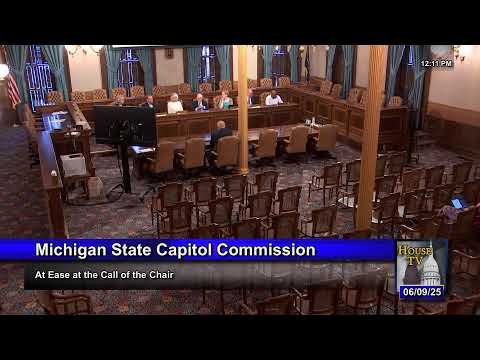
Capitol commission updates restoration projects; explores skylight solar and drone limits
Summary
The Michigan State Capitol Commission received an update on multiple restoration projects — Fourth Floor decorative painting, glass floor restoration and exterior dome inspection — and discussed potential voltaic skylights and tighter drone controls after a drone survey of the dome.
The Michigan State Capitol Commission on June 9 received progress reports on ongoing restoration work and initial plans for energy and drone policy changes.
Rob Blackshaw, the commission’s executive director, told commissioners that the Fourth Floor decorative painting is underway by contractor Evergreen and that crews found long-standing cracking in several brick archways. “The cracks are a lot less” on the north side, Blackshaw said, and a structural engineer’s technical analysis has not yet required structural reinforcement; staff plan to monitor the cracks and use flexible fillers in the plaster to reduce future cracking.
Blackshaw said the project’s West Side work will include removing and replacing a delaminated ceiling where leaked glycol and water historically affected plaster and paint. He described the East Side work as phase one and said scaffolding will remain in place as the project moves west after July 4.
The commission also heard an update on glass-floor restoration in the rotunda. Blackshaw said Lucid Glass completed rescans after some historic cast-iron openings proved uneven; 20 glass panels are installed, “another 20 to 30 arriving next week,” and staff expect about 50 panels in place by July 4. The glass-floor work remains on track to finish by next spring, he said.
Blackshaw reported that a drone firm completed a high-definition exterior inspection of the Capitol dome, allowing staff and architects to evaluate paint condition and loose metal without full scaffolding. He said the drone footage enables targeted repairs and is more cost efficient than full scaffolding inspections.
The director also described an exploratory study of voltaic skylights for the chamber: the skylights would use glass-like panels with embedded microcells and, according to Blackshaw, “the solar panels will definitely pull 30 to 40% off the electrical grid,” though he added the projected energy yield has not been finalized.
On drones, Blackshaw flagged security concerns after the drone inspection and said Representative Bill Brock is drafting legislative language; he described outreach with Michigan State Police and a recent drone symposium. “We’re even thinking about if the drones are allowed in the future,” Blackshaw said, adding the commission is considering permitting checklists and geofencing to protect the historic building.
The commission did not take a formal vote on restoration or energy items during the public session. Blackshaw said he will return with photographs, a dome assessment from architects and construction managers, and additional technical data for future meetings.
Details such as contractor names, panel counts and the projected finish window were presented during the executive director’s report and remain subject to further technical review and confirmation.