Get Full Government Meeting Transcripts, Videos, & Alerts Forever!
Get email alerts on the Climate Commitment Act topic
No spam. Unsubscribe anytime.
Washington officials brief Oregon senators on Climate Commitment Act, linkage and investment outcomes
Summary
Washington officials told the Oregon Senate Committee on Energy and Environment on June 9 that Washington’s Climate Commitment Act — the state’s cap-and-invest program — has been operating since Jan. 1, 2023, producing auction revenue directed to transportation, wildfire prevention, school HVAC upgrades and other climate and equity priorities.
Washington officials told the Oregon Senate Committee on Energy and Environment on June 9 that Washington’s Climate Commitment Act — the state’s cap-and-invest carbon program — has been operating since Jan. 1, 2023, generating auction revenue that Washington’s legislature has directed to transportation, wildfire prevention, school HVAC upgrades and other climate and equity priorities.
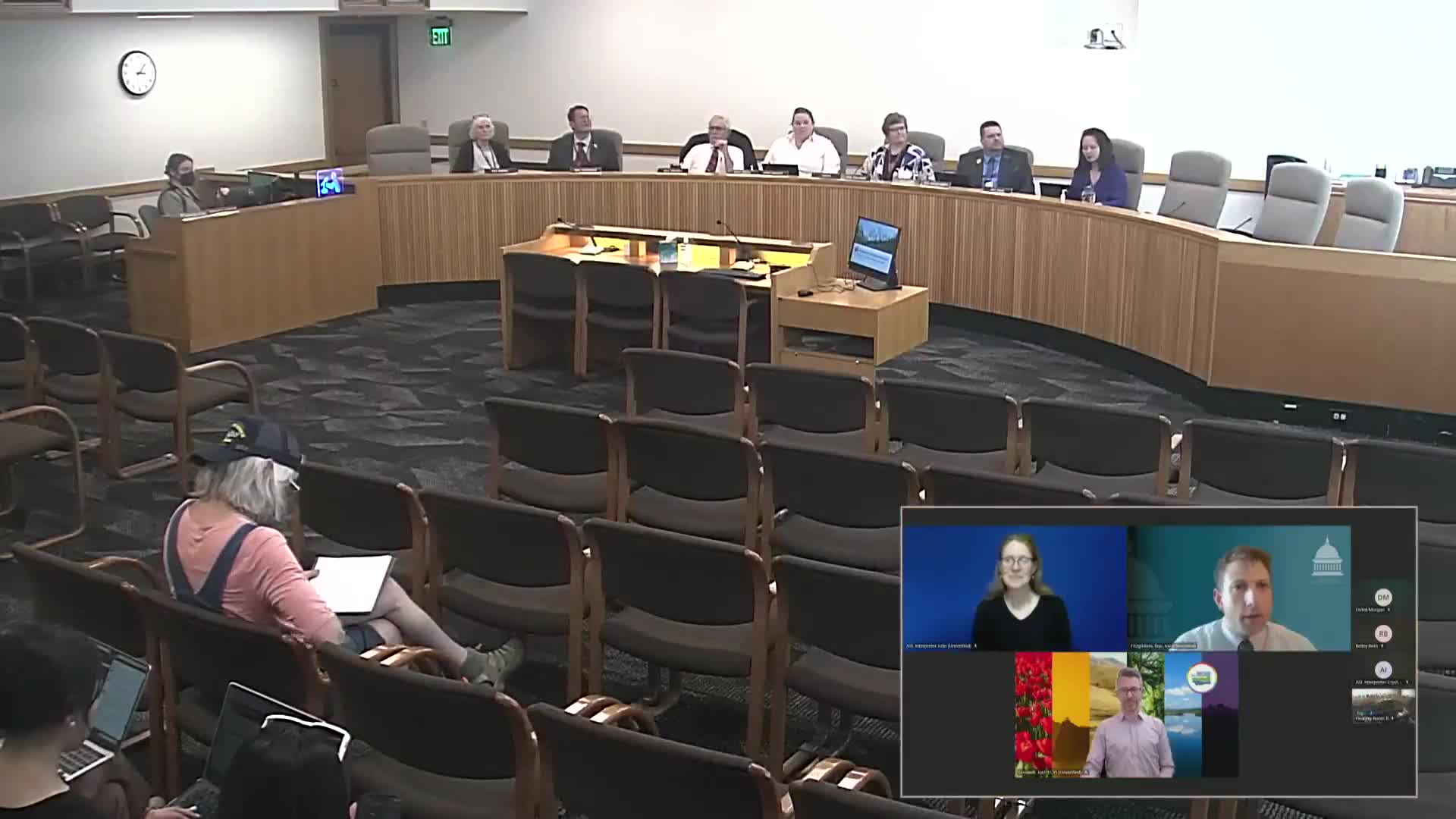
The hearing in Salem featured Representative Joe Fitzgibbon, House Majority Leader in the Washington State House of Representatives, and Joel Creswell, Climate Pollution Reduction Program Manager at the Washington State Department of Ecology, who described program mechanics, revenue flows and Washington’s work to negotiate linkage with California and Quebec. "The Climate Commitment Act's compliance functions began on January first of 2023," Fitzgibbon said, and he added that "Washington's program has been a great success." Joel Creswell described the program’s technical components and the statutes that require air-quality protections and targeted spending.
Why it matters: Oregon lawmakers are considering similar steps and asked how Washington’s experience affects market prices, fairness for trade‑exposed industries, the use of offsets and protections for communities already overburdened by air pollution. Washington officials said linkage with the larger California–Quebec market should lower and stabilize allowance costs and that program revenues have funded projects with direct statewide and local impacts.
Key program design and results - Scope and timeline: Fitzgibbon said the program covers roughly three‑quarters of Washington’s greenhouse gas emissions by regulating the state’s largest emitters; allowances decline each year so the cap tightens through 2050. He described the program as intended to align with statutory reduction targets (45% by 2030, 70% by 2040, 95% by 2050 relative to a 1990 baseline). - Auctions and revenue: Creswell said Washington holds quarterly auctions and reported proceeds of about $1.8 billion in 2023 and about $810 million in 2024, with total proceeds to the state described as roughly $2.8 billion to date. The program sets a price floor and ceiling; within that range the market clears auction prices. - Spending accounts: By statute most revenues flow into three top‑level accounts: the Carbon Emissions Reduction Account (focused on transportation), the Climate Investment Account (broader decarbonization) and the Air Quality and Health Disparities Improvement Account (targeting overburdened communities and tribal projects). Creswell said the statute requires that a portion of funds be prioritized for tribal projects (statutory tribal priority) and that at least a minimum percentage go to overburdened communities. - Air‑quality and environmental justice protections: Creswell described an expanded air‑quality monitoring network in 16 designated overburdened communities. The program requires monitoring and triggers — including restrictions on use of offsets — if air quality in those communities does not improve as emissions decline. - Offsets and protocols: Creswell said Washington has adopted four offset protocols to date — U.S. forestry, urban forestry, livestock methane capture and ozone‑depleting substances — and that offset credits are limited in the program. "Offset credits are limited. So you can only use offset credits for 8% of your compliance obligation. And then starting in 2027, that will drop to 6%," he said. Creswell also said Washington is developing a blue carbon (marine) protocol.
Questions from Oregon legislators Oregon senators asked about partisan divisions, competitiveness for trade‑exposed industries, rural impacts, forest carbon and fuel prices. Fitzgibbon acknowledged the program passed without bipartisan votes in 2021 but said bipartisan collaboration has increased during implementation and in appropriation decisions, particularly for capital and transportation budgets that distribute the auction proceeds. On competitiveness for emissions‑intensive, trade‑exposed industries, both speakers described allocations of no‑cost allowances to such firms to limit leakage and to protect ratepayers where utilities are concerned. Creswell explained those firms receive allocations on a per‑unit‑of‑production basis so they retain an incentive to reduce emissions.
Other implementation details and timelines Creswell outlined Washington’s linkage work: the state built its rules to be ready for linkage with California and Quebec, has done statutory updates and an environmental‑justice assessment, and is negotiating a linkage agreement that Washington hopes to execute in 2026 and begin joint auctions in 2026–27. He said most auctions to date have cleared above the price floor, though prices fluctuate.
Unanswered or limited items in the briefing Speakers acknowledged several limits on what the committee could assume from the briefing: Creswell said relatively few offsets have been issued so far in Washington (fewer than 10 projects, by his estimate); precise attribution of changes in retail fuel prices to the program is difficult because of global oil market factors; and several program details — such as exact future allocation formulas and the final terms of a linkage agreement — remain subject to ongoing rulemaking and negotiation.
What officials offered next Fitzgibbon and Creswell offered follow‑up contacts and said they would provide data and technical assistance to Oregon staff and legislators. Creswell said Ecology publishes an annual report and a searchable dashboard with project‑level spending details for Climate Commitment Act funds.
Ending Oregon senators thanked the witnesses and said they would follow up; both Washington guests said they were available to assist as Oregon continues to study and consider policy options.