Get Full Government Meeting Transcripts, Videos, & Alerts Forever!
Get email alerts on the Groundwater Quality topic
No spam. Unsubscribe anytime.
Committee hears broad support and concerns on update to Groundwater Quality Protection Act
Summary
Senate Bill 1154 (dash-A3) would revise Oregon’s Groundwater Quality Protection Act to improve early detection, agency coordination and community involvement in groundwater contamination responses; stakeholders largely supported updates but disagreed about how prescriptive the statute should be.
Senate Bill 1154 (dash-A3) would revise the 1989 Groundwater Quality Protection Act to strengthen early detection and response for groundwater contamination, clarify agency roles, and set procedures for local committees, assessments and action plans when contamination is detected.
Chandra Ferrari, natural resources policy adviser with the governor’s office, summarized why the bill was proposed: groundwater constitutes approximately 95% of Oregon’s freshwater and supplies some or all of the drinking water for roughly 80% of Oregonians and 90% of rural residents. SB 1154 creates clearer criteria and agency responsibilities for designating groundwater quality "areas of concern" (a yellow-light stage) and groundwater quality management areas (GUMAs, a red-light stage), requires formation of local committees for voluntary implementation plans, and authorizes the governor to appoint a lead agency and interagency team to develop action plans when a GUMA is designated.
The dash-A3 amendment narrows or clarifies several authorities after stakeholder meetings. The bill explicitly states the designation process does not give the Water Resources Department new authority to require measurement and reporting from domestic wells; on-site septic inspections require owner consent or a warrant; a prior provision allowing limitation on development in unconnected areas was removed; and most new OWRD authorities were removed except a narrowly defined water-right issuance in limited circumstances if contaminated domestic wells are voluntarily abandoned.
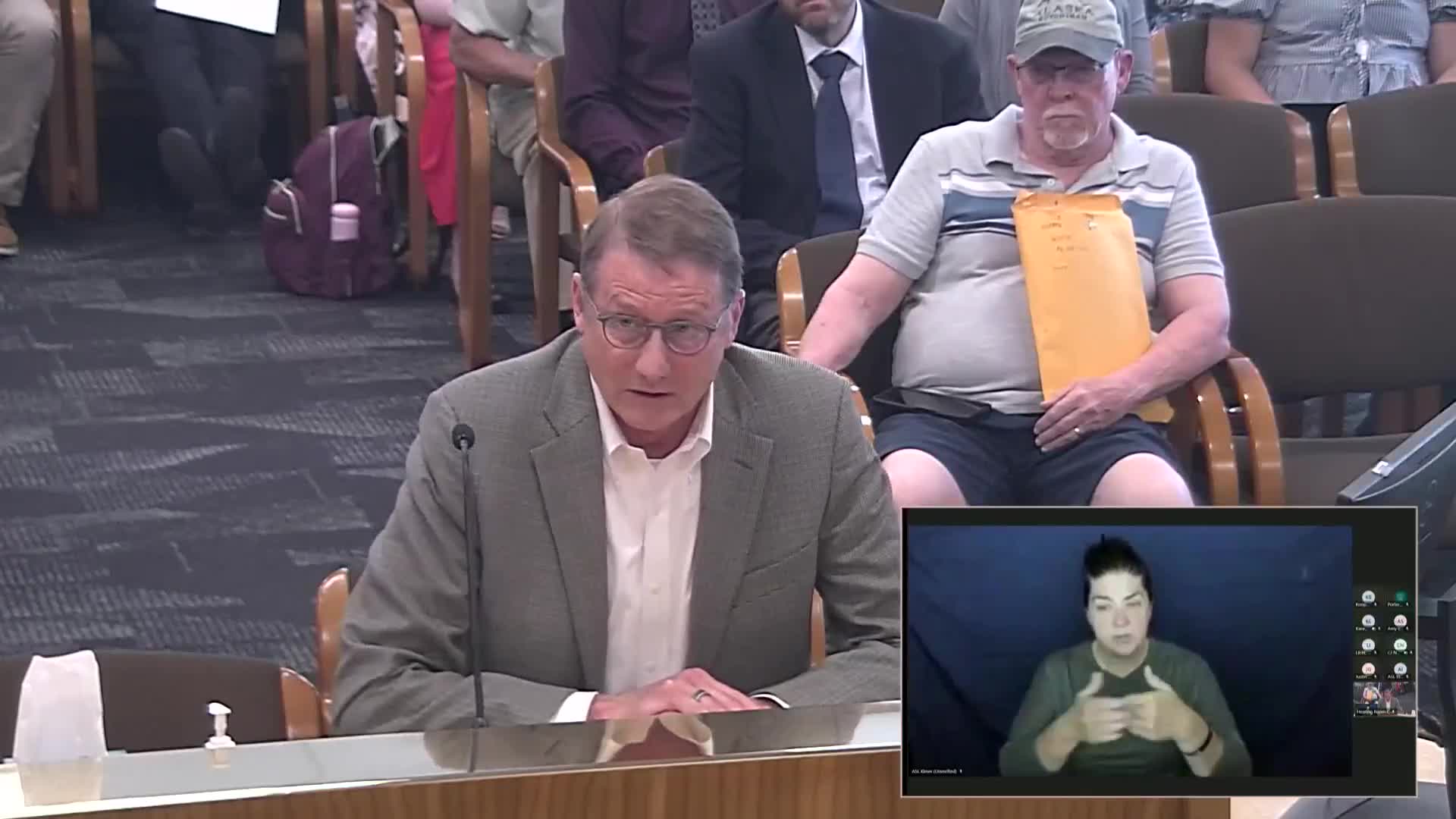
Public testimony was lengthy and mixed but broadly supportive of strengthening the statute. Speakers included: - Karen Lewatsky, Water Program Director, Oregon Environmental Council, in support and citing the Lower Umatilla Groundwater Management Area experience as demonstrating the need for clearer statutory tools. - Cheyenne Holiday, advocacy manager, Verde, urging the committee to adopt the bill to strengthen agency coordination and community engagement. - Caleb Lay, director of policy and research with Oregon Rural Action, described withdrawing support from an earlier version because specific mandatory agency actions had been removed, but said he hoped to re-engage if those provisions are restored. - Justin Green, executive director of Water for Eastern Oregon, supported interagency teams and asked for peer review of hydrogeologic findings when declaring areas of concern or management areas. - Greg Addington, executive director, Oregon Farm Bureau, said the bill addresses an identified problem and expressed organizational neutrality given remaining concerns about data sources and process; he praised progress through stakeholder engagement. - Amy Van Son, Center for Food Safety, said the dash-A3 amendment watered down mandatory regulatory tools and called for stronger measures to hold polluters accountable. - CJ Nugent, licensed water-well driller, offered technical suggestions, including consistency with existing statute for a 15,000 gallons-per-day figure (transcript notes a 5,000-gallon figure in the draft) and recommended required findings be cited in proposed orders.
Committee members asked clarifying questions about specific provisions, including the limited water-right issuance tied to voluntary abandonment of contaminated domestic wells and the protections for private well owners. No committee vote on SB 1154 was recorded in the transcript; the public hearing was closed after the testimony.
The record shows broad stakeholder engagement and disagreement over how prescriptive the statutory tools should be. The dash-A3 amendment reflects some changes made after stakeholder discussions, but several public witnesses urged either a stronger mandatory approach (to protect public health) or clearer scientific review and transparency before designations are made.