Get Full Government Meeting Transcripts, Videos, & Alerts Forever!
Get email alerts on the Natural Resources Reform topic
No spam. Unsubscribe anytime.
Senator Henskins reads lengthy Natural Resources amendments; Senate postpones action
Summary
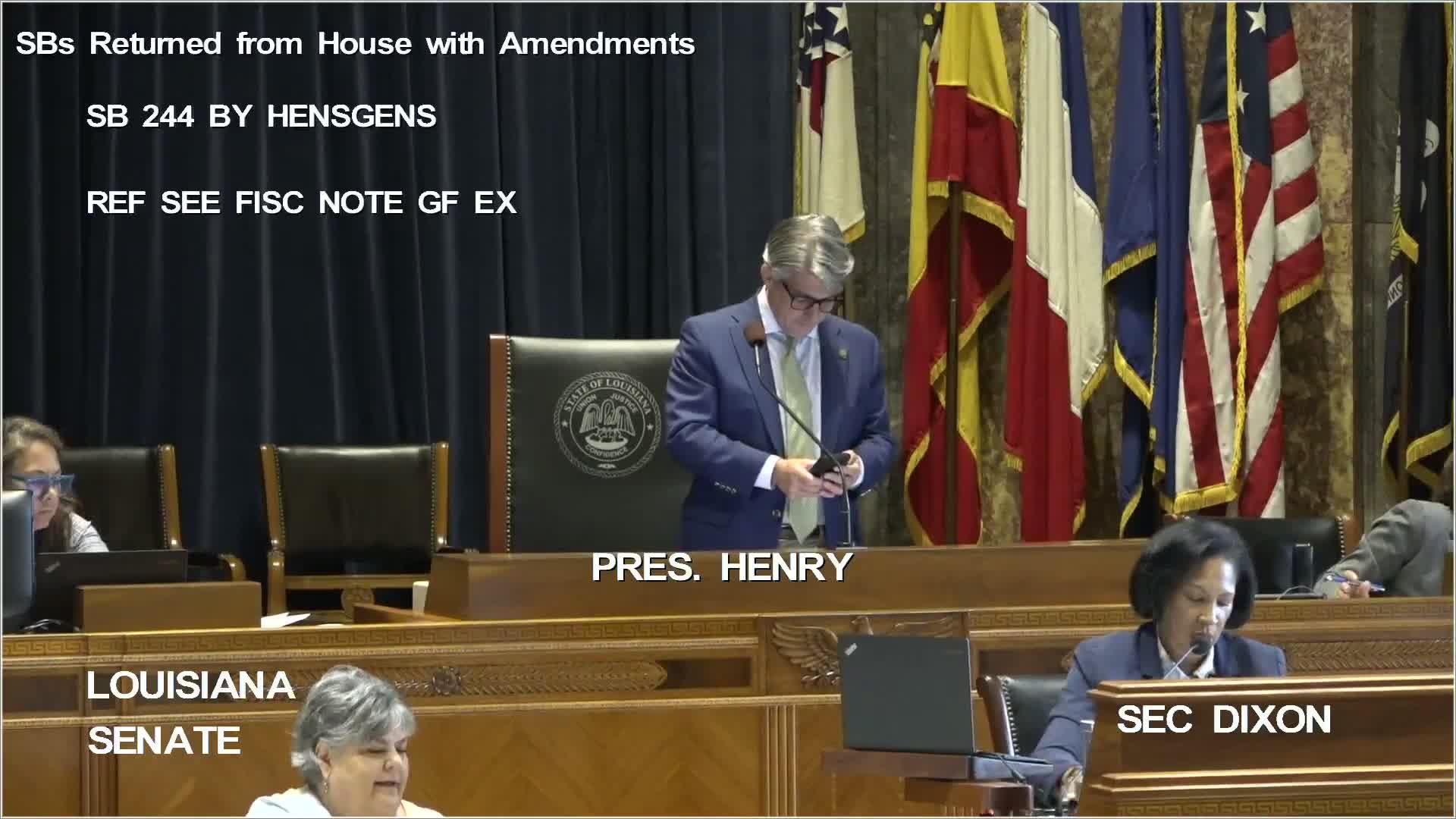
Senator Henskins spent nearly 20 minutes reading House amendments to Senate Bill 244 — a sweeping overhaul of the state’s natural-resources statutes — and told the Senate he would not ask for a vote today, instead asking the chamber to resume consideration the following day.
Senator Henskins spent an extended period on the floor reading House amendments to Senate Bill 244 — a comprehensive rewrite of statutes that would rename the Department of Natural Resources, create new offices, change bonding authority, and add provisions on carbon sequestration, pipelines, remediation, water resources and related fees and funds. After the reading, Henskins told the Senate he did not intend to seek concurrence today and asked that the bill be returned for further consideration tomorrow.
The bill contains dozens of substantive changes across energy, water and land-use law. Henskins described a voluntary alternative-dispute-resolution process under the department’s jurisdiction that would let parties select retired judges as hearing masters; those masters would issue draft decisions subject to 30-day review, and panels of three hearing masters would handle appeals of the ADR findings. The measure also revises how carbon dioxide pipelines are defined and when an operator can claim “common carrier” status — language that affects the use of eminent domain and whether the Louisiana Public Service Commission would have rate-setting oversight for certain lines.
Henskins outlined new notice requirements for certain well permits (class 5 and class 6), including a requirement the applicant make a reasonable search and good-faith effort to notify operators, mineral servitude owners, leaseholders and surface owners within specified distances or areas. The bill would require publication of certain geological sequestration applications on the department website and includes provisions authorizing confidential treatment of bid information during solicitation (with finalized bids becoming public once awarded).
On remediation, Henskins said the bill would require submission of an evaluation of a remediation plan within 180 days after a responsible party admits liability or a court finds liability, permit 30 days for alternate plans and comments, and direct courts to adopt the “most feasible” remediation plan unless another plan is proven superior by clear and convincing evidence. The bill would allow a party who meets regulatory standards to satisfy remediation responsibility and includes provisions about attorneys’ fees and how awards would be paid into court registry accounts. Henskins also noted a provision that would limit non-remediation damages to 300% of fair market value in some cases and set transitional rules tied to an effective date near 09/01/2027.
Henskins described numerous fiscal and fund changes: adjustments to how various resource and restoration fees are collected and invested (including use of the Louisiana Management Pool), changes to the natural resource financial security fund, and directions about the mineral and energy operation fund and carbon dioxide geological trust monies. He said the House added water-resources language to authorize a comprehensive program, establish state jurisdiction over water resources, and to alter several permitting and reporting requirements for wells — including removing some registration and construction standard mandates and changing inspection and measurement authority.
Multiple members asked for clarification during the reading. One senator noted the body would not act on the bill today and sought confirmation that Henskins intended to return the bill later; Henskins confirmed he would ask that the bill be brought back tomorrow to allow members time to study the changes. No vote was taken on the substance of the bill during this session.
Because of the breadth of changes and cross-jurisdictional consequences, Henskins told colleagues the reading was intended to give members line-and-page references so they could review the amended text prior to any final action.
Provisions described by Henskins reference the Department of Environmental Quality (DEQ), the Louisiana Department of Wildlife and Fisheries (LDWF), the Louisiana Public Service Commission, the Office of Mineral Resources, the natural resource commission, and existing statutory citations (including RS 30-related provisions) that the bill would amend or supersede. Henskins repeatedly framed the items he read as amendments that members should study before any concurrence vote.
Ending: The measure will return to the Senate calendar for further consideration; Senator Henskins asked the presiding officer to bring SB 244 back the next day so members can review the specific line- and page-numbered amendments.