Get Full Government Meeting Transcripts, Videos, & Alerts Forever!
Get email alerts on the Drug Testing topic
No spam. Unsubscribe anytime.
Board adds oral‑fluid testing to random drug‑testing options for probation and intervention participants
Summary
After a presentation from Vault Health and medical review officer Dr. James Ferguson, the Board of Registered Nursing voted unanimously to allow oral‑fluid (saliva) testing as an acceptable method for random drug testing in probation and intervention programs, subject to a contract addendum and program rules discussed at the meeting.
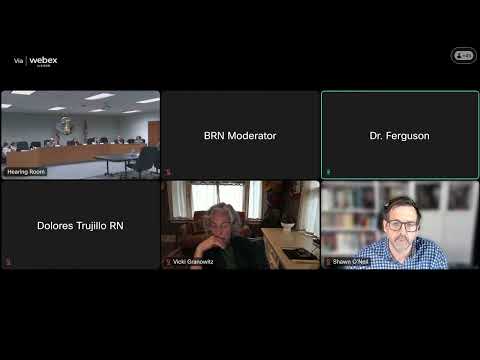
The California Board of Registered Nursing voted unanimously May 29 to permit oral‑fluid (commonly called saliva) testing as an acceptable method for random drug testing for probationers and intervention‑program participants, after a technical presentation from Vault Health and its medical review officer.
Board members heard detailed evidence about how oral‑fluid testing differs from urine, hair and blood testing and how programs should integrate multiple specimen types. Board Chair Tricia Wynne moved the motion to allow oral‑fluid testing; the motion was seconded and passed with votes from President Dolores Trujillo, Vice President Nilu Patel and other board members.
Why it matters: Board staff and members said oral‑fluid testing could make supervised collections more accessible and improve program compliance for participants who live far from collection sites. Vault Health described a “virtual monitored collection” workflow that lets participants use shipped kits and be monitored live by a collector through an online video connection.
Key facts and implementation details presented at the meeting: - Vault Health said a typical virtual bundle is five test kits (two tubes per test to enable a split specimen), and the kit set (five tests + shipping supplies) costs $35. Vault’s head, Sean O’Neill, described an online scheduling and live‑monitoring process in which kits are opened on camera, the collector verifies oral‑cavity suitability and the participant seals and ships the sample within 24 hours. - Medical review officer James Ferguson emphasized testing science differences: oral fluid is a distinct matrix (a mix of saliva and respiratory secretions) with a very short detection window for many drugs — typically 24–36 hours and in some cases up to 48 hours — and often detects parent compounds rather than urine metabolites. “We pretty much always call it oral fluid and not just saliva,” Ferguson said, noting variability of the specimen and the importance of mixing matrices for perspective on results. - Ferguson and Vault staff warned that collection devices vary and laboratory certification is device‑specific; programs should confirm at least two certified labs can process the chosen device to support split‑specimen confirmation testing. They said oral‑fluid point‑of‑collection screening devices are highly sensitive but not sufficiently specific for forensic actions, and they do not recommend oral‑fluid point‑of‑collection screening for forensic programs. - Turnaround times: Vault and Ferguson said screening negatives typically return rapidly; Vault estimated negatives reach labs and return in roughly two days assuming no shipping delays, with longer times for confirmatory testing on nonnegatives. Ferguson described a two‑stage screen/confirm laboratory workflow. - Labs and devices: Vault identified the immunoassay devices’ manufacturer class (an Abbott immunoassay device) and said it uses independent labs (CRL and DrugScan) for confirmation. Vault said it does not use Abbott laboratories for testing even though Abbott supplies some collection devices. - Not recommended uses: oral‑fluid testing is not recommended by Vault for alcohol biomarker testing (blood/PEth are preferred) and is not recommended as a stand‑alone point‑of‑collection forensic test.
Board action and next steps: The board voted to allow oral‑fluid testing as one tool in a mixed‑matrix random testing program. Vault and board staff explained the contractual step needed: an addendum to the board’s existing vendor contract that would add oral‑fluid testing under the same terms and conditions; only after that addendum is signed could Vault begin offering oral‑fluid collections as part of the program’s random schedule. Board counsel also warned about potential shipping and international logistics for participants traveling overseas.
Public comment and concerns: Public commenters asked how participants who already have informal permission to use virtual collections will be handled; staff said the contract addendum governs vendor capability and that probationers or intervention participants should contact their case manager or probation monitor about using virtual collections. Several board members pressed for clarity about lab certification and chain‑of‑custody issues.
What the board did not decide: The board did not change program rules beyond authorizing the vendor option and did not adopt new regulations. It left details such as when staff approval versus vendor discretion applies to the virtual option to operational guidance during the contract addendum process.
Ending note: Board members repeatedly emphasized oral fluid should be one of several random matrices used. Ferguson summarized the scientific message: “Follow‑up testing in a different matrix does not invalidate the previous result,” and recommended mixing matrices to provide perspective rather than to supplant other specimen types.