Get Full Government Meeting Transcripts, Videos, & Alerts Forever!
Get email alerts on the Budget topic
No spam. Unsubscribe anytime.
Fairbanks school board hears updated FY26 projection: $2.5 million surplus, but veto risk could force cuts
Summary
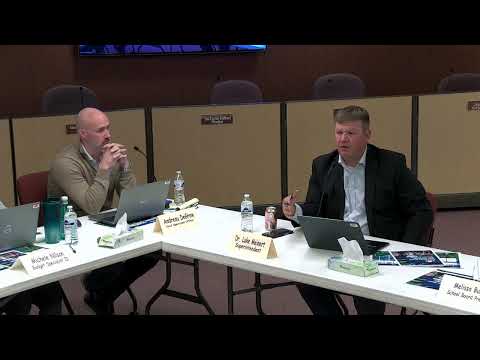
At a June 9 work session, the Fairbanks North Star Borough School District heard an updated FY26 budget outlook showing a preliminary $2.5 million top‑line surplus as Superintendent Dr. Luke Minor and Chief Operations Officer Andy DeGraw walked the board through new revenue and expenditure assumptions.
At a June 9 work session, the Fairbanks North Star Borough School District heard an updated FY26 budget outlook showing a preliminary $2.5 million top‑line surplus as Superintendent Dr. Luke Minor and Chief Operations Officer Andy DeGraw walked the board through new revenue and expenditure assumptions.
The update matters because the board must approve a final budget at a special meeting June 24, while the state’s final actions — including a possible gubernatorial line‑item veto by June 19 and the state’s recent failure of a disparity test — could reduce state support and force mid‑cycle cuts.
DeGraw said the district’s balancing‑act tool now shows about $2.5 million available after adjustments. "So just shy of $2,800,000 there" in additional local contribution, DeGraw said, and "we ended up getting about 15,800,000 from the $700 BSA increase." He also reported administration is comfortable increasing the district’s federal impact‑aid projection by roughly $650,000. Those gains are partly offset by an increase in charter allocations of about $750,000, DeGraw said, yielding the roughly $2.5 million surplus.
Minor told the board he would provide "more specific recommendations for the board based on known state level revenues" before the June 24 approved‑budget meeting. He cautioned the governor has until June 19 to act on portions of the state education budget and that the district does not yet know how a line‑item veto would affect final revenue.
Board members and staff discussed how to spend any add‑back funds if the surplus holds. Several board members said they prefer targeted, one‑time or narrowly scoped restorations rather than broad pupil‑teacher ratio (PTR) changes. Mr. Burgess said his top two priorities would be restoring Barnett magnet positions cut this year and adding high‑school counselors; he also listed CTE, reading supports and art as subsequent priorities. Several members supported using some of the borough’s additional local contribution as one‑time funding or to bolster fund balance rather than recurring spending.
On expenditure categories, DeGraw noted the recommended budget keeps elementary PTR at 26:1, reflected reductions to Barnett magnet staffing in the recommended budget, and includes a 2.5 FTE reduction in secondary counselors that the board could consider adding back. He also flagged curriculum and laptop replacement as reduced in the recommended budget and described transportation as currently subsidized $2.0 million from the general fund; at current route levels DeGraw said the transportation program faces roughly a $3.5 million deficit, but with about $1 million recently added to statewide transportation funding the district expects the transportation fund shortfall to be nearer $500,000 next year.
Board members asked for granular, line‑item scenarios that administration can present prior to June 24. DeGraw told the board he would prepare more detailed add‑back options (for example, partial FTEs such as a 0.6 position) and dollar estimates so the board could choose targeted restorations instead of broad PTR changes.
Members and staff also discussed external risks. DeGraw said the state recently failed the disparity test — an outcome that could involve roughly $80 million at the state level — and that the state intends to appeal. He said it remains unclear how any judgment would be distributed among districts and that the district is monitoring the situation. Board members asked about two bills the administration referenced: HB 57 and SB 113, which administrators said remain on the governor’s desk and could affect available funding for reading interventions and CTE; DeGraw said there were no definitive updates on either bill but that the governor has until June 19 to act.
Administrators also warned of possible federal changes: DeGraw said a proposed 15% cut to some federal education funds is under discussion in Congress and could represent roughly a $1 million to $2 million hit to the district, depending on definitions and final language.
On reserves and fund balance, DeGraw said the district expects a decline in fund balance this fiscal year on the order of $3 million to $5 million, and he estimated the district’s current fund balance before that decline had been roughly $8 million to $10 million. He said final numbers will take several weeks to settle because of turnover in the accounting office and usual year‑end processes; administration expects an update in mid‑July.
Board members and administrators discussed program‑level options administrators could present for targeted investment: middle‑school reading coaches or short‑term instructional staff to run focused intervention groups; partial FTE restorations at specific schools; district‑level STEM or science teacher positions; expanded CTE access via restored shuttle services between Lathrop and Hutch; and focused magnet supports at Barnett and Hutchison. Danette Peterson’s emailed recommendations — referenced repeatedly by board members — will be included in the materials administration provides before June 24, administrators said.
No formal motions or votes were taken at the June 9 work session. Administration said it will continue to update the board as state and federal developments crystallize and will add detailed add‑back and cut scenarios to the balancing‑act tool ahead of the approved‑budget meeting June 24.
The board will consider the final FY26 budget after the governor’s decisions by June 19 and at the scheduled June 24 approved‑budget meeting.