Get Full Government Meeting Transcripts, Videos, & Alerts Forever!
Get email alerts on the School Budget topic
No spam. Unsubscribe anytime.
Independent consultants warn of large deficit; board approves budget adjustments and schedules tax scenarios for next meeting
Summary
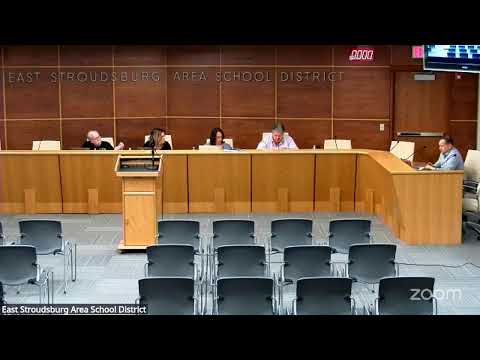
Consultants who reviewed East Stroudsburg Area School District finances told the district finance committee that the district faces a material budget shortfall and recommended adjustments to the preliminary 2025–26 budget that the committee voted to advance for board consideration.
Consultants who reviewed East Stroudsburg Area School District finances told the district finance committee that the district faces a material budget shortfall and recommended adjustments to the preliminary 2025–26 budget that the committee voted to advance for board consideration.
"Hello. Good evening, everyone. My name is Jim Marabelli," said Jim Marabelli of School of Business Consultants, who presented the review along with Joe Caputo. Marabelli summarized his team’s independent analysis of revenues and expenditures and described adjustments the consultants recommended to the preliminary budget.
The consultants said current-year variances and policy choices have produced what they view as a realistic shortfall: a projected $12,700,000 deficit for 2024–25 and, after proposed adjustments, a $28,300,000 gap for 2025–26. "After everything you just the 25/26, we're looking at $185,600,000 in revenue versus $214,000,000 in expenditures for a deficit of $28,300,000," Marabelli said during the presentation. The consultants said their estimate is independent of internal forecasts and built from district accounting records, audited financials, and state reporting.
Why it matters
The consultants pointed to a set of drivers that together widened the gap: a large increase in salary and benefit costs tied to a newly ratified teacher contract, unusually high health-insurance claims and a late premium payment to the district’s self-insured trust, higher special-education and charter-school tuition costs, and more modest local tax growth after assessment appeals.
Key findings and figures
- Teacher salaries and benefits rose sharply in 2024–25 after a new contract. The consultants reported teacher salaries rose from roughly $46 million in 2023–24 to about $54 million in 2024–25, an increase the consultants attributed largely to the new contract and step movement.
- Health insurance: the consultants said the district discovered approximately $1,600,000 in unpaid retiree premium remittances to the district’s health trust. They reported projected health-care spending of about $27,000,000 for the current year versus the $22,000,000 the budget assumed.
- Charter tuition: the presentation said the district budgeted $8,750,000 for charter-school tuition but projected actual payments near $11,000,000 for 2024–25. Consultants said they caught a PDE-363 filing error—"the PDE 363 was filed based on 24/25 expenditures rather than 23/24," Marabelli said—and expect to recover about $1,450,000 through reconciliation, reducing the near-term outflow but leaving an elevated baseline for next year unless state tuition reform occurs.
- Local revenue and assessed value trends: presenters used county-assessed-value data to show local (real-estate) revenue has been essentially flat for years and that post-reassessment commercial assessment appeals reduced the tax base. The consultants said delinquent- and current-tax receipts have been inconsistent and recommended more conservative budgeting of those receipts.
- Per-student spending: the consultants noted East Stroudsburg’s 2024 per-pupil spending at about $25,006.71, higher than the regional intermediate unit (CIU 20) and state averages they showed.
Recommendations presented
Consultants recommended a combination of revenue- and expense-side steps and operational changes the committee asked staff to implement and present as a revised preliminary budget at the next public board meeting. Recommendations included:
- Adjust revenue assumptions downward (the consultants recommended dropping roughly $2.8 million of optimistic revenue assumptions used in the preliminary budget).
- Add a conservative $1,450,000 marker for charter tuition in 2025–26 absent state reform.
- Reverse prior-year receivable entries promptly after each audit (the presenters said delaying these reversals hides the district’s live financial position and recommended reversing them in July following audit close so monthly reports reflect current-year reality).
- Use Forecast5 analytics and more consistent historical-trend inputs (the consultants flagged entries remaining on the balance sheet that distort month-by-month forecasting).
- Critically evaluate staffing and use the district’s salary module to reflect live position data (the consultants said the district’s CSIU-integrated budgeting and payroll tools now allow position-level accuracy and recommended leveraging that for ongoing budget management).
- Shift certain cafeteria monitor positions and other legitimate food-service expenses from the general fund to the cafeteria fund to reduce general-fund expenses where allowable under federal and state food-service rules.
Discussion and reactions
Board members and staff pressed on details: several asked whether budget variances were timing issues (receivables/payables not reversed) or structural changes, and presenters said both factors exist. Marabelli and Caputo repeatedly framed their analysis as conservative and independent: "This is completely independent, and we relied on the best data available," Marabelli said.
Board members also asked about potential offsets: refinancing debt, relying on prospective state aid increases (including the district’s recently received tax-equity supplement), and legislative changes to charter funding. Marabelli said a pending state policy change to charter tuition could materially reduce charter payments (he cited a hypothetical $5.3 million reduction if certain reform passes) but emphasized that the district should not budget that savings until the change is enacted.
Votes and next steps
The finance committee voted to direct administration to update the preliminary 2025–26 budget to incorporate the consultants’ recommended adjustments and to present the revised budget, plus a set of tax-rate options (0%, 2%, 4% and the Act 1 index of 5.6%), at the full board meeting scheduled for July 16. Committee members asked the presentation to include net cost to taxpayers after homestead rebates.
Committee members also approved a slate of facilities, curriculum and technology purchases and contracts presented during the meeting; those approvals were moved and carried by voice votes during the session (items were budgeted and/or funded by grants where specified).
Ending
Marabelli and Caputo concluded by urging the committee to use the revised assumptions and management changes to produce a clearer fiscal picture before the board adopts final 2025–26 budgets and tax rates. The committee scheduled the updated budget and tax-option materials for the next board meeting and asked administration to prepare scenario slides showing the revenue impact and the homestead-rebate-adjusted cost to taxpayers for the 0/2/4/5.6% scenarios.
Votes at a glance
- Approve purchase of two St. Luke's-funded UTV hydration vehicles (powersports): approved by voice vote. - Approve purchase of portable metal detector posts and associated iPads (school security equipment): approved by voice vote. - Approve consultants’ recommended preliminary budget adjustments and direction to present revised budget and tax scenarios at next meeting: approved by voice vote. - Approve curriculum and instructional material purchases (French/German/Spanish materials, business and consumer-math resources, assessment platforms, restorative-practices professional development): approved by voice vote. - Approve multiple facilities and capital contract payments as listed on the agenda (roofing, flooring, natatorium work, generator and sprinkler work): approved by voice vote.
(Committee roll-call detail for each vote was not specified in the meeting transcript; approvals were recorded by unanimous or majority voice votes during the session.)