Get Full Government Meeting Transcripts, Videos, & Alerts Forever!
Get email alerts on the Conditional Use Permit topic
No spam. Unsubscribe anytime.
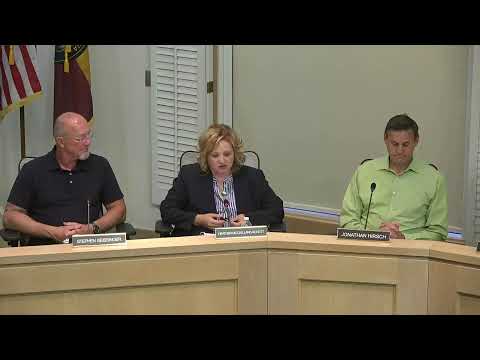
Poquoson planning commission reaffirms denial of front-yard pickleball court after neighbors object
Summary
The Poquoson Planning Commission voted to recommend denial of Greg Shaw’s conditional use permit to install a private pickleball court in a front/side-yard area at 8 Rochambeau Drive after neighbor objections over noise, lighting and property value concerns; commissioners also noted the application did not change the legal zoning question.
The Poquoson Planning Commission on May 19 recommended denial of a conditional use permit for a private pickleball court at 8 Rochambeau Drive, the property of applicant Greg Shaw. The commission voted to adopt Resolution B, recommending denial of the applicant’s request after neighbors, including Rob Small speaking for his mother Shirley Small of 3 Rochambeau Drive, raised new objections about noise, lighting and potential property-value impacts.
Neighbors told the commission they now oppose the court after learning more about the installation and its proximity to adjacent houses. "It's the ping of the pickle ball... it's the impulse noise that's the real problem," said Rob Small, who said all neighbors on Rochambeau Drive had objected. Small cited articles and research he submitted to the commission and told members the Perez family — Carlos and Carol Perez, who live adjacent to the proposed court — had filed an objection after learning more about the plan.
Applicant Greg Shaw, who described the proposed court as sited in a portion of his property that he said is more like a side or backyard than a front yard, told the commission the project would comply with city ordinances on noise and lighting. Shaw said his handheld readings were about 55 decibels and he used a conservative 70-decibel figure for calculations. He told commissioners, "When you go into a house from outside, that decibel value drops 20 decibels," and argued that the city ordinance measures interior noise and that his project would fall within those standards.
Commission members debated whether the proposed court was consistent with RS (low-density single-family) zoning and whether new conditions added by the City Council — painting the court to blend with the ground and adding additional shrubs — would meaningfully address neighbors’ concerns. Chairwoman Schott said she could not support the application, citing the ordinance’s intent for low-density residential areas: "I cannot support this application." Several commissioners said the dispute was not about pickleball as a sport but whether the use was appropriate in that front/side setting under existing zoning.
Commission discussion cited other factual points presented at the hearing: the applicant proposed two 15-foot light poles for evening play; Shaw said lights would be used only during play, not continuously. Rob Small said he provided a packet of approximately 125 pages of material to commissioners and that articles he included suggested courts adjacent to residences can reduce property values; Shaw and other speakers countered that those studies involved multiple courts in community settings, not a single private residential court.
The commission considered options including reaffirming its prior denial, taking a new vote that night, or postponing until absent members could attend. The body voted to adopt Resolution B to recommend denial; the chair announced, "The recommendation is denied." The denial was a recommendation to City Council, consistent with the commission’s role in the conditional use process.
The commission’s record shows neighbors raised concerns about impulse noise, additional nighttime lighting, and localized property impacts; the applicant and his spouse, DeShaw Shaw, said the court was intended for family use and casual play and argued it would be sited and screened to reduce visibility. The commission’s action was procedural (a recommendation to City Council) and not an alteration of the city’s zoning code.
What’s next: the commission’s recommendation will be transmitted to the City Council for its consideration under the conditional use permit process. The commission also used the discussion to underscore that applicants must show consistency with the city’s RS zoning standards and applicable ordinances; the commission did not adopt any variance or condition beyond its recommendation of denial.