
Anchorage utilities advance joint waste‑to‑energy effort; regulators and technical hurdles remain
Get AI-powered insights, summaries, and transcripts
Subscribe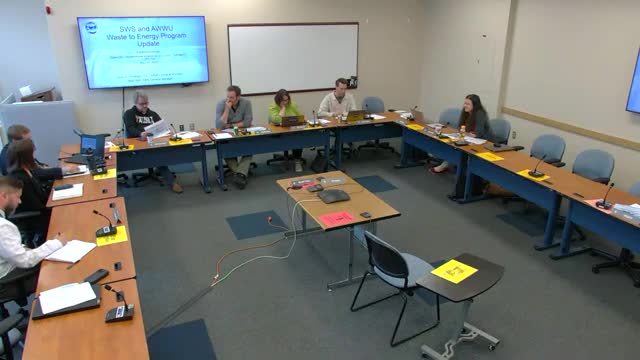
Summary
Anchorage Water & Wastewater and Solid Waste Services told the assembly their joint waste‑to‑energy program has moved from concept to procurement planning, but regulators rejected an alternate SEP and technical work on landfill gas and leachate treatment continues
Anchorage Water & Wastewater (AW) and Solid Waste Services (SWS) staff told the Infrastructure, Enterprise and Utility Oversight Committee on May 31 that their joint waste‑to‑energy program has progressed from conceptual approval to active procurement planning and stakeholder outreach, but regulators have rejected an initial supplemental emissions project (SEP) proposal and technical and permitting work remains.
David Persinger, general manager of Anchorage Water & Wastewater Utility, said the program has completed a kickoff, set vision and goals, and is preparing requests for proposals (RFPs) with the municipal purchasing office. He said selection‑committee drafts are in progress and that project managers are beginning stakeholder engagement with energy partners, Anchorage International Airport, JBER and technology providers such as Arctic Slope Regional Corporation.
Kelly Toth, general manager of Solid Waste Services, said the municipality’s compliance order by consent (COBC) remains in process and that regulators rejected the alternate SEP the agency proposed. Toth said SWS is working constructively with regulators and pursuing partnership approaches to identify feasible technical solutions for landfill gas issues. She said a new flare blower and panel procurement has been signed for another project and that materials are on order.
On leachate and PFAS treatment, staff said earlier deep injection and large‑scale evaporation options were not viable; they described a planned hybrid pretreatment approach and said they will convene the Solid Waste Association of North America (SWANA) to host a full‑day PFAS training for municipal staff and stakeholders to explore treatment options. Persinger said the program will perform benchmark testing and seek technical guidance from Alaska Department of Environmental Conservation (ADEC) water staff before committing to final disposal or discharge approaches.
Staff also summarized publicly available plant operations: the municipality currently incinerates biosolids at the Aspen wastewater plant and cited a throughput figure of about 20 tons per day of sludge from that facility. Persinger and Toth showed examples of operating waste‑to‑energy plants, and Persinger highlighted an economic case for beneficial use rather than routine flaring of landfill gas.
Financial exposure tied to the COBC was discussed. Municipal staff said the potential value of fines linked to landfill gas exceedances was about $200,000 and that spending $271,000 on a supplemental environmental project could offset that exposure if the agencies agree on a SEP approach; staff stressed the figures are for planning and are tied to regulator negotiations.
No final technical choice was made at the meeting. Staff said next steps include finalizing RFPs, continuing stakeholder engagement, scheduling a potential site visit or “lunch and learn” at the Central Transfer Station for committee members, convening national expertise on PFAS treatment, and submitting revised permit packages to EPA for the wastewater plant process in early June.
Clarifying details from the meeting: the COBC remains active and the municipality’s alternate SEP was rejected and reworked with regulators; the potential fine exposure without a SEP was cited as $200,000 and an SEP cost estimate of $271,000 was discussed; Aspen wastewater incineration was described at about 20 tons of sludge per day; staff plans to submit a revised wastewater permit package to EPA in early June and to host a SWANA PFAS training to inform technical choices.