
Assembly questions cost and scope of Jacobs amendment for Anchorage Water and Wastewater strategic plan; no vote taken
Get AI-powered insights, summaries, and transcripts
Subscribe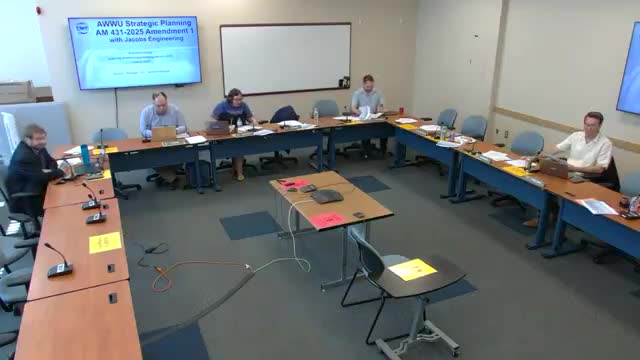
Summary
At a June 6 Anchorage Municipality work session, Anchorage Water and Wastewater Utility (AWWU) General Manager David Persinger presented a proposed amendment to a Jacobs Engineering Group contract to move from a drafted strategic plan into implementation under the Effective Utility Management framework.
At a June 6 Anchorage Municipality work session, Anchorage Water and Wastewater Utility (AWWU) General Manager David Persinger presented a proposed amendment to a Jacobs Engineering Group contract to move from a drafted strategic plan into implementation under the Effective Utility Management framework. The assembly asked for a detailed cost breakdown and additional documentation; no vote was taken.
Persinger said the work will focus on four strategic goal areas — community sustainability, financial viability, operational optimization, and employee leadership and development — and emphasized a deep dive on employee and executive leadership development, plus building key performance indicators and a public-facing dashboard. "Our mission is to protect the health and welfare of the public and the environment by providing responsible water and wastewater services," Persinger said.
Why this matters: AWWU’s capital program and workforce directly affect customer rates and service reliability. Persinger told the assembly the utility runs a capital improvement program of roughly $70,000,000 a year, and that the customer information system (CIS) supports about $10,000,000 in monthly fee collections. He also stressed workforce continuity: AWWU has roughly 285 positions, more than 100 licensed operators, and it can take "5 to 7 years" to train and fully certify a new operator.
Presentation and scope: Persinger said AWWU initiated strategic planning via an RFP in 2023 and executed a contract in 2024 for about $125,000 to develop a strategic plan based on the EUM framework (a framework created by water-sector organizations and endorsed by the U.S. Environmental Protection Agency). The current amendment — first introduced May 20 and described in documents as an "A version" after revisions — would fund implementation tasks that Persinger described as facilitation, workshops, KPI/dashboard support, executive coaching, and team-building for division and executive leadership.
Costs and contested items: Several assembly members probed line-item costs. Assembly member Johnson said the proposal "feels a bit spendy to me," pointing to Jacobs’ listed contractor rates (Persinger referred to contractor billing at roughly $400 an hour for on-site staff) and per-trip travel figures in the proposal (Persinger read examples including $700-a-night hotel charges, $1,200 each-way airfare for the on-site facilitator, and $200 per-day meals). The proposal’s sample workshop price cited in materials included a 20-hour, $8,000 team-building workshop. Persinger said he had worked with the contractor to reduce the amendment by roughly $64,000 by trimming executive coaching, consolidating workshops and reducing trips.
Value and alternatives: Assembly members asked whether similarly qualified local contractors could perform the work and whether the administration should issue a new RFP for implementation services. Persinger said the contractor team (Jacobs with subcontractor Beate Wright/ULLC) already led the strategic-plan development and that continuing with the same facilitator carries institutional knowledge and continuity. He cited examples of large utilities using EUM, naming the New York City Department of Environmental Protection and DC Water as users of the framework.
Requests and next steps: Multiple assembly members requested a supplemental memo with a clearer cost and scope breakdown showing what portions are EUM-specific (framework adoption and KPI setup) versus other consulting services (team building, executive coaching, travel). The administration said the amended scope runs into 2026 for some deliverables and that the A-version will be placed on a future agenda for formal consideration. No motion or vote occurred during the work session.
Context and risk: Persinger framed workforce retention as the main driver: he described recent turnover, including a licensed operator who left after a 12-year AWWU career, and warned of broader recruitment pressure from private utilities and out-of-state opportunities. He also noted that changing the state’s historical-test-year rate process would require legislative action; his remarks about rate-setting described the existing Alaska regulatory approach as backward-looking (rates set on a historical test year). Assembly members emphasized fiscal stewardship and asked for comparisons that show the long-run value of the proposed investment in leadership development.
Ending: The assembly asked for supplemental budget details and implementation examples; Persinger said he would provide those materials and that the administration expects an amended contract item to appear on a forthcoming agenda for formal action.