Get Full Government Meeting Transcripts, Videos, & Alerts Forever!
Get email alerts on the State Budget topic
No spam. Unsubscribe anytime.
Durham delegation warns budget uncertainty could reduce services for Medicaid, public health and schools
Summary
Delegation members told Durham County officials that House and Senate budget proposals differ sharply, conference negotiations are pending and several program areas relied on by the county — Medicaid administration, SNAP, child care subsidies, HBCU capital, and school capital — face cuts or structural changes that could shift costs to counties.
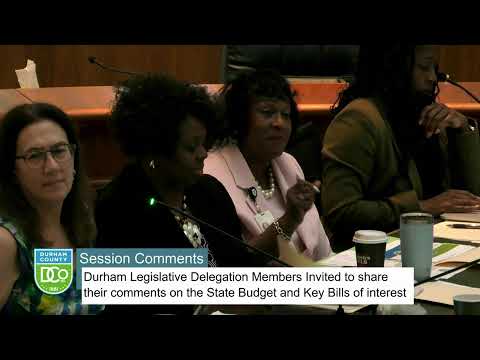
Durham County officials and members of the county's legislative delegation met to review the state budget outlook and locally targeted proposals, and delegation members said both chambers have produced divergent budgets and a conference committee had not yet been established.
The delegation briefed county leaders that the House and Senate budgets differ on taxes, spending priorities and program structures. Delegation members and county staff said an unresolved fiscal picture could delay or reduce funding for programs counties rely on for health, social services and education.
Why it matters: county leaders warned the meeting that proposed tax cuts in the state plans, lower revenue projections and federal funding reductions together make it unclear which state programs will be funded. Durham County officials said that if programs are cut or centralized at the state level, counties could see greater service demands without matching revenue.
Delegation members called out several specific areas of local concern. Durham Public Health and Social Services staff and county leaders described program-by-program risks: possible centralization of Medicaid casework, proposed Medicaid work and eligibility verification rules, cuts to SNAP-related nutrition programming and public-health capacity, uncertainty on child-care subsidy funding, and continued expansion of private school voucher funding.
DSS director Maggie Clapp identified one specific provision in the House budget that county staff said could have immediate operational impact. Clapp said the centralization language appears in the House budget and pointed county officials to the citation in that draft: "It is in the House budget bill. It can be found on page 2251, line 2 to 23," adding that county directors are still seeking clarity on whether the provision would move operations to the state or fund a statewide workforce model.
County staff described how a move to centralized Medicaid administration could affect vulnerable clients and county operations: fewer in-person caseworker interactions, loss of local relationships that help avoid service disruptions (for example, preventing a long-term-care discharge when paperwork is delayed), and potential transfer of administrative costs to counties even if service operations move to a state office.
Delegation members also highlighted other budget items affecting Durham: Senate draft funding that would allocate $100 million for renovations at North Carolina Central University (not present in the House draft), and a multibillion-dollar biennial allocation for private school vouchers that delegation members said would divert resources from public schools in future years. Delegation members described the voucher allocation in the current biennial proposals at roughly $1.3 billion over two years.
County leaders raised public-health and safety concerns tied to federal funding changes. Delegation members and staff warned the group that federal cuts already discussed at the congressional level could reduce epidemiology and pandemic-response capacity; locally, staff pointed to recent reductions in HIV and STI testing funds and to programs such as double-bucks farmers-market incentives that augment food access for low-income residents.
On correctional-health costs, delegation members highlighted a pending state change (HB546, Medicaid modernization) that the group said could reduce county jail health-care expenses. County officials reported they currently spend millions annually on detainee health care and welcomed language that could shift some care to Medicaid coverage.
Delegation members said conference negotiations will determine which items survive and encouraged county leaders to keep communicating priorities. County officials said they will continue to seek clarifying language from DHHS and from conferees because many proposals remain unclear in draft budget language.
Ending: Delegation members asked county staff to continue outreach to legislative conferees and to other counties to build coalitions; county leaders said they will follow up with DHHS on the proposed centralization language and with the delegation on HBCU and school capital requests.