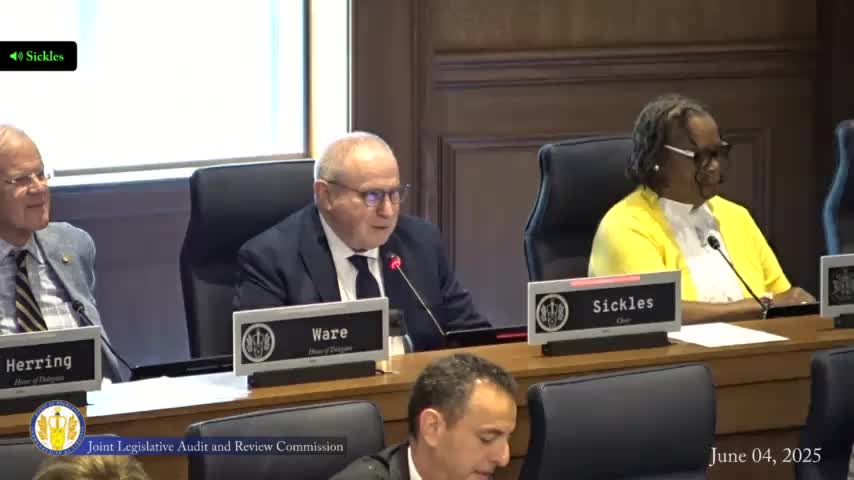
JLARC: Transferring Virginia—s juvenile justice agency to HHR would not guarantee better services, could risk public-safety focus
Loading...
Summary
The Joint Legislative Audit and Review Commission staff presented findings that transferring the Virginia Department of Juvenile Justice from the Public Safety secretariat to the Health and Human Resources secretariat would not by itself ensure better access to services for court‑involved youth and could compromise DJJ—s public‑safety mission.
The Joint Legislative Audit and Review Commission staff presented findings that transferring the Virginia Department of Juvenile Justice from the Public Safety secretariat to the Health and Human Resources secretariat would not by itself ensure better access to services for court‑involved youth and could compromise DJJ—s public‑safety mission.
Britney Utz, who led JLARC—s study, said, "DJJ already provides a range of rehabilitative services to youth which are similar to HHR services and reportedly more accessible." The study team described DJJ—s regional service coordinator (RSC) model and said it has expanded provider networks and emphasized timely delivery of services.
Why this matters: the proposal to move DJJ was prompted by advocates who contend alignment under HHR could improve access to behavioral‑health and social services for youth. JLARC—s review combined interviews with current and former secretaries and agency directors, DJJ staff, public defenders and commonwealth—s attorneys, and national experts to weigh feasibility, costs and benefits.
Key findings: JLARC staff said many court‑involved youth already receive similar services through DJJ—s RSC model, which contracts with Evidence Based Associates to coordinate statewide service providers and requires service delivery timelines (JLARC noted RSC services are typically available more quickly than comparable HHR services). The commission—s staff also reported that other states split about evenly on whether juvenile justice sits under public safety or HHR, and there is no clear evidence that organizational placement alone drives rehabilitative outcomes.
JLARC raised concerns that HHR—s large and locally operated programs could limit secretarial leverage, and that DJJ could receive less policy focus inside a larger HHR secretariat. The staff also flagged operational dependencies that would remain important regardless of placement, including coordination with the Department of Criminal Justice Services, the Department of Corrections and the State Police for compliance, case planning and investigations.
Staff highlighted particular operational issues inside DJJ: committed youth are generally confined at Bon Air Juvenile Correctional Center, and JLARC noted staffing challenges at Bon Air with a reported vacancy rate of 51% in fiscal year 2024. JLARC also reported that a DJJ evaluation of rehabilitative programming for committed youth (directed by the General Assembly) was in the governor—s office for final review and not yet publicly released.
Rather than recommending a transfer, JLARC presented alternatives to achieve similar goals, including codifying a children—s cabinet to coordinate child‑serving agencies across secretariats and increasing funding for embedded Community Services Board staff in court service units to speed referrals and crisis response. JLARC also recommended better tracking of services each youth receives (dosage and provider) so outcomes can be tied to interventions.
Process and next steps: the study was presented in a slide package; JLARC did not issue a separate standalone written report. JLARC staff emphasized the options are policy choices for the General Assembly and executive leadership to consider, and noted the commission of youth and the Office of the State Inspector General have ongoing or planned work specifically focused on Bon Air.
Speakers at the presentation included JLARC staff who fielded questions from legislators, including Senator Locke, Senator McDougall, Delegate Tatum and others; those exchanges covered differences in service delivery for youth on probation versus youth committed to Bon Air and requested timing for the DJJ internal report.
Ending: JLARC—s analysis concluded that placement under HHR alone would not guarantee better service access, and recommended targeted steps to improve coordination and service tracking instead of a structural transfer.